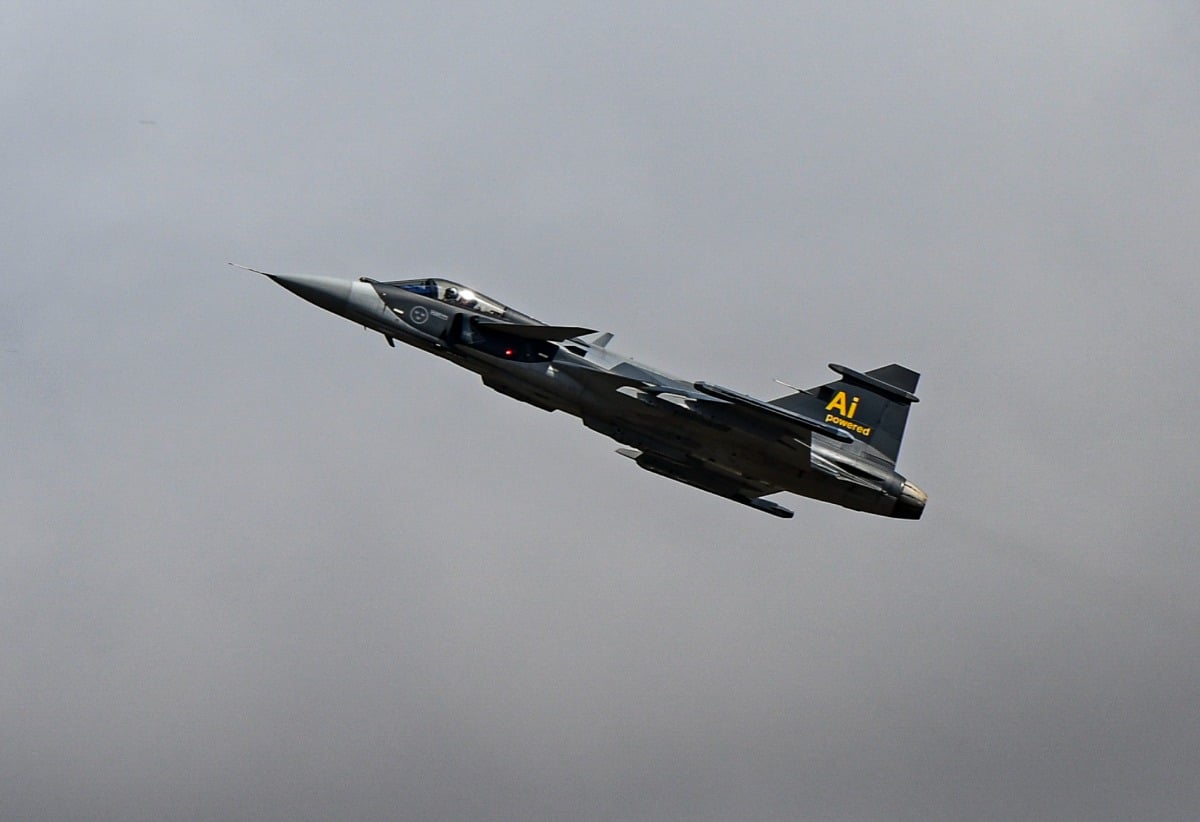
The ink is dry on the deal for Ukraine to acquire Sweden’s Saab Gripen E, and the defense commentariat is throwing a party. They are calling it a masterstroke of logistics. They claim the Gripen is the ultimate guerrilla fighter—built for dispersed operations, capable of taking off from highways, and cheap to run.
They are dead wrong.
The defense establishment is fighting the last war, blinded by a romanticized vision of nimble jets operating out of the Swedish woods. In reality, sending the Gripen E into Ukraine is an expensive, logistically complex distraction that misinterprets the fundamental nature of modern, contested airspace. It is a textbook example of choosing a shiny procurement victory over cold, hard strategic utility.
I have spent years analyzing aerospace supply chains and military procurement cycles. I have watched defense ministries sink billions into platforms because they look good on paper, only to watch those same platforms choke when the realities of spare parts, specialized tooling, and electronic warfare environments hit the fan. This deal has all the hallmarks of a procurement trap.
The Highway Takeoff Myth
Let's dismantle the primary argument for the Gripen: its ability to operate from road bases.
Proponents love to point out that the Swedish Air Force designed the Gripen to operate under the BAS 90 concept, utilizing reinforced stretches of highway. The narrative says Ukraine can scatter these jets across the country, hiding them from long-range missile strikes.
It is a beautiful theory. It fails completely under actual combat conditions in a high-intensity conflict.
Operating a fighter jet from a highway requires more than just a flat piece of asphalt. It requires a massive mobile footprint. You need fuel bowsers, ammunition loaders, specialized diagnostic equipment, and highly trained mechanics.
- The Target Profile: A highway strip lacks the hardened shelters of a permanent airbase. A single drone or a coordinated cluster munition strike turns a exposed Gripen on a road into burning scrap metal.
- The Logistical Tail: Moving these support teams constantly to avoid detection creates a massive, vulnerable convoy system. You are not hiding a jet; you are merely shifting the target from a fixed coordinates base to an exposed logistics column.
Worse, the Gripen E is not its predecessor, the Gripen C/D. The E-model is heavier, packed with far more complex avionics, and features a completely different engine—the General Electric F414. It is an incredibly sophisticated piece of machinery. The idea that a team of conscripts can service a General Electric F414 engine with a basic toolbox on the side of a highway in freezing rain is an absolute fantasy.
The Two-Engine Supply Chain Nightmare
Ukraine’s air force is rapidly turning into a logistics museum. They are already integrating the F-16 Fighting Falcon, which relies on the Pratt & Whitney F100 or General Electric F110 engines. Now, they are adding the Gripen E with the GE F414.
To the untrained eye, both are American-designed engines. To an aerospace engineer, they represent two entirely separate worlds of tooling, spare parts, and diagnostic software.
Imagine running an airline where half your fleet uses one set of highly specific turbine components and the other half uses another, but your mechanics are operating under constant bombardment and your supply lines stretch back hundreds of miles through Poland. It is a recipe for catastrophic downtime.
When a jet sits on the ground because a specific actuator or a proprietary software patch is stuck at a border checkpoint, it is not an asset. It is a multi-million-dollar liability. By forcing Ukraine to support two entirely different Western fighter ecosystems simultaneously, this deal guarantees that neither fleet will operate at maximum capacity.
The Electronic Warfare Trap
The real battle over Ukraine happens in the electromagnetic spectrum. Russian long-range surface-to-air missile systems, like the S-400, combined with heavy electronic jamming, have effectively turned the skies into a no-fly zone for both sides.
The Gripen E boasts an impressive Electronic Warfare (EW) suite. Saab engineers deserve credit; their internal jamming systems and active electronically scanned array (AESA) radar are top-tier. But let's look at the math of modern air defense.
No fourth-generation fighter, no matter how advanced its electronic countermeasures, can survive prolonged exposure inside a dense, integrated air defense system (IADS). The Gripen E is not a stealth aircraft. Its radar cross-section is smaller than an F-16, but it is still highly visible to low-frequency radar networks.
If these jets cannot penetrate deeply contested airspace to provide close air support or strike high-value targets without massive risk, what is their actual mission?
They become incredibly expensive, over-engineered air-defense platforms. They will be relegated to firing long-range missiles like the Meteor or Storm Shadow from deep within safe territory. If you are just using a multi-million-dollar jet as a flying launchpad for a cruise missile, you don't need a Gripen E. You could achieve the same standoff capability far more cheaply with ground-launched systems or older, refurbished airframes.
The Brutal Reality of Production Scalability
Let’s talk about numbers, because numbers win wars of attrition.
Saab produces the Gripen in relatively small batches. The global supply chain for the Gripen is specialized and tight. If Ukraine loses an F-16, there is a global pool of thousands of airframes, spare parts, and retired jets across NATO nations to draw from. The global ecosystem for the F-16 is massive and deeply entrenched.
If Ukraine loses a Gripen E, replacing it is a multi-year headache. The production line cannot just ramp up overnight to replace combat losses.
"In a war of attrition, uniqueness is a vulnerability. Standardized mediocrity beats bespoke excellence every single time."
By introducing a boutique fighter into a high-loss environment, Ukraine is investing precious pilot training hours and maintenance personnel into a platform that cannot be easily reinforced or replaced when the attrition rate inevitably spikes.
The Real Question Leaders Should Be Asking
Instead of asking, "How do we get Western jets into Ukraine?" planners should have been asking, "What is the most cost-effective way to deny the enemy control of the skies?"
The answer isn't a new fighter fleet. The answer is an overwhelming investment in ground-based air defense, long-range loitering munitions, and mobile missile systems.
The cost of a single Gripen E package—including training, weapons, and maintenance contracts—could fund hundreds of advanced air-defense missiles or thousands of long-range strike drones. Drones don't require airfield maintenance. Drones don't require three years of pilot training. Drones don't cause a national crisis when they get shot down over enemy lines.
This deal is a political victory masquerading as a military strategy. It makes for great headlines in Stockholm and Kyiv. It satisfies the desire to see high-tech Western hardware matching up against adversaries. But on the ground, where the grease meets the metal, it is an operational headache that will drain resources away from the capabilities that actually matter.
Stop celebrating the arrival of the Gripen. Start preparing for the logistical bottleneck that is about to follow it.