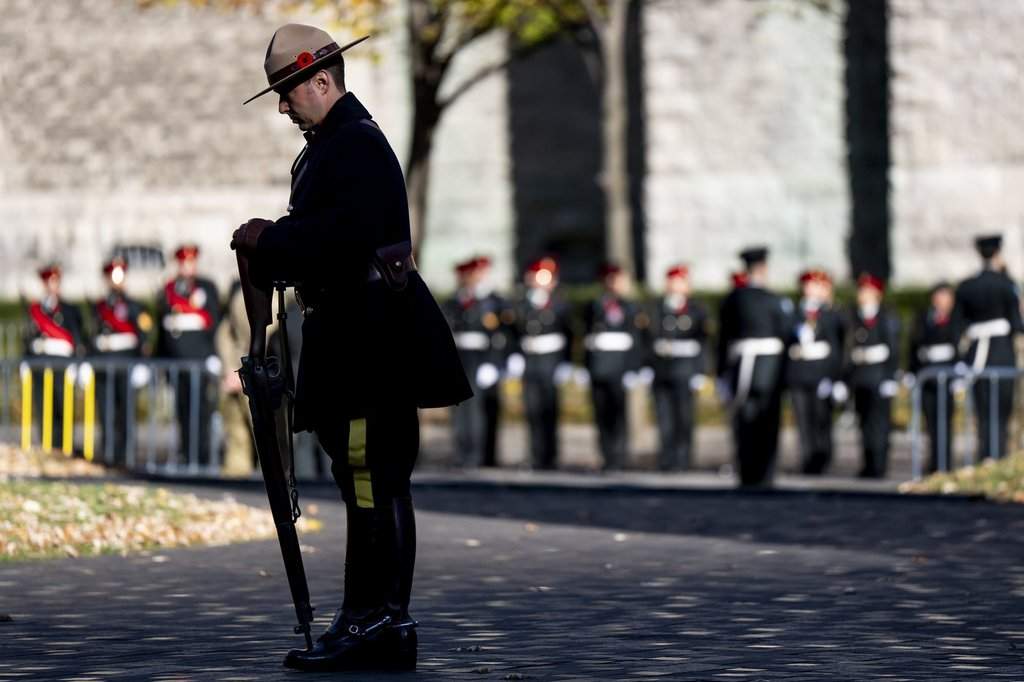
November 11 in Montreal isn't a statutory holiday. Most office towers stay open, kids go to school, and the metro runs on its regular weekday schedule. Yet at 11 a.m. sharp, thousands of Montrealers still step away from their desks and bundle up against the sharp autumn wind to gather at Place du Canada.
If you've never attended the annual Montreal Remembrance Day ceremony, you might assume it's just a quiet, formal obligation reserved for aging veterans and politicians. You'd be wrong. Standing in that crowd alongside soldiers from the Canadian Armed Forces, cadets, families, and everyday commuters is one of the most grounding experiences the city offers all year.
I've attended ceremonies downtown and in smaller boroughs over the years, and what always strikes me is the contrast. Downtown Montreal is loud, impatient, and constantly moving. Then the bugler plays the Last Post, the two minutes of silence hit, and you can actually hear the wind rustling the dry leaves in the park. Even the traffic along René-Lévesque Boulevard seems to hold its breath.
What Actually Happens at Place du Canada
The main civic ceremony takes place at the Montreal Cenotaph in Place du Canada, right across from the Mary, Queen of the World Cathedral. Unlike Ottawa's massive national broadcast at the National War Memorial, Montreal's gathering feels distinctly personal and accessible. You don't need VIP passes to get close enough to see the wreath-laying or hear the pipe bands.
The event is organized annually by the Royal Canadian Legion Quebec Command alongside local military units. It follows a strict, time-tested military protocol that hasn't changed much in decades—and honestly, it shouldn't.
Here is how the morning unfolds if you plan to go:
- 10:30 a.m. The Parade Arrives. Military contingents, veterans' associations, cadets, and police and fire honour guards march into position around the cenotaph. Seeing members of historic local regiments like The Black Watch (Royal Highland Regiment) of Canada in full ceremonial dress sets the tone immediately.
- 10:55 a.m. Official Greetings and Prayers. Dignitaries, municipal leaders, and military chaplains offer brief remarks. Keep in mind that Montreal ceremonies are genuinely bilingual, switching smoothly between French and English throughout the morning.
- 11:00 a.m. The Last Post and Two Minutes of Silence. This is the core of the day. The bugle call echoes off the surrounding skyscrapers, followed by complete stillness. In many years, a 21-gun salute fired by artillery units marks the beginning and end of the silence—a sudden, chest-thumping boom that startles tourists who didn't read the schedule.
- 11:02 a.m. The Lament and Act of Remembrance. A lone piper plays a lament, followed by the reading of In Flanders Fields or the Act of Remembrance ("They shall grow not old, as we that are left grow old...").
- 11:10 a.m. Laying of the Wreaths. Representatives from the federal, provincial, and municipal governments lay wreaths first, followed by Silver Cross Mothers, veterans' groups, and community organizations.
Once the official parade marches off around noon, the barriers open. That's when dozens of ordinary people walk up to the base of the cenotaph to pin their paper poppies directly onto the wreaths. It's quiet, unscripted, and deeply moving.
Why Quebec's Relationship With November 11 Is Unique
You can't talk honestly about Remembrance Day in Montreal without acknowledging the province's complicated history with military service. While Ontario, British Columbia, and the Atlantic provinces treat November 11 as a statutory public holiday, Quebec does not.
For decades, historical tensions around conscription during both World Wars shaped how Quebec viewed federal military commemorations. Outside of Montreal and Quebec City, participation in November 11 events historically lagged behind the rest of Canada.
That dynamic has shifted noticeably over the past twenty years. Part of that change comes from the reality of modern service. Thousands of Quebecers served in Afghanistan between 2001 and 2014, particularly through units based at CFB Valcartier and Montreal's reserve regiments. When local communities lost soldiers in Kandahar, the connection to Remembrance Day stopped feeling like distant 20th-century history and became immediate and personal.
Today, Montrealers show up not out of political obligation, but out of genuine respect for the people who served—from the dwindling number of Second World War and Korean War veterans to peacekeepers who deployed to Bosnia, Cyprus, and Haiti, and younger veterans dealing with the invisible wounds of modern conflicts.
Smaller Borough Ceremonies Worth Knowing About
While Place du Canada draws the largest crowds and television cameras, it's far from the only place Montrealers pay tribute. In fact, if you dislike large crowds or want something closer to home, the borough ceremonies often feel even more intimate.
- Westmount Cenotaph (Sherbrooke Street West). Located right outside Westmount City Hall, this ceremony draws a dedicated neighbourhood crowd and features strong participation from local schools and cadet corps.
- Pointe-Claire and the West Island. Several West Island municipalities, including Pointe-Claire, Beaconsfield, and Sainte-Anne-de-Bellevue, host well-attended morning services. Sainte-Anne-de-Bellevue holds particular significance because it's home to Ste. Anne's Hospital, the long-term care facility that has served Canadian veterans for over a century.
- Verdun and Lachine. Both boroughs have deep working-class roots tied to wartime manufacturing and military enlistment, and their local Royal Canadian Legion branches organize proud, community-driven tributes every November 11.
- Notre-Dame-des-Neiges and Mount Royal Cemeteries. Before November 11, volunteers and cadets place small Canadian flags on thousands of veterans' graves across the mountain—a visual reminder of just how many Montreal families were shaped by war.
Common Mistakes People Make When Attending
If you're planning to attend a Montreal Remembrance Day ceremony for the first time, a little preparation goes a long way. People regularly show up unprepared and end up uncomfortable or missing the key moments.
Arriving at 10:58 a.m. Don't do this. By 10:55 a.m., the perimeter around Place du Canada is packed several rows deep, and street closures around Peel and René-Lévesque will slow you down. Aim to be standing in your spot by 10:25 a.m. at the latest.
Underdressing for standing still. Montreal weather in mid-November is unpredictable. It might be 6°C and sunny, or it might be sleeting sideways with a biting wind. Walking at 4°C feels fine; standing motionless on cold pavement for 75 minutes feels miserable. Wear thermal socks, gloves, and a proper windproof coat.
Treating it like a photo op. Taking a respectful photo or two from the crowd is fine, though stepping in front of veterans to get a close-up shot with your phone isn't. Keep your phone on silent—not vibrate—and put it away entirely between 10:55 a.m. and 11:15 a.m.
Forgetting cash for a poppy beforehand. While the Royal Canadian Legion has introduced tap-enabled donation boxes in recent years, many local volunteers still rely on traditional cash trays. Pick up your poppy a few days early at a metro station, grocery store, or local Legion branch.
How to Actually Support Montreal Veterans Beyond November 11
Wearing a poppy for two weeks in November is a meaningful gesture, yet it doesn't pay a veteran's rent or fund mental health counseling in February. Once the wreaths are cleared away from Place du Canada, thousands of veterans across Greater Montreal continue navigating the transition back to civilian life.
Many face chronic pain, post-traumatic stress, or bureaucratic delays when trying to access support through Veterans Affairs Canada. Others, particularly older veterans in long-term care, simply deal with severe isolation.
If you want your tribute to carry real weight this year, take one concrete step beyond attending the morning ceremony:
- Donate directly to the Legion's Poppy Fund. Every dollar collected in Montreal stays within the local community to assist veterans and their dependents with emergency shelter, medical equipment, and food security. You can donate online through the Royal Canadian Legion Quebec Command if you miss the street canvassers.
- Support local veteran housing initiatives. Organizations like Old Brewery Mission in Montreal run dedicated programs specifically designed to get homeless veterans off the street and into stable, permanent housing with wraparound care.
- Visit or volunteer at Ste. Anne's Hospital. Even an hour of companionship or participation in community events makes a measurable difference for aging residents who spent their youth in uniform.
- Learn the local names on the monuments. Next time you walk past a cenotaph in your neighbourhood, stop for three minutes and read the engraved names and dates. Look up one local regiment—whether it's the Royal Montreal Regiment, Les Fusiliers Mont-Royal, or the Canadian Grenadier Guards—and understand what they went through.
Show up on November 11, stand quietly in the cold for an hour, and bring someone younger with you so the habit doesn't fade out with the last generation that remembers the Second World War firsthand.



