Arrival is supposed to feel like exhaling.
You set down the heavy bag, kick off the boots that have blistered your heels for years, and let the room wrap around you like a warm coat. Yet when Karl Bushby finally walked up to his mother's front door in Hull on November 2, 2026, ending twenty-eight years and one day on the road, the sharpest emotion waiting for him wasn't triumph. It was vertigo. At fifty-seven, after more than ten thousand days away from home, the former paratrooper stood on the threshold of a life that had moved on without him—and realized that the hardest step of his entire journey might be the one across the front mat.
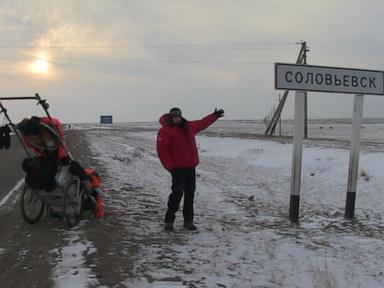
People love to turn big numbers into tidy applause. Thirty-one countries across four continents. Roughly thirty to thirty-six thousand miles covered by human muscle. A walk that began on November 1, 1998 in Punta Arenas, Chile, with about five hundred dollars in his pocket, a two-wheeled cart he called "the Beast", and two stubborn rules: never use motorized transport to advance the route, and never go home except on foot.
Numbers are clean. Real life is messy.
When Bushby set out at twenty-nine, he thought it would take around twelve years. Twelve years is a long stretch, certainly, long enough for a toddler to grow into a teenager, long enough for a starter car to rust out. Twelve years is still a project with a visible finish line. Twenty-eight years is something else entirely. Twenty-eight years is an entire adulthood. It is watching friends buy houses, bury parents, get divorced, and retire while you are still leaning at a forty-five-degree angle against Patagonian gales or swimming across the Caspian Sea for thirty-one days because war closed the land route ahead of you.
Why does a story like that pull at us so fiercely? Because deep down, most of us know what it feels like to be trapped by motion—or stuck in place.
Two Rules on a Wall Map
Picture a young soldier in the mid-1990s looking at a wall map. His father had sent a birthday card mentioning an argument between two soldiers over whether anyone could walk from London to New York across the Bering Strait. Bushby grabbed a marker and drew a single unbroken line from England through Europe and Asia, over the frozen strait, and all the way down to the southern tip of South America.
To understand the pull of that line, let's use a simple metaphor: think of a taut wire stretched from one end of a dark theater to the other. Walking it doesn't prove you're clever. It proves you refuse to drop off.
Before leaving, Bushby had served twelve years in the British Army, including time stationed near Dover. He says those military years left him with a cynical, guarded view of people. When you spend years preparing for conflict and watching how badly humans can treat one another, it is easy to build walls around your chest and call that realism.
Then he stepped onto the Patagonian steppe with five hundred dollars, zero sponsors, and no Spanish.
Hurricane-force winds knocked him and his cart off the road for days. In the high Andes and across the Atacama, hunger set in. In Peru, a severe stomach infection and secondary bacterial illnesses left him fearing the worst. In Colombia, at the height of armed insurgency and kidnapping threats, he signed a professionally drafted will at his father's urging and still moved through the country like smoke, sometimes missing active gunfights by a single day.
I have known seasons where keeping a single promise to myself felt heavier than carrying a pack uphill. When you are exhausted, hungry, and looking at a border that just slammed shut in your face, giving up doesn't feel like cowardice. It feels like relief. Anyone who has ever tried to stick to a grueling habit—whether paying down crushing debt, caring for a sick relative, or rebuilding a life after a breakup—knows that moment when the goal stops feeling inspiring and starts feeling like a sentence.
The Myth of the Lone Wolf
We like our heroes solitary. We want a rugged lone wolf who conquers the earth through sheer grit and teeth-gritted willpower.
Bushby himself pushes back against that fairy tale. After twenty-eight years on the road, he has said that roughly 99.999 percent of the people he met showed him the very best of humanity. Even in places where danger was real, ordinary strangers kept him alive—offering food when he had none, shelter when the weather turned brutal, a moment of warmth or human contact when isolation threatened to hollow him out.
Consider what happens next when a cynical soldier has to rely on strangers day after day:
His armor starts to crack.
To make this concrete, consider a hypothetical traveler—let's call her Maya—who leaves her hometown with a strict plan to hike three thousand miles alone, convinced that people are mostly out for themselves. By week four, rain rots her tent poles in a mountain pass. A rancher she barely speaks the language of invites her into a barn, dries her gear by a stove, and hands her hot soup without asking for a dime. By month six, Maya isn't just hiking miles; she's unlearning a lifetime of suspicion.
That is the quiet miracle inside Bushby's walk. The journey wasn't a solo conquest of nature. It was a twenty-eight-year stress test of human decency across thirty-one nations. Governments issued visa refusals and deported him. Financial crises dried up sponsorships. Pandemics and wars redrew maps. Bureaucracy stalled him for months or years at a time. Yet at ground level, person to person, strangers kept opening doors.
Bushby has been remarkably honest about the darker side of that obsession, too. He has called the twenty-eight years "totally self-centred" in a practical sense—because survival, money, logistics, and keeping the line unbroken had to come first every single day. Admitting that takes real nerve. Most people dressed up in a twenty-eight-year adventure would polish every rough edge until only glory remained. Bushby doesn't. He talks about the cost to personal relationships, about a son and a granddaughter he has distance and history to navigate with, about spending nearly three decades counting dollars abroad only to feel bewildered by store brands and which way traffic moves back home in Britain.
When the Mission Ends, Who Are You?
Here is the part nobody warns you about when you chase a massive goal: what happens the morning after you win?
For nearly three decades, Karl Bushby had an answer every time he woke up. Put one foot in front of the other. Protect the cart. Solve today's border, today's meal, today's weather. Even when progress slowed to a crawl, the mission gave shape to every sunrise.
As he neared the end—swimming across the English Channel in October 2026 after crossing the Bosphorus Bridge back into Europe in May 2025, then walking the final stretch into Hull—he voiced a fear that stops a lot of ambitious people cold: My purpose and reason for living is about to end.
Think about that sentence.
Not I'm tired. Not I'm scared of the cold. My purpose is about to end.
When you define yourself by an ordeal, finishing the ordeal can feel like a small death. You go from being a man walking across the world to a fifty-seven-year-old figure trying to figure out how to live in ordinary rooms again, even joking with disarming candor about going from a global odyssey to living in his mother's basement.
There is a lesson there for anyone pouring every ounce of identity into a single career, title, relationship, or grind. A goal can carry you across oceans, deserts, and frozen straits. It cannot be your entire soul forever. Eventually, the walking stops. Eventually, you have to sit down in the kitchen, look at the people across the table, and ask who you are when nobody is clapping and there is no next border to cross.
Bushby has talked about wanting to speak in schools—something he loved along the way—and perhaps retraining as a teacher. That makes a strange, poetic kind of sense. After spending ten thousand days learning the world through blisters, salt water, and strangers' generosity, passing that hard-won perspective to younger people turns a long, solitary road into a bridge.
The Quiet Weight of the Front Door
On November 2, 2026, children lined the street near his mother's home in Hull as Bushby pushed his cart the last few steps and wrapped his arms around his mother, Angela. Cheers rose, then hushed.
For twenty-eight years, home was a dot on a map and a promise kept one step at a time. Now the dot is solid brick, familiar voices, and quiet mornings.
Stepping across that threshold doesn't erase the wind, the hunger, the visa battles, or the years lost to waiting. It proves something quieter and more enduring than a world record: you don't have to conquer the whole earth to find out what people are made of—you just have to keep walking until you see it with your own eyes.
Then comes the real work: learning how to stay.