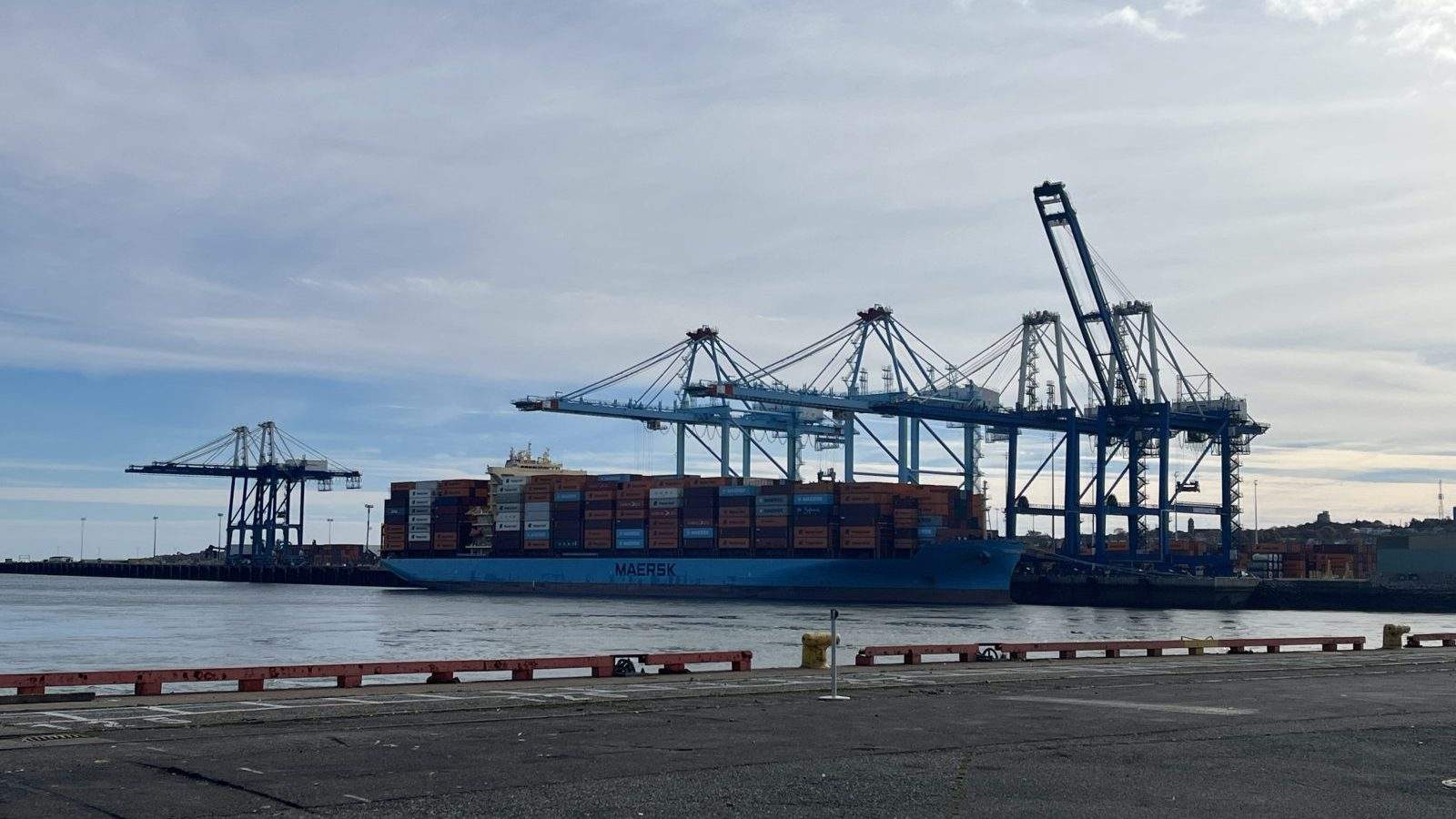
Salt sits in the creases of your knuckles long after you wash your hands in Saint John. You feel it when the fog rolls off the Bay of Fundy at four in the morning, thick enough to muffle a forklift horn three piers away, and you taste it when the wind shifts south across the harbor. For decades, people in New Brunswick understood that rhythm with quiet resignation. The tide rises forty feet. The tide drops forty feet. Things arrive, things leave, and in between, a province with small-town roots and big-ocean ambitions tries not to get left behind on the mudflats.
Money headlines rarely sound like cold salt air. A press release announcing a $463 million expansion at the Port of Saint John reads like a ledger sheet written by people who never had to listen to a diesel engine idle in a November drizzle while waiting for a berth. Four hundred and sixty-three million dollars. Big number. Clean number. Easy to skim past while eating toast.
Except big numbers on a harbor wall are never really about steel pilings and concrete caissons. They are about whether a machinist in Grand Bay-Westfield gets to keep her house without driving sixty miles each way for contract work. They are about whether a sawmill manager in Miramichi or a potato shipper in the St. John River Valley can get a container onto deep water without watching a vessel sail past toward Montreal or Halifax because the local terminal ran out of room or crane capacity.
Geography is a funny thing. New Brunswick sits right where the land meets the open Atlantic, yet economic geography has a cruel habit of routing cargo through bigger hubs with deeper pockets and older momentum. For years, shippers across the province lived with an unspoken tax: friction. Every extra rail switch, every delayed sailing, every workaround needed to reach an export market shaved pennies off a margin that was already thin as paper.
To make sense of what four hundred and sixty-three million dollars actually changes on the ground, let's build a hypothetical scenario—a composite sketch drawn from real supply-chain pressures in eastern Canada rather than a single real person. Picture Claire, a logistics coordinator working out of a modest office inland from the coast, staring at a shipping schedule where a missed cutoff means cargo sits in a yard for another week. One missed sailing cascades into late deliveries, higher storage fees, and nervous buyers asking why New Brunswick shipments always seem to take the scenic route.
Wait. Let's pause and be honest about how confusing port economics can feel from the outside. When politicians and port authorities talk about berth modernization, container handling capacity, and terminal upgrades, most of us hear white noise. Dredging. Cranes. Supply chains. Words that sound vital in a speech and abstract at the kitchen table.
Think of a port like the throat of a household during holiday dinner. You can have the best roast in the oven and thirty cousins hungry in the living room, but if the hallway is narrow and the door sticks, food reaches the table cold and late. A modernizing marine terminal widens the hallway. It clears the bottleneck so goods from New Brunswick factories, farms, and forests can move from land to ship without stalling in line.
The Invisible Tax of Standing Still
Exporting is simple in theory and punishing in practice. A company in New Brunswick makes something good—lumber, processed food, industrial goods, specialty materials—and wants to sell it across the ocean. Between the loading dock and the foreign buyer stands a chain of handoffs. Rail cars roll east or south. Trucks eat highway miles. Containers wait to be lifted, stacked, inspected, cleared, and loaded onto a vessel that runs on a tight schedule governed by fuel costs, weather, and global trade routes.
When a port lacks modern capacity or deep, efficient berths, delays compound quietly. A ship that cannot turn around quickly becomes an expensive floating warehouse. Shipping lines notice. Over time, carrier schedules shift toward ports where cranes move faster and yards breathe easier.
That is the real threat behind stagnant infrastructure. It rarely looks like a dramatic collapse. Instead, it looks like a slow drift toward irrelevance. A regional exporter loses a contract not because their product failed quality checks, but because transit times stretched past what a buyer in Europe or Asia will tolerate.
I have stood on cold docks watching heavy gear swing over dark water and felt that peculiar tension between human effort and industrial scale. A single longshore crew can work with precision that borders on choreography, guiding a steel box down into a cell guide with inches to spare, while a single outdated bottleneck ashore undoes hours of hustle. You feel it in your shoulders. You feel it in the quiet frustration of men and women who know how to work hard and hate watching time leak away.
New Brunswick has never lacked grit. Anyone who has spent a winter in Atlantic Canada knows how people show up when ice coats the roads and pipes freeze before dawn. Grit keeps communities warm. Grit does not, by itself, widen a shipping lane or upgrade heavy terminal infrastructure.
Why Four Hundred and Sixty-Three Million Matters Now
Global trade does not wait for provinces to catch up. Supply chains have become twitchier, more selective, and far less forgiving of slow links. When a major capital commitment—$463 million directed at the Port of Saint John—enters the picture, it signals a refusal to accept second-tier status as permanent fate.
Let's be clear about what public-private port investment actually does when it is executed well. It lowers the barrier between local producers and global markets. When a terminal has stronger infrastructure, better berth capability, and smoother cargo flow, New Brunswick exports gain breathing room. Producers can plan further ahead. Freight costs become more predictable. Smaller and mid-sized businesses across the province gain a fighting chance to compete beyond regional borders instead of relying solely on nearby buyers.
Picture our hypothetical coordinator, Claire, six months after new terminal upgrades come online. The same freight still leaves New Brunswick, still crosses rail and road, still faces Atlantic weather. Yet the handoff at the water feels less like wrestling a stuck zipper and more like sliding a bolt home. Fewer rollovers. Tighter reliability. A client overseas stops asking "Where is my shipment?" and starts asking "Can you send more?"
Here is a metaphor to keep in your pocket: a river dammed with driftwood still holds water, right up until the pressure builds or the flow dries to a trickle. Clearing the channel lets current move with purpose. Upgrading a port clears the channel for provincial trade.
Still, no honest observer should pretend a big dollar figure is a magic wand. Mega-projects test patience. Construction brings noise, dust, detours, and months where promises look better on architectural renderings than they do through chain-link fences. Cost pressures can bite. Schedules can slip. Anyone who has watched major public works unfold knows skepticism is healthy; blind cheerleading usually ages badly.
The Ripple Beyond the Breakwater
If the story stopped at shipping containers, it would only matter to freight nerds and bond analysts. The deeper stakes run straight through New Brunswick's labor market and community confidence.
Ports are anchors. When a port grows stronger and handles more export volume, demand ripples outward in ways that are easy to miss until you trace the paycheck. Stevedores, equipment operators, rail crews, truckers, customs brokers, mechanics, inspectors, engineers—real livelihoods depend on steady maritime activity. When export volumes rise, hours stabilize. Overtime becomes a choice rather than a scramble. Apprenticeships have real footing.
And look further inland. A farmer growing crops in western New Brunswick or a manufacturer turning out goods in the Moncton or Fredericton corridors may never set foot on a Saint John pier. Yet competitive port access shapes the economics of getting those goods to tidewater. Lower friction at the coast can strengthen the business case for expanding a plant or hiring another shift back home.
History across coastal regions teaches a sobering lesson: places that underinvest in their gateways eventually watch wealth and talent drift elsewhere. Young people pack bags because the best opportunities sit in another province or another country. Families split across time zones. Towns shrink by a few mailboxes a year.
Conversely, when a region backs its strategic assets with serious capital, it sends a message that echoes past the harbor mouth. It says New Brunswick intends to trade on the world stage, not merely watch ships pass by on the horizon.
Doubts Worth Keeping in the Room
Let's not gloss over the hard questions. Whenever hundreds of millions of dollars are tied to trade infrastructure, reasonable people ask fair questions.
Will the boost to New Brunswick exports be immediate, or will it take years of steady relationship-building with shipping lines and buyers to show up in trade statistics? Usually, the answer leans toward steady accumulation rather than overnight fireworks. Ports build reputation one reliable sailing at a time.
Will local workers and local businesses see their fair share of the upside, or will the benefits feel concentrated among large operators? That depends on execution, training, and how well regional supply chains connect to the expanded capacity.
Uncertainty is part of any big bet. Global demand fluctuates. Trade policies shift. Freight rates swing wildly between boom and slump. Anyone claiming certainty about five years from now is selling something. What we can judge right now is whether New Brunswick is putting stronger physical bones in place so that when opportunity knocks, the door actually opens.
Salt on the Pilings, Hope in the Wake
Stand on the shore at Saint John long enough and you start seeing time differently. Empires built on wooden ships came and went. Steam gave way to diesel. Bulk cargo shared space with containerized trade. Every era demanded a different kind of port, and every era rewarded the places willing to adapt without losing their spine.
A $463 million port project is not a fairy tale ending. It is a heavy, practical bet on movement over stagnation, connection over isolation, and New Brunswick's right to carry its own weight in global commerce.
Out on the bay, the tide keeps doing what it has done for ten thousand years—rising forty feet, falling forty feet, indifferent to speeches and spreadsheets alike. Now, at least, the harbor is getting ready to meet the water on better terms.