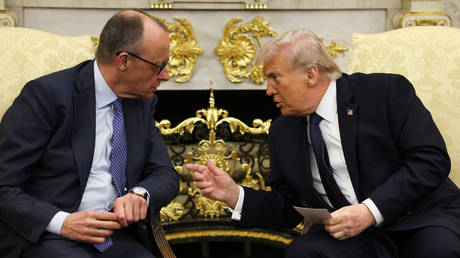
German Chancellor Friedrich Merz issued a sharp, public warning to Washington, demanding that the administration of U.S. President Donald Trump refrain from interfering in upcoming German elections. The extraordinary diplomatic friction centers on a new U.S. State Department grant program designed to fund European organizations aligned with "Western civilizational heritage". While the U.S. frames this initiative as a benign effort to protect democratic resilience, Berlin views it as a backdoor attempt to funnel American state capital directly into the hands of the far-right Alternative for Germany party. Under German law, foreign political funding is strictly illegal, and Merz is drawing a hard line before the state votes this autumn.
The tension represents a fundamental shift in transatlantic relations. For decades, the alliance between Berlin and Washington was anchored by shared democratic norms and mutual respect for domestic sovereignty. That post-Cold War consensus has officially evaporated. By leveraging federal tax dollars to cultivate ideologically aligned, nationalist movements abroad, the White House is testing the limits of international law and sovereign borders. Recently making news recently: Why Blowing Up Bridges is a Billion Dollar Failure of Military Imagination.
The Weaponization of the State Department
The controversy originates within the Bureau of Democracy, Human Rights, and Labor. Originally established under Jimmy Carter to challenge Soviet authoritarianism, this specific arm of the State Department has been quietly repurposed by the Trump administration. Rather than monitoring global human rights abuses or assisting transition democracies, the bureau is now deploying capital to secure ideologically friendly footholds in Western Europe.
The mechanism for this influence is a newly unveiled grant program titled Developing Civilizational Bonds, Democratic Resilience, and Rule of Law in Europe. Valued at nearly five million dollars, the program invites European charities, think tanks, and individuals to apply for funding. On paper, the stated objective is to support sovereignty, address migration challenges, and counter online censorship. More information into this topic are detailed by NPR.
In practice, the criteria match the rhetorical talking points of European populist movements. Former U.S. diplomatic officials privately admit that the grant guidelines are intentionally ambiguous. By designing the eligibilities to include individuals and loosely defined civil organizations, the State Department can bypass traditional diplomatic channels. They can put a massive thumb on the scale of domestic European politics, lifting candidates and causes that would otherwise lack the resources to scale their operations.
The Loophole in German Party Finance
Germany maintains some of the strictest political financing laws in the democratic world. Under the German Political Parties Act, parties are prohibited from accepting direct or indirect donations from foreign sources. This legal firewall is designed to prevent hostile foreign states from buying influence or distorting the domestic political debate.
The State Department funding model exploits a critical structural loophole. While direct contributions to political parties remain highly illegal, funding for non-profit foundations, cultural associations, and independent media outlets is far harder to regulate. In Germany, political parties operate alongside dedicated party-affiliated foundations. Independent think tanks and advocacy groups also play a major role in shaping public opinion. By funneling millions of dollars to these intermediary groups, foreign actors can amplify specific political narratives without ever transferring a single euro directly to a candidate's campaign chest.
Merz addressed this exact dynamic during his summer press conference in Berlin. He made it clear that Germany does not interfere in American elections and expects the same boundary to be respected in return. The Chancellor's preemptive strike is designed to alert German intelligence and financial regulators to scrutinize any inbound American capital flowing toward far-right networks.
The Battle for the East
The immediate target of this political tug-of-war lies in the regional elections of Saxony-Anhalt and Mecklenburg-Western Pomerania. These eastern states have long been fertile ground for the Alternative for Germany party. Economic anxiety, demographic stagnation, and deep-seated skepticism toward the federal government have created a highly volatile electorate.
For the far-right, these state elections are not merely regional contests. They serve as a launchpad for national power. If the Alternative for Germany party secures majorities or dominant positions in these state parliaments, it will severely paralyze Merz's ability to govern nationally. The Christian Democratic Union faces an existential math problem. The party's federal congress explicitly forbids any formal coalition with the far-right, leaving Merz with few stable options to form functional regional governments.
A sudden influx of American-backed financial support could decisively tip the balance in these regional races. Small, localized campaigns in eastern Germany do not require tens of millions of dollars to achieve maximum impact. A few hundred thousand dollars, strategically deployed through social media campaigns, localized rallies, and targeted digital operations, can easily swing a close election. By funding the periphery of the populist movement, Washington is effectively subsidizing the infrastructure that keeps the far-right competitive.
The Global Strategy of Sarah B. Rogers
This funding effort is not an isolated bureaucratic initiative. It is a highly coordinated strategy overseen by key figures within the U.S. foreign policy apparatus, most notably Sarah B. Rogers. Rogers has emerged as the public face of the Trump administration's aggressive posture toward traditional European liberal democracies.
Her itinerary over the past year reveals a clear pattern of engagement. She has actively cultivated ties with conservative groups, libertarian think tanks, and right-wing populist parties across Europe, including visits to Ireland and the United Kingdom. Her public statements consistently hammer on themes of digital freedom, migration, and the preservation of national sovereignty against supranational organizations like the European Union.
The ideological friction is deeper than mere campaign finance. In December, the updated U.S. National Security Strategy warned that Europe was facing a period of "civilizational erasure". The document openly praised the rise of patriotic political movements across the continent, signaling a profound departure from traditional U.S. commitments to European integration. From the perspective of the current White House, the traditional political establishments in Berlin and Paris are no longer dependable partners. Instead, they are viewed as stagnant forces of a declining liberal order that must be challenged by populist alternatives.
The Risks of a Fractured Alliance
The long-term danger of this covert funding strategy is the permanent fracture of the Western security alliance. While Merz has attempted to maintain a professional working relationship with Trump—meeting at the White House earlier this year to discuss defense and Middle Eastern security—the domestic interference threat is rapidly poisoning the well.
If Berlin determines that U.S. agencies are actively financing domestic political subversion, the diplomatic retaliation will be severe. Germany could restrict intelligence sharing, limit cooperation on transatlantic security initiatives, and accelerate its defense decoupling from the United States. Merz’s recent decisions, including pulling the plug on joint European defense procurement projects in favor of localized, sovereign capabilities, suggest that Berlin is already preparing for a future where Washington is as much a competitor as an ally.
The era of trusting in a unified Western political front is over. As Washington openly pivots to funding ideological proxies on European soil, sovereign nations like Germany are being forced to defend their democracies not from eastern adversaries, but from their oldest treaty allies. The upcoming state elections will reveal whether Germany's legal firewalls are strong enough to withstand the financial might of the modern American populist machine.