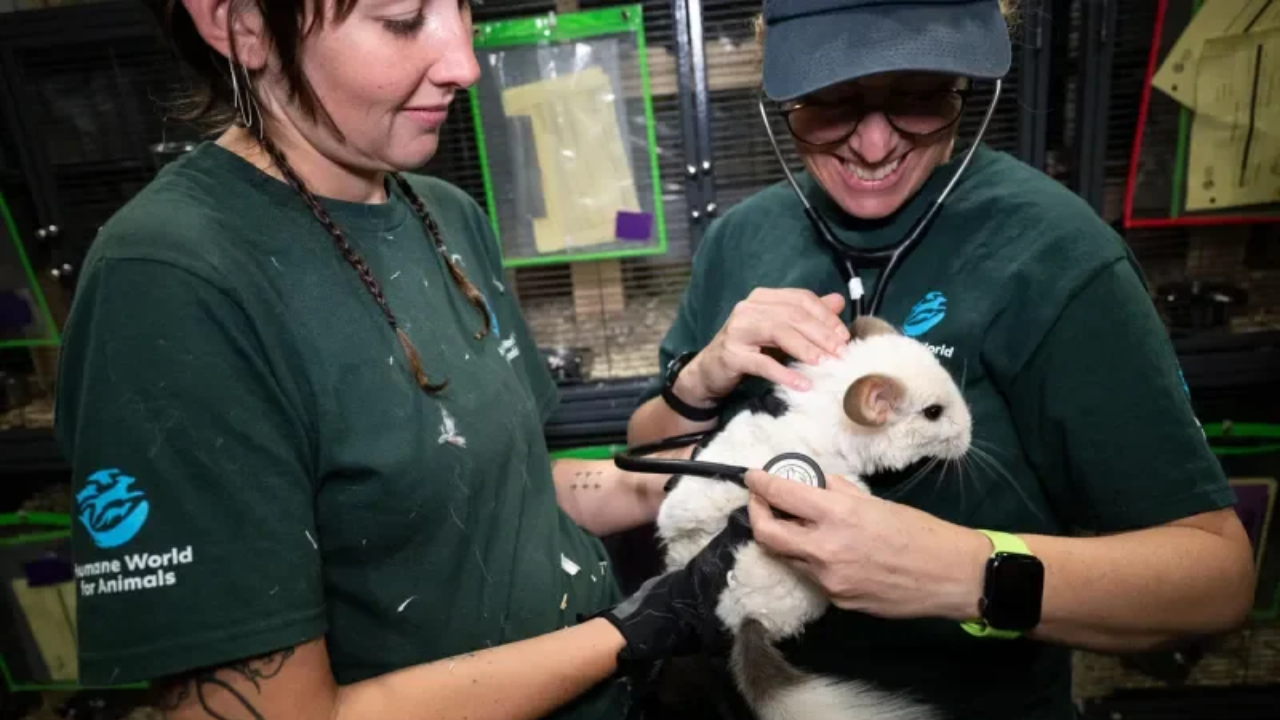
Silence.
That is the first thing that hits you when you walk into a room holding nearly a thousand small mammals that have spent their lives in rows of stacked wire cages. You expect a cacophony, a frantic scratching of claws against metal, or the high-pitched chirps these creatures use to warn one another of hawks circling the rocky slopes of the Andes, yet instead there is only the heavy, humid hum of poor ventilation and the rhythmic rustle of small bodies shifting in the dim light.
Nine hundred and fifty-one.
Numbers like that tend to blur in a news headline, turning living, breathing animals into an abstract inventory line item on a press release. When Humane World for Animals stepped into a breeding facility in Ohio across two separate operations to pull 951 chinchillas out of stacked, cramped cages, the public saw a statistic—a massive rescue, a logistical triumph, a line of text scrolled past during a morning commute. What the headline cannot carry is the smell of ammonia clinging to the back of your throat, or the specific, velvet-soft weight of an animal whose evolutionary biology was designed for dry, freezing mountain air, suddenly gasping in the stagnant heat of the American Midwest.
The Architecture of Invisible Suffering
To understand why 951 chinchillas ended up packed inside a single Ohio facility, you have to look at the economics of the exotic pet and fur trade, and how easily an animal’s greatest evolutionary gift becomes its worst curse. Chinchillas possess the densest fur of any land mammal on Earth. While a human hair follicle grows a single strand, a chinchilla grows up to sixty hairs from a single pore, creating a coat so thick that parasites like fleas literally suffocate inside it. In the high, arid elevations of South America, that coat kept them alive through bitter nights. In a commercial breeding operation in Ohio, that exact same biology turns a warm, poorly ventilated room into an oven.
Consider a hypothetical buyer—let’s call her Elena—walking into a brightly lit suburban pet store on a Saturday afternoon. She sees a small, plush gray creature with oversized ears and dark, inquisitive eyes sitting behind glass, munching on a pellet. The price tag says two hundred dollars. The clerk tells her they are low-maintenance, quiet, and clean. Elena has no way of tracing the supply chain backward from that clean glass enclosure to a windowless barn hundreds of miles away, where that animal’s parents live in wire-bottomed cages barely wider than their own bodies, never touching solid ground, never feeling cool mountain wind, and never taking the volcanic dust baths their skin desperately requires to absorb excess oils.
I have walked through facilities where large-scale animal neglect hides behind commercial licenses, and the hardest part to explain to someone who has never stood there is the sheer weight of the repetition. It is not one sick animal; it is hundreds of identical wire boxes, tier upon tier, stretching down an aisle like a warehouse for auto parts. When you look into the first cage, you feel a sharp pang of grief. By the fiftieth cage, your brain tries to protect itself by flattening the animals into a pattern, and you have to force yourself to stop, look closely at individual faces, and remember that every single one of those 951 chinchillas experiences fear, heat stress, and pain entirely alone.
Why Two Operations Were Needed to Empty the Cages
Pulling nearly a thousand animals out of a single location is not a matter of loading a few cardboard carriers into the back of a van. If you rush the extraction of fragile, heat-sensitive rodents, you risk killing the very lives you came to save through acute stress and thermal shock. Chinchillas cannot sweat. When their core temperature rises above seventy-five degrees Fahrenheit, their blood vessels dilate, their ears turn bright red as their bodies desperately try to dump heat, and within minutes they can suffer fatal heatstroke.
That physiological fragility explains why Humane World for Animals had to execute the Ohio rescue across two distinct operations rather than one sweeping raid. Moving 951 chinchillas requires a rolling climate-controlled logistics chain—veterinary triage teams stationed on-site to check for overgrown teeth, matted fur, and respiratory infections before a single carrier is loaded, followed by temperature-regulated transport vehicles calibrated to keep the air cool and dry. During the first phase, responders removed the most critical cases and established a baseline for the population's health; during the second operation, teams returned to clear the remaining tiers, ensuring no breeding pairs or hidden juveniles were left behind in the back rows.
Think of the logistics like defusing a room full of glass ornaments during an earthquake. Every movement has to be deliberate. Responders wear protective gear not because chinchillas are aggressive—they rarely bite, preferring to flee or freeze—but because months or years of accumulated waste in uncleaned trays create airborne particulate hazards that burn human lungs just as easily as animal ones. Between the first and second waves of the Ohio rescue, shelter partners across multiple states had to scramble to assemble hundreds of multi-level enclosures, source metric tons of timothy hay, and stock up on fine pumice dust so the survivors could finally clean coats matted with grease and grime.
The Myth of the Low-Maintenance Exotic Pet
Why does a facility in Ohio breed nearly a thousand chinchillas in the first place? Because demand keeps the cages full, and that demand is built on a string of persistent misunderstandings about what these animals actually need to survive.
If you ask ten people what a chinchilla eats, half will guess carrots or sunflower seeds, and the other half will admit they have no idea. In reality, a chinchilla’s digestive tract is a delicate fermentation engine built to process tough, dry, high-fiber grasses. Feeding them sugary treats or rich seeds is like pouring diesel fuel into a precision watch—it gums up the works, triggers painful gastrointestinal stasis, and can prove fatal within twenty-four hours. Even their teeth never stop growing, lengthening by two to three inches every year, which means without constant access to coarse hay and safe wood to chew, their molars elongate into sharp spikes that lacerate their own tongues and cheeks.
In a high-volume breeding mill, individual dental checks and tailored nutrition do not fit the profit margin. Animals are fed the cheapest bulk pellets available, bred back-to-back until their bodies give out, and housed on wire mesh so waste falls through to trays below—a design that saves labor costs while causing chronic bumblefoot, a painful bacterial infection of the footpads caused by standing on thin metal bars day and night. When rescuers examine survivors from operations like the one in Ohio, they routinely find missing toes, scarred ears from cage-mate aggression triggered by overcrowding, and coats so fouled that the fur has to be carefully trimmed away to let the skin breathe.
What Happens When the Cage Door Finally Opens
Imagine spending your entire existence inside a two-foot cube of galvanized steel, with bright fluorescent lights buzzing overhead and nowhere to hide when a shadow passes by. Chinchillas are crepuscular prey animals—hardwired to sleep in tight, dark rock crevices during the day and emerge at dusk to forage and leap across boulders. Depriving them of a hiding spot is not a minor inconvenience; it keeps their nervous systems locked in a permanent state of low-grade panic, flooding their tiny bodies with cortisol until their immune systems collapse.
When the 951 chinchillas from Ohio arrived at emergency intake centers and partner shelters, the transformation began with surprisingly small gestures. Veterinary teams offered each animal a cardboard hide box, a handful of fresh orchard grass, and a shallow ceramic bowl filled with fine gray volcanic dust.
Watch a rescued chinchilla encounter a dust bath for the first time after months of deprivation, and you will see what recovery looks like in real time. At first, the animal hesitates at the edge of the bowl, whiskers twitching, unsure whether the unfamiliar texture is safe. Then it steps inside, drops onto its shoulder, and begins to roll—twisting its spine with astonishing speed, kicking clouds of gray powder into the air until every single follicle of its dense coat is coated and lifted. When it shakes itself off, the greasy, clumped fur springs back into a soft, cloud-like halo, and for the first time in its life, the animal looks like what it was meant to be.
Yet rehabilitation at this scale stretches animal welfare networks to their absolute limits. Nine hundred and fifty-one animals do not get adopted in a weekend. Each chinchilla can live fifteen to twenty years in proper captivity—longer than many dogs and cats—which means every single adoption requires screening families who understand that they are signing up for a two-decade commitment, complete with air-conditioned rooms, specialized exotic veterinarians, and daily out-of-cage exercise in chinchilla-proofed spaces.
The Blind Spot in Our Legal Safety Net
It is easy to point a finger at the operator of a single Ohio breeding facility and treat the case as an isolated moral failure, a bad actor who simply let things get out of hand. That framing is comforting, and it is completely incomplete.
Across the United States, oversight of commercial rodent and exotic mammal breeding sits in a regulatory gray zone that would shock most pet owners. While dogs and cats bred for the wholesale pet trade fall under specific federal licensing and inspection frameworks, smaller mammals frequently slip through loopholes where state agricultural departments treat them as livestock, local humane societies lack the specialized equipment to house hundreds of exotics at once, and municipal zoning boards never inspect what happens behind closed barn doors until a neighbor complains about the smell or an insider blows the whistle.
We have built an entire retail ecosystem that encourages impulse purchases of complex, long-lived wild species while keeping the industrial machinery that produces them completely out of sight. You can walk into a strip-mall store, swipe a credit card, and walk out fifteen minutes later with an animal native to the South American Andes, without anyone verifying whether your apartment even has air conditioning capable of keeping the room below seventy degrees during an August heatwave. As long as consumers treat exotic animals as aesthetic accessories rather than high-needs companions, facilities like the one in Ohio will continue to stack cages to the ceiling to meet the order sheets.
Nine Hundred and Fifty-One Heartbeats
I keep coming back to the sheer scale of that number, trying to hold all 951 lives in focus at once without letting them collapse back into a statistic. If you lined those carriers up end to end, the row would stretch longer than three football fields. Behind every wire door in that line sits a distinct temperament—the bold juvenile that hops straight to the front to sniff a rescuer’s gloved finger, the timid elderly female huddled at the back of her hide box with ears flattened against her neck, the bonded pair pressing their flanks together for reassurance in a strange room that finally smells like clean hay instead of waste.
Humane World for Animals and its network of transport drivers, veterinarians, and shelter staff did the brutal, unglamorous work of pulling those 951 individuals out of the dark across two grueling operations. They triaged the sick, cooled the overheated, and carried carrier after carrier out into fresh air. Now the heavier, quieter work begins in dozens of foster homes and sanctuary rooms across the country, where volunteers will spend months teaching traumatized animals that human hands bring food and fresh water rather than rough handling.
Somewhere tonight, in a quiet room kept at a steady sixty-five degrees, a small gray animal that spent its whole life staring through steel mesh is sitting inside a cardboard box, its long whiskers twitching softly in the dark as it listens to the sound of a house settling around it—and for the very first time, the silence is safe.


