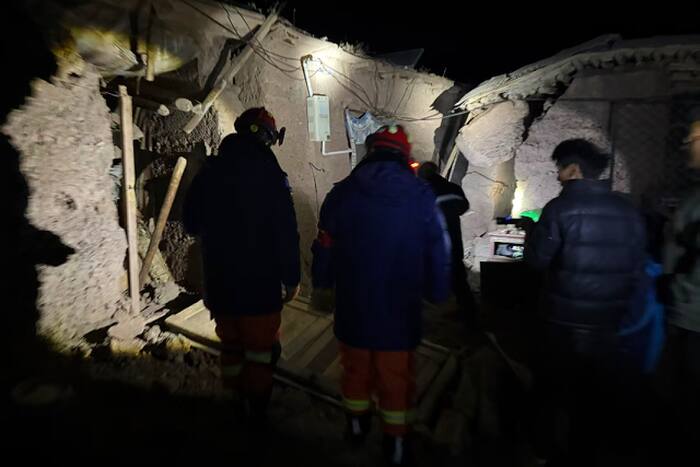
A powerful earthquake in China’s Tibet region has collapsed hundreds of homes and killed at least sixteen people, exposing once again how fragile rural mountain settlements remain when the ground begins to tear apart. Reports of destroyed dwellings and rising casualty counts are only the opening ledger of any major tremor on the Tibetan Plateau. The deeper story lies in why seemingly modest structural failures at high elevation turn fatal so quickly, how remote terrain slows down rescue and verification, and why decades of seismic science still collide with harsh economic and geographic realities.
Every time a major earthquake strikes Tibet, the headline numbers arrive in fragments. Early reports count collapsed walls and initial fatalities. Hours or days later, revised tallies reflect villages that took days to reach over fractured roads or high passes. Watching these dispatches unfold over a career covering disasters and geopolitical reporting brings a familiar, sobering clarity. A death toll rarely starts at its final number when shaking hits scattered, high-altitude communities spread across vast valleys and steep slopes.
Tectonic Pressure Under the Roof of the World
The Tibetan Plateau exists because massive continental crust is colliding. The Indian tectonic plate pushes northward into the Eurasian plate, driving uplift that created the highest mountain ranges on Earth and storing immense strain along faults across the region. When friction along a fault gives way suddenly, energy radiates outward as seismic waves, shaking rock and soil with violent acceleration.
Even a moderate-to-strong tremor feels punishing in an environment shaped by extreme geology. Steep valleys can amplify ground motion through topographic effects, where ridges and slopes focus or intensify shaking compared with flat basins. Loose sediment, talus, and frozen ground or permafrost layers add another layer of instability. Ground shaking does not just test buildings; it can trigger rockfalls, landslides, and cracked roadways that sever lifelines within seconds.
Shallow Ruptures and Violent Shaking
Depth matters enormously in how people experience an earthquake. A deep event spreads energy over a wider area before reaching the surface, often softening the sharpest jolt directly above the source. A shallower rupture sends concentrated energy straight up into nearby settlements, producing intense vertical and horizontal acceleration over a compact zone.
In high-altitude areas, shallow shaking meets thin air and freezing temperatures. A structure that survives a brief rattle might still suffer progressive collapse when heavy roof materials lose support. Once a wall buckles or a beam slips out of its seat, gravity finishes the job in an instant.
Why Traditional Rural Construction Fails Under Stress
Walk through almost any high-elevation village in this part of the world and you see architecture shaped by scarcity rather than textbook engineering codes. Timber is scarce at high altitudes. Steel and reinforced concrete cost money, require transport over difficult terrain, and demand skills and curing conditions that are hard to guarantee in cold, dry mountain climates.
Historically, builders relied on local stone, rammed earth, and mud brick paired with heavy timber posts and flat earthen roofs. Those roofs serve a clear purpose in freezing climates: thick layers of earth and sod insulate living spaces against brutal wind and cold. Yet that same thermal mass becomes a deadly liability during strong lateral shaking. Heavy roofs sitting atop unreinforced masonry or brittle walls create top-heavy loads that push walls outward when the ground sways.
The Gap Between Code and Reality
Over recent decades, governments and aid agencies have pushed seismic-resistant building standards, retrofitting programs, and relocation or reconstruction initiatives across earthquake-prone regions. On paper, engineering guidelines look clear: tie walls together, reinforce corners, lighten roofs where possible, and anchor structural elements so they move as a unit rather than tearing apart.
In practice, closing the gap between engineered drawings and everyday construction is slow and uneven. Rural builders often work with whatever materials are affordable and available nearby. Retrofitting an existing home costs money a household may not have, and rebuilding an entire house to modern standards is a major undertaking when incomes are modest and seasons for construction are short.
Consider a hypothetical example of two neighboring mountain hamlets struck by the same level of shaking. Hamlet A has mostly older unreinforced stone and mud-brick houses with heavy earthen roofs; several walls bow outward and collapse, trapping occupants inside. Hamlet B has a higher share of homes built or upgraded with ring beams, corner bracing, and lighter roofing materials; walls crack and plaster falls, yet the main frames hold long enough for residents to get outside. Nothing about the earthquake changed between the two places except what stood above the ground.
Geography and the Bottleneck of Response
Earthquakes test engineering first, then logistics. When a powerful earthquake hits remote mountain valleys, distance is measured in road conditions and weather rather than straight-line kilometers. A landslide across a single canyon road can turn a two-hour drive into a multi-day detour or force crews to clear debris under the threat of aftershocks.
High elevation compounds every operational challenge. Thin air slows physical exertion for rescue workers hauling tools and clearing rubble. Freezing nights turn injury and exposure into an immediate race against hypothermia for anyone trapped or left without shelter. Even communications can lag when power lines snap or cell sites lose backup power in rugged terrain.
Information Lag in the First Forty-Eight Hours
Early casualty figures almost always carry uncertainty. In the first hours after a major tremor, authorities rely on initial reports from local officials, scouts, and seismic networks while full assessments are still forming. Villages tucked behind ridges or along secondary tracks may not report severe damage until someone walks out or a reconnaissance team arrives.
That lag creates tension in news coverage and public expectations. Readers want firm numbers immediately, while responders are still piecing together a sprawling picture across difficult terrain. Experienced observers treat early fatality counts and damage estimates as provisional snapshots rather than final tallies, knowing revisions often follow as access improves.
Policy Trade-Offs and Uncomfortable Realities
Disaster response inevitably surfaces policy debates that have no easy, cost-free answers. Concentrating scattered rural populations into larger, more accessible settlements can make it easier to build safer housing, deliver medical care, and maintain roads and power grids. Yet resettlement can also sever ties to ancestral grazing land, alter traditional livelihoods, and create social strain if new housing does not fit local lifestyles or climates.
Funding priorities present another hard trade-off. Spending heavily on disaster preparedness and structural upgrades before a quake requires political will and upfront capital for a threat whose exact timing is unknown. Waiting until after a disaster strikes brings surge funding and intense attention, but by then the human loss has already occurred.
What Reconstruction Gets Right—and What It Misses
Post-quake rebuilding often brings visible improvements in specific towns or corridors, complete with sturdier materials and clearer safety rules. Still, rebuilding after a crisis is rarely a clean slate. Supply chains get strained, labor is stretched thin, and pressure to put roofs back over people's heads quickly can collide with thorough inspection and quality control.
True resilience is not a single project or a one-time aid package. It is a continuous grind of better materials, practical training for local builders, reliable emergency access, and honest accounting of vulnerabilities before the next fault slips.
Looking Closely at Every Number That Follows
When a powerful earthquake hits a high-altitude region and leaves hundreds of homes collapsed and at least sixteen people dead, the immediate grief belongs to the families and communities living through the aftershocks. Anyone tracking the story from afar has a straightforward responsibility: look past the initial tally, pay attention to how homes were built and how quickly help reached the hardest-hit pockets, and remember that geology never negotiates with unfinished defenses.