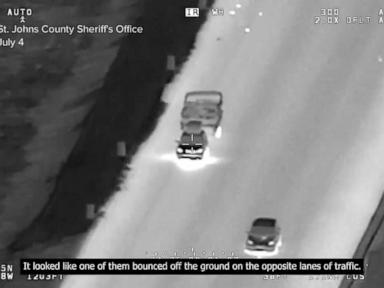
A holiday stunt on Interstate 95 in St. Johns County, Florida, ended in a felony arrest after a passenger firing mortar-style fireworks from a moving truck was tracked for miles by a police helicopter. The incident, captured in vivid detail by the St. Johns County Sheriff’s Office air unit, highlights a growing trend of aggressive highway endangerment and the high-tech policing methods used to stop it. While the occupants of the vehicle believed they were cloaked by the anonymity of a dark interstate, they were actually being watched from thousands of feet above by a thermal-imaging flight crew.
The arrest on July 4, 2026, serves as a stark reminder of the massive gap between public perception of police surveillance and the reality of modern airborne law enforcement.
Anatomy of a Ten Mile Air Track
The sequence began during the peak of Fourth of July celebrations. On a crowded stretch of I-95, a pickup truck pulling a boat was cruising southward. From the passenger window, bright flashes erupted. These were not harmless sparklers; they were commercial-grade mortar fireworks launched directly into the flow of highway traffic.
Hovering above was a St. Johns County Sheriff's Office patrol helicopter. The air unit, tasked with monitoring holiday traffic and spotting emergencies, locked its high-definition camera onto the vehicle.
For ten miles, the flight crew kept the camera crosshairs glued to the truck. On the recorded feed, fireworks could be seen ricocheting off the asphalt and exploding near oncoming vehicles in the adjacent lanes. The sheer physics of the situation are terrifying when broken down.
| Metric | Estimated Value | Impact |
|---|---|---|
| Vehicle Speed | 70 mph ($102.6 \text{ ft/s}$) | Reduces driver reaction time to near zero. |
| Firework Burn Temp | Up to $1,800^\circ\text{F}$ | Easily ignites fuel, plastics, or dry brush. |
| Tracking Distance | 10 miles | Allowed ground units to coordinate a perfect box-in. |
| Flight Duration | ~8.5 minutes | Sustained aerial observation prevented any chance of escape. |
The pilot of the helicopter calmly guided ground deputies toward the truck.
"They appear to be shooting fireworks out of the window at cars on the interstate," the pilot reported over the radio frequency. "We’ve got it on camera, but it looks like it was mortar-style."
The driver of the truck, completely unaware of the eye in the sky, continued driving southbound.
The Illusion of Anonymity on the Interstate
When blue lights finally flashed behind the truck, the occupants reacted with classic, unearned confidence. Body camera footage released by the sheriff’s office reveals a masterclass in immediate denial.
"This vehicle was seen launching fireworks out of the passenger side," the stopping deputy announced.
"No, not us sir," the driver replied without hesitation.
"Not this car?" the deputy asked.
"No man, not us," the passenger chimed in, attempting to play the role of the innocent holiday traveler.
The deputy then asked if they knew how their vehicle had been singled out from the hundreds of other trucks on the highway that night. They had no idea. The deputy pointed upward into the pitch-black Florida sky, toward a blinking strobe light thousands of feet above them.
"You see that little flashy dot?" the deputy asked.
"Yeah. Is it a drone?" the driver asked.
"No," the deputy responded. "That’s a helicopter who’s been following you for the past ten miles. You're gonna stick with that story? Let's be real, it's on recording."
This exchange exposes a massive blind spot for the modern offender. Many citizens assume that police surveillance is limited to what can be seen from a patrol cruiser’s windshield. They assume that if there are no headlights behind them, they are invisible. They fail to realize that modern sheriff's departments utilize high-altitude infrared cameras that can read a license plate from a mile away in total darkness.
The Lethal Physics of Highway Fireworks
To the average teenager or reckless passenger, throwing a firework out of a car window seems like a minor prank. It is a loud noise, a flash of light, and a brief moment of adrenaline. But from an engineering and safety perspective, it is indistinguishable from firing a weapon.
A mortar-style firework is designed to be launched from a stable, vertical tube. The black powder lift charge propels the shell upward, where a timed fuse ignites the secondary effect.
When launched horizontally from a vehicle traveling at highway speeds, the physics change drastically:
- Relative Velocity: If the vehicle is traveling at 70 mph and the firework is ejected backward, it stalls in mid-air. If fired forward or sideways, its speed is added to or subtracted from the vehicle’s velocity, making its trajectory completely unpredictable.
- Wind Resistance: At high speeds, the wind resistance instantly strips away any stability the firework has, causing it to tumble wildly. This is why the video showed the mortars bouncing off the highway lanes rather than flying straight.
- Target Vulnerability: A windshield is designed to withstand rock chips, not a concentrated, superheated explosion. If a mortar shell hits a windshield at a combined speed of over 100 mph, it can easily penetrate the glass, blinding the driver and causing a catastrophic high-speed pileup.
This is why Florida law does not treat this as a simple misdemeanor or a fireworks violation. The passenger was arrested and hit with a severe felony charge: shooting a deadly missile into a vehicle.
Under Florida Statute 790.19, throwing, projecting, or shooting any missile—which includes rocks, bullets, or fireworks—at or within any occupied vehicle is a second-degree felony. It carries a penalty of up to 15 years in state prison. The law is intentionally broad because the state legislature recognized decades ago that throwing objects at moving cars is highly likely to result in death.
The Cost of Airborne Policing
While the arrest was a success, it shines a light on the massive financial resources required to police modern highways from above. Operating a law enforcement helicopter is an incredibly expensive endeavor.
Most county air units utilize light turbine helicopters, such as the Bell 407 or the Eurocopter AS350. The hourly operating cost of these aircraft—including fuel, routine maintenance, searchlights, and high-definition thermal camera systems—typically ranges from $600 to $1,200 per hour.
When you factor in the salaries of the pilot and the tactical flight officer (TFO), a single patrol flight can easily cost taxpayers thousands of dollars.
Some critics argue that using a million-dollar aircraft to chase down a reckless driver shooting fireworks is an inefficient use of public funds. However, law enforcement leadership views it as a necessary deterrent. A multi-car crash on I-95 can shut down a major interstate artery for hours, causing millions of dollars in lost economic productivity, property damage, and potentially costing lives. By intercepting the truck before it caused a wreck, the air unit likely saved the county money in the long run.
Why Drones Cannot Replace Helicopters Just Yet
During the traffic stop, the driver’s first instinct was to ask if the flashing light in the sky was a drone. This is a common assumption. Drones are everywhere, they are cheap, and they are increasingly used by police departments.
But the St. Johns County incident demonstrates exactly why manned helicopters remain the gold standard for highway patrol.
Federal Aviation Administration (FAA) regulations strictly limit commercial and public drone flights. Most police drones are restricted to "Line of Sight" operations, meaning the pilot on the ground must be able to see the aircraft with their own eyes. While the FAA has begun granting waivers for "Beyond Visual Line of Sight" (BVLOS) flights, the technology is still limited by battery life.
A standard police drone has a flight time of 30 to 45 minutes. A helicopter can stay aloft for several hours, cruise at over 120 mph, and cover vast geographic territories without needing to land and swap batteries. Furthermore, a helicopter can carry a massive, gyro-stabilized camera rig that can zoom in on a suspect from miles away, a payload far too heavy for a standard tactical drone.
Until battery technology takes a massive leap forward, county sheriffs will continue to rely on noisy, expensive, but highly effective manned helicopters to keep watch over our transit corridors.
The passenger who decided to turn I-95 into his personal launchpad learned this lesson the hard way. He went from celebrating the Fourth of July with friends to sitting in a county jail cell, facing a felony charge that could alter the trajectory of his life forever. It is a high price to pay for a few seconds of cheap entertainment.