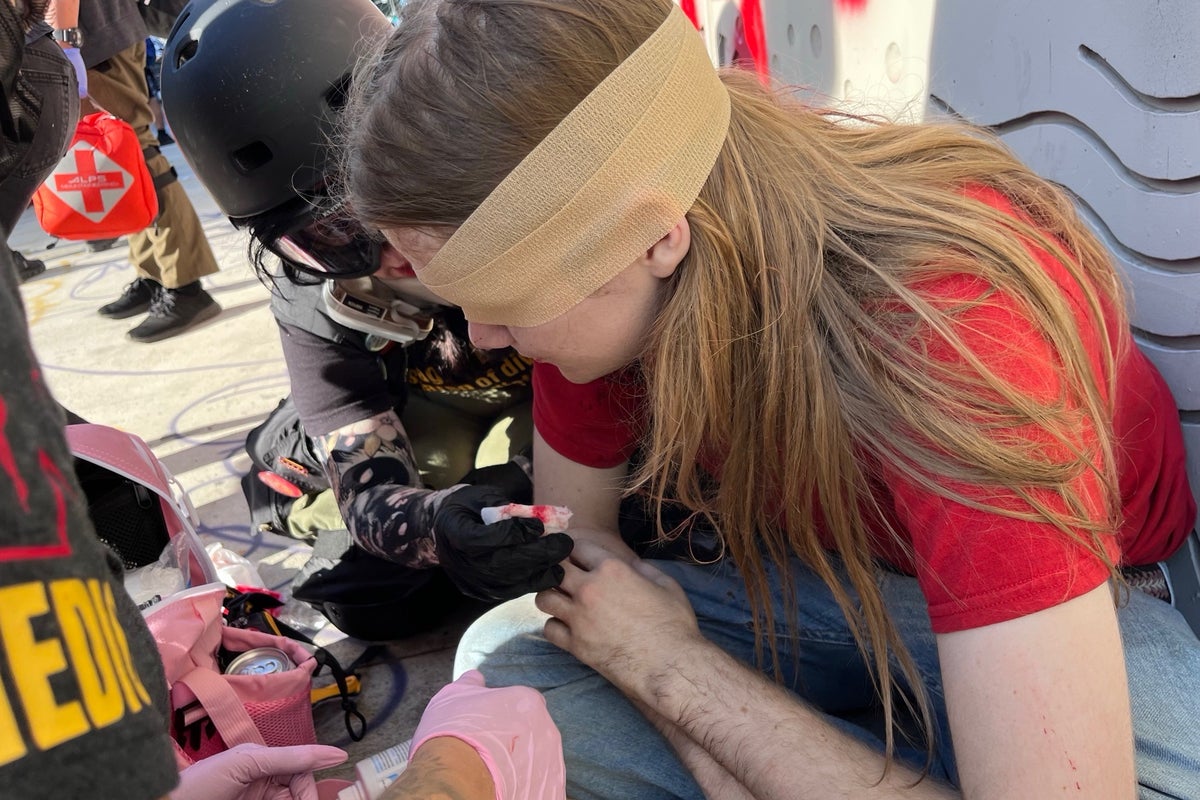
A camera lens is not a shield. When a teenager in Portland stood on a sidewalk to document a federal response to civil unrest, he assumed his role as a passive observer granted him a measure of safety. He was wrong. The impact of a "less-lethal" munition fired by Department of Homeland Security (DHS) agents didn't just break the skin; it shattered his globe, resulting in the surgical removal of his eye. This incident, now at the center of a formal civil rights complaint, exposes the widening gap between police hardware capabilities and the constitutional protections of those recording them.
The victim was not throwing stones. He wasn't toppling fences or painting graffiti. According to the complaint, he was standing still, holding his camera, fulfilling a role that has become essential in the modern accountability ecosystem. His injury is a permanent physical manifestation of a systemic failure in crowd control tactics where the distinction between an "agitator" and a "chronicler" has been dangerously blurred.
The Mechanics of Kinetic Impact
To understand why this happened, we have to look at the physics of the tools being used. Law enforcement agencies often use the term less-lethal to describe 40mm impact munitions, foam-tipped projectiles, or "bean bag" rounds. This language is a marketing triumph but a physiological misnomer. These rounds are designed to cause "pain compliance" by delivering massive kinetic energy to a specific point on the body.
When these munitions are fired from a distance, they are remarkably imprecise. At thirty feet, a projectile meant for a person's thigh can easily strike their throat or face if the target moves or if the shooter's aim is off by just a few degrees. In the chaos of a midnight deployment, those degrees become the difference between a bruise and a permanent disability. The teenager in this case was struck directly in the eye, suggesting that the "cone of fire" was aimed at head-height, a direct violation of standard use-of-force protocols which dictate aiming for "large muscle groups" like the legs or buttocks.
Federal Immunity and the Accountability Gap
Suing the federal government is an uphill battle. While local police departments are often subject to civil rights lawsuits under Section 1983, federal agents operate under a different legal framework. The Bivens doctrine, which once allowed individuals to sue federal officers for constitutional violations, has been consistently narrowed by the Supreme Court over the last decade.
This creates a "black hole" of accountability. If a DHS agent shoots a bystander during a domestic deployment, the victim must prove not just that their rights were violated, but that the specific circumstances of the violation haven't been "precluded" by previous court rulings. The complaint filed in this case isn't just about seeking damages for a lost eye; it is a direct challenge to the idea that federal agents can deploy into American cities and act with near-total impunity.
The Digital Witness as a Target
There is a growing body of evidence suggesting that journalists and legal observers are being targeted specifically because they are recording. It sounds like a conspiracy theory until you look at the data from recent years of civil unrest. In cities across the country, individuals wearing high-visibility "Press" or "Legal Observer" gear have been pepper-sprayed, beaten, and shot with impact munitions at higher rates than the general crowd.
The logic is grim but simple. If you remove the witness, you control the narrative. By incapacitating the person with the camera, the official police report becomes the only version of events that exists on the record. In this specific Portland incident, the camera was the only thing the victim was carrying. He was engaged in a protected First Amendment activity. By firing on him, the agents weren't just neutralizing a perceived threat; they were silencing a recording device.
The Myth of Non-Lethal Intent
We need to stop using the word "non-lethal" entirely. It suggests a level of safety that does not exist in reality. Medical journals have documented hundreds of cases where "less-lethal" rounds have caused:
- Intracranial hemorrhaging
- Ruptured organs
- Permanent blindness
- Death
When these tools are marketed to departments, they are sold as "safe alternatives" to lead bullets. This lowers the psychological threshold for an officer to pull the trigger. If you believe your weapon is "safe," you are more likely to use it in situations that don't actually require force. This "force creep" is exactly how a teenager with a camera ends up in an emergency room having his eye removed.
Rules of Engagement in Domestic Spaces
The DHS deployment in Portland was a departure from traditional federal roles. Usually, federal agents protect buildings. In this instance, they moved blocks away from federal property to engage with crowds. This expansion of jurisdiction created a friction point where agents trained for border security or tactical entries were suddenly performing crowd control duties they weren't necessarily equipped for.
Crowd control is a specialized skill. It requires de-escalation, spatial awareness, and a high degree of restraint. When you drop "tactical" units into a protest environment, they bring a "search and destroy" mindset to a "contain and manage" situation. The result is a violent mismatch. The teenager's injury is the data point that proves this mismatch is lethal in everything but name.
Policy Reform is a Moving Target
Agencies often promise "internal reviews" after these incidents. These reviews are almost always opaque and rarely lead to significant changes in equipment or training. To prevent another eye from being lost, the change must be legislative. There must be a hard ban on aiming kinetic impact munitions at the head or neck, backed by criminal penalties for officers who ignore the rule.
Restricting the use of these weapons to "imminent threats of serious bodily harm" would align their use with the actual danger they pose. Currently, they are used for simple "non-compliance," such as a person not moving fast enough when told to clear a sidewalk. That is a disproportionate response that fails any reasonable "balancing test" of government interest versus individual rights.
The Cost of the Medical Bill
Beyond the physical trauma, there is a staggering financial reality. A prosthetic eye, the surgeries required to prepare the socket, and the lifetime of follow-up care can cost hundreds of thousands of dollars. For a teenager, this is a debt sentence as much as a physical one. When the government causes this level of damage to a citizen who was not committing a crime, the "civil rights complaint" is often the only path to preventing total financial ruin.
The legal system moves slowly. It will likely take years for this case to reach a settlement or a verdict. In that time, more "less-lethal" rounds will be fired into more crowds. The question for the public isn't whether the teenager should have been there. In a free society, a citizen has every right to be on a public sidewalk with a camera. The question is why the government feels entitled to use permanent, life-altering force against a person whose only "weapon" was a memory card.
The camera remains the most powerful tool for justice, provided the person holding it survives the encounter. We are currently asking citizens to risk their lives to prove what is happening in their own streets. That is an unacceptable price for transparency.
Hold the line on the First Amendment or watch it disappear one "less-lethal" shot at a time.