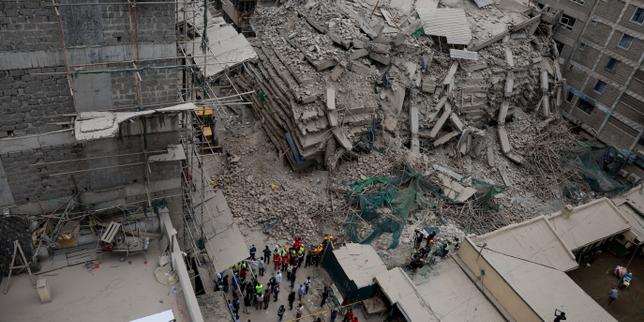
Every time a ten-story skeleton folds onto itself in Nairobi, the coverage writes itself. Rescue sirens. Grieving families. Angry speeches about rogue contractors and greedy landlords.
That script is lazy. Worse, it is comforting.
Blaming a "rogue builder" lets everyone else off the hook. It turns a systemic failure of incentives, incentives, and structural physics into a morality play about one bad guy cutting corners with cheap rebar.
If we keep treating high-rise collapses in Nairobi as isolated acts of criminality or bad luck, we will keep pulling bodies from twisted steel. The real collapse happens months earlier—inside approval desks, financial spreadsheets, and mismatched ambition.
The Lazy Consensus Around "Rogue Builders"
Standard reporting treats a collapsing building like a sudden storm. One minute it stands; the next minute it drops ten floors in seconds, and crews rush in with cranes and floodlights.
The implied conclusion is simple: enforce rules harder, arrest more contractors, and mourn the victims until the next one goes down.
That misses the mechanics of urban growth in a fast-expanding capital. When demand for housing and commercial space explodes faster than formal financing, planning capacity, and inspection bandwidth, cutting corners stops being an anomaly. It becomes a business model.
Calling every failing site a "rogue" operation implies there is a clean, orderly pipeline sitting right next door that everyone simply chooses to ignore. In reality, builders operate inside a web of land costs, delayed permits, informal labor markets, and tight margins. When a developer already has borrowed money ticking at high interest on expensive land, every week of bureaucratic delay pushes them toward shortcuts—extra floors tacked onto a foundation drawn for fewer, thinner columns, or rushed curing times before stripping formwork.
Rescue operations get the cameras because tragedy is immediate and visual. Prevention gets ignored because nothing visibly happens when a beam is poured to spec or an over-ambitious floor is rejected on paper.
What Happens When Ambition Outruns Structural Physics
A ten-story structure is not a tall bungalow. Loads compound down the frame. Wind and eccentricities punish sloppy alignment.
Let us define the terms cleanly so we stop talking in vague outrage:
- Dead load: The permanent weight of the structure itself—concrete, steel, partitions, finishes. Add unapproved floors and you multiply dead load fast.
- Live load: The variable weight of people, furniture, equipment, and occupancy.
- Load path: The continuous route carrying forces from the roof through slabs, beams, columns, and footings into the ground. Break or overload any link in that chain, and progressive collapse becomes a real threat.
Thought Experiment: The Three-Floor Gamble
Imagine a scenario where a developer holds a plot in an expanding Nairobi neighborhood and secures approvals for seven stories. Construction costs rise mid-project, and projected rents look tighter than expected. Adding three more floors on top of an already poured lower frame looks like free profit on a spreadsheet. Concrete is poured faster. Curing is rushed. The lower columns—never engineered for ten stories of dead and live load—carry a quiet tax every single day. Nothing fails during the pour. Failure waits for a load threshold, a curing weakness, or a moment of instability.
When a building drops suddenly, people often assume the whole structure was made of dust and wishful thinking. Often, one critical element gives way—a punching shear failure around a column, a buckled member, or inadequate reinforcement—and the upper floors pancake onto the slabs below.
I have watched real estate ventures burn millions chasing vertical density without respecting soil mechanics, curing discipline, or structural redundancy. When capital wants ten stories out of a seven-story budget and timeline, physics does not negotiate. Physics collects.
The Questions People Ask That Miss the Point
When a collapse hits the headlines, search queries spike with predictable questions. Most of them point a flashlight at the wrong wall.
"How can we tell if a building under construction is safe?"
You cannot reliably diagnose a ten-story frame from a sidewalk photograph or a casual walk past the hoarding. Visual checks catch obvious chaos—exposed rusted steel, tilted formwork, spilled materials—but structural integrity lives inside mix ratios, compaction, rebar placement, cover depth, curing times, and verified engineering calculations.
A site can look tidy on a Tuesday morning and still harbor fatal flaws in lower columns or foundation interfaces. Treating visual inspection by non-engineers as a seal of safety creates false confidence.
"Why do buildings keep collapsing even after regulations are announced?"
Announcing crackdowns is cheap. Day-to-day enforcement across a sprawling city is expensive, slow, and vulnerable to friction at every checkpoint.
Rules only change behavior when compliance is faster and clearer than evasion, and when non-compliance carries real, certain consequences before concrete sets. A policy memo after a tragedy does not alter a pour scheduled for six o'clock the next morning.
"Should rescue efforts focus more on speed or precision?"
Both matter, and pretending they are opposites is a false choice. Early hours after a collapse are critical for anyone trapped in survivable voids, yet rushing heavy machinery onto unstable debris can shift slabs and endanger both survivors and rescuers.
Disciplined search-and-rescue teams balance urgency with structural stabilization and acoustic/thermal detection. Speed without stabilization compounds risk; endless caution wastes precious time. The real failure is treating rescue as the primary crisis response while ignoring what happens before a single brick is laid.
What Heavyweight Engineering Actually Demands
Serious structural engineers—the people whose names stay on drawings long after politicians move on—treat tall buildings with healthy paranoia. Good engineering is conservative where uncertainty lives.
It respects material testing rather than trusting word of mouth. It enforces curing and quality control as non-negotiable steps, not optional delays. It aligns architectural height with geotechnical reality and verified structural capacity.
Here is the catch, and I will own it without flinching: strict engineering discipline slows projects down and raises upfront costs.
If you refuse unverified floor additions, insist on proper testing, and demand real sign-offs at critical stages, fewer buildings go up overnight. Some projects stall. Some developers walk away because the numbers no longer work on a shortcut model.
That is the real trade-off nobody wants to own out loud: faster, cheaper vertical expansion in a growing city comes with higher structural risk. You can have cheap speed, or you can have reliable height. Pretending you can have both without paying the price in safety is how ten-story frames end up on the ground.
Practical Moves That Actually Reduce Risk
Outrage fades in a week. Systems change when incentives shift. If you care about stopping the next collapse in Nairobi—whether you regulate, finance, design, or live in high-rise housing—stop waiting for miracles and focus on high-leverage friction points:
- Tie financing disbursements to verified milestones: Banks and lenders hold real leverage. Release construction tranches only against documented structural checks and independent verification—not just promises of progress.
- Audit height creep early: Flag projects where visible floor counts outpace approved drawings while the frame is still accessible, before finishes hide the evidence.
- Protect site engineers' independence: Make sure structural sign-offs carry real accountability and cannot simply be shopped around until someone stamps a risky change.
- Publish clear compliance status: Give buyers, tenants, and local officials plain, verifiable records of approvals and inspections rather than opaque paperwork trails.
A collapsing building is never a surprise to the laws of physics. It is only a surprise to people who believed shortcuts could scale forever.