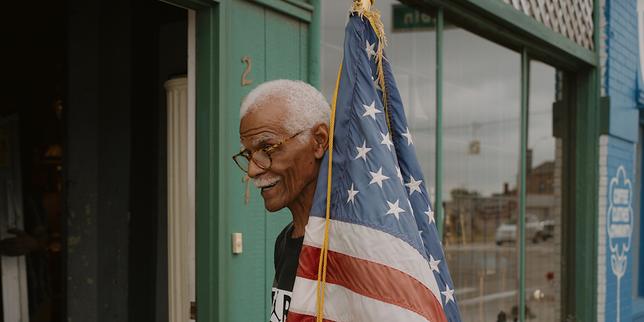
Eighty years of American history do not arrive with a fanfare. They sit quietly in the dim corners of a Detroit storefront, wrapped in the scent of aged mahogany, old leather, and dust that refuses to settle. Marvin Nash has spent decades handling the remnants of other people’s lives, acquiring forgotten tables, tarnished silverware, and discarded wardrobes from a city that has reinvented itself through catastrophe several times over. Born into an era where the color of a man’s skin strictly dictated his coordinates on a map, Nash represents a vanishing generation of Black proprietors who built parallel economies inside a deeply segregated metropolis. Observers passing through Detroit often look for grand political manifestos written on banners, but the truest documentation of urban transformation exists in the inventory of a secondhand shop. Here, the arc from mid-century racial apartheid to contemporary populist polarization is measured not in abstract political science papers, but in the physical weight of items salvaged from abandoned mansions and demolished factories.
The trajectory of Detroit cannot be understood without confronting the deliberate architecture of mid-century segregation. When Nash was growing up, neighborhoods were partitioned by invisible yet unbreakable legal and social barricades. Housing covenants and discriminatory lending practices ensured that Black families remained compressed within specific municipal boundaries, regardless of their economic capacity. This forced containment paradoxically birthed a vibrant, self-contained commercial ecosystem along avenues like Hastings Street and Woodward Avenue, where Black-owned businesses thrived because their patrons were barred from downtown department stores. Yet, this internal prosperity was perpetually vulnerable to municipal decisions. Urban renewal projects in the mid-twentieth century infamously targeted and dismantled thriving Black business districts under the guise of civic modernization, displacing communities and eroding generational wealth accumulation before it could take root. Also making headlines recently: The Pathology of Institutional Self Defense Why State Protection Mechanisms Accelerate Radicalization.
The physical destruction of those neighborhoods left psychological scars that never fully closed. When the 1967 civil unrest erupted, it served as a violent exclamation point on decades of police brutality, economic deprivation, and housing discrimination. White flight accelerated immediately afterward, turning a booming manufacturing capital into a hollowed-out shell within a single generation. Factories that once employed hundreds of thousands of unionized workers packing high-wage assembly lines began shuttering or relocating to suburban rings and overseas manufacturing hubs. Nash watched the steady evacuation of capital and population from the storefront windows, picking through the domestic wreckage left behind by families fleeing the city in panic. The chairs and sideboards he bought and sold during those decades carried the quiet despair of a collapsing industrial empire.
Decades of municipal neglect followed, turning vast swaths of Detroit into urban prairies where nature reclaimed concrete blocks. For many residents, the traditional political alignment with the Democratic Party felt increasingly transactional rather than transformative. Generations of voters delivered reliable majorities to party candidates, yet basic municipal services deteriorated, public schools struggled, and economic mobility remained elusive for working-class households. This chronic frustration created an opening for alternative political narratives. When modern populism swept through the industrial Midwest, it did not arrive as an alien ideology; it tapped into a profound, long-standing resentment toward coastal elites, institutional gatekeepers, and political establishments that had presided over the region's decline for half a century. More information on this are explored by NBC News.
Listening to patrons enter Nash's shop reveals the subtle erosion of old partisan certainties. Working-class voters of various backgrounds express a weariness with political rhetoric that fails to translate into tangible community revitalization. Some lean toward anti-establishment figures who promise a radical disruption of the status quo, even when those promises carry deep contradictions. Nash himself remains an acute observer rather than a partisan zealot, watching how economic insecurity distorts political loyalties. When a community feels forgotten by the mainstream, the appeal of a political earthquake often outweighs the fear of what might collapse in the tremors. The ideological shifts reshaping modern American politics find their local expression right here, among people who survived redlining, deindustrialization, and the cynical promises of successive administrations.
Antiques possess a stubborn materiality that human memory often lacks. While politicians rewrite campaign speeches and pundits sanitize history for television audiences, a nineteenth-century oak desk bears the literal dents and scratches of the people who built their lives around it. Nash understands this tactile record better than most. He recognizes that every object in his shop tells a story of ambition followed by displacement. Families buy items to anchor themselves in a city that constantly threatens to wash away its own history. In a place where entire neighborhoods have been wiped off the map or abandoned to the elements, salvaged furniture serves as domestic architecture, providing a temporary sense of permanence in an environment defined by transience.
The transformation of downtown Detroit in recent years introduces another layer of complexity to the urban narrative. Billions of dollars in corporate investments have revitalized the central core, bringing gleaming sports arenas, trendy restaurants, and luxury lofts to areas that were derelict thirty years ago. Yet, this renaissance often bypasses the historic neighborhoods where the majority of Black residents live. For long-term Detroiters, downtown development resembles a separate city engineered for incoming professionals rather than the people who weathered the decades of blight. This spatial and economic divide fuels a quiet cynicism about growth metrics trumpeted by city hall. When prosperity arrives wrapped in gentrification, it frequently feels less like a recovery and more like a displacement under a different name.
Navigating the daily realities of running a small enterprise in a volatile urban market requires a specific brand of resilience. Nash has survived economic recessions, high property tax pressures, shifting commercial trends, and the relentless march of online retail that has decimated traditional antique dealers across the country. His survival is a testament to deep community roots and an encyclopedic knowledge of regional material culture. While national media outlets treat Detroit as a political laboratory or a symbol of rust belt despair, the daily rhythm of the city is shaped by individuals quietly solving practical problems without waiting for government rescue.
The political polarization gripping the nation manifests differently on the ground level of an antique shop. Ideological purity matters far less than economic survival and personal dignity. When customers argue over national politics near the front counter, the debates frequently reflect a shared anxiety about the future rather than partisan tribalism. People feel the ground shifting beneath their feet, sensing that the old social contract governing American life has expired, though no consensus exists on what should replace it. The appeal of strongman politics or populist upheaval draws strength from this widespread sense of institutional failure.
Historians often look backward to explain the present, but observing someone like Nash suggests that the past is not a foreign country; it is piled high in the back room, waiting for someone willing to look closely. The segregation of the past laid the groundwork for the geographic and economic divides of today, while the industrial betrayal of the late twentieth century prepared the soil for current populist rebellions. Every artifact passing through the store is a physical witness to a broken promise.
As evening settles over the avenue, the traffic thins out, leaving the storefront bathed in the amber glow of vintage lamps. Outside, the city continues its endless cycle of destruction and reconstruction, tearing down old structures to make room for speculative futures. Inside, the heavy oak tables and cast-iron brackets stand unmoved, indifferent to election cycles and media cycles alike. The real history of America is not found in the polished talking points of campaign headquarters, but in the quiet endurance of those who watch the world change from the same street corner for eighty years, taking stock of what was lost and calculating what remains.