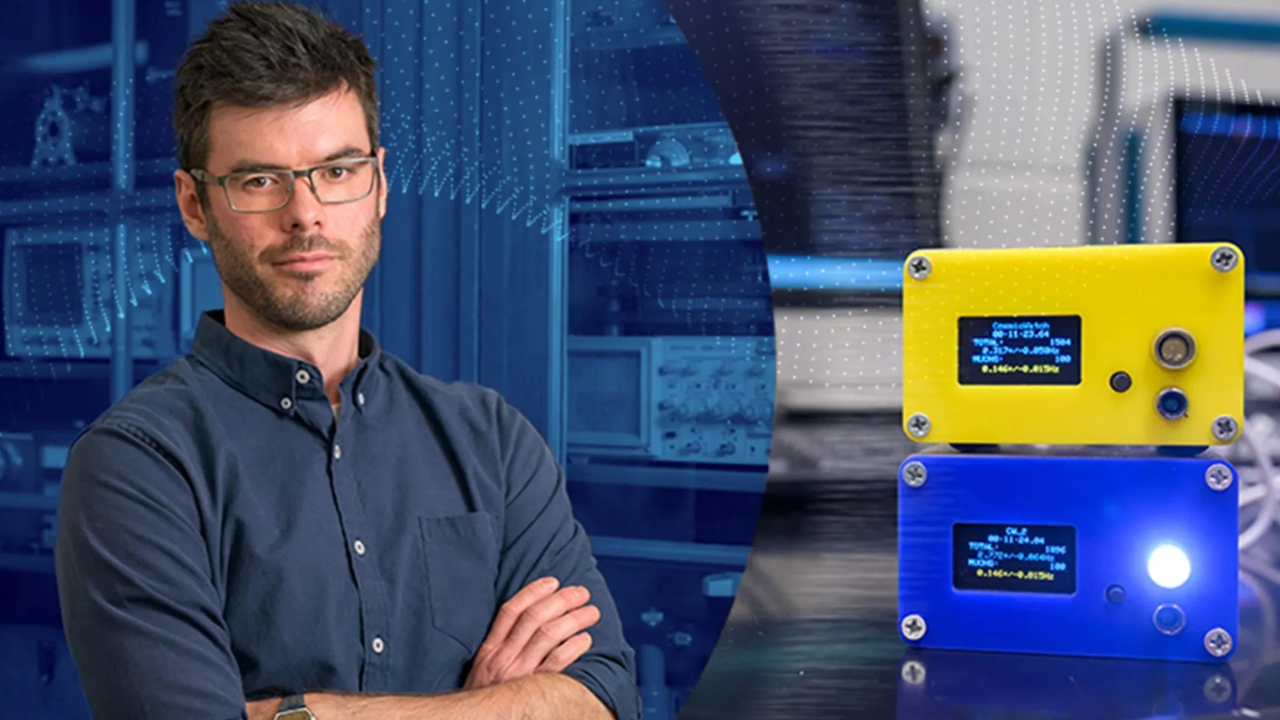
The CosmicWatch pocket muon detector is a sub-one-hundred-dollar open-source hardware project that allows students and hobbyists to track high-energy subatomic particles streaming through the atmosphere. Built using a silicon photomultiplier, a plastic scintillator block, and an Arduino microcontroller, this handheld device turns invisible cosmic radiation into quantifiable data. What started as an academic prototype out of MIT has quietly evolved into a decentralized global citizen science network, reshaping how everyday people interact with high-energy astrophysics.
For decades, particle physics remained confined behind heavy concrete walls, guarded by multimillion-dollar national laboratories and institutional gatekeepers. Detecting elementary particles required equipment priced out of reach for standard secondary school budgets. That financial barrier created an artificial wall between academic inquiry and public participation. The invention of low-cost hardware changes that dynamic entirely.
The Anatomy of a Desktop Particle Trap
At its mechanical core, the detector relies on a simple principle of luminescence. When a high-energy secondary particle originating from deep space passes through the device, it strikes a piece of plastic scintillator. The material flashes with a microscopic amount of light upon impact. A specialized sensor known as a silicon photomultiplier captures those faint photons and converts them into an electrical pulse. An onboard microcontroller processes the signal, records the timestamp, and logs the event.
The engineering brilliance lies in simplification. Traditional laboratory detectors demand high operating voltages and fragile photomultiplier tubes. By swapping those expensive components for modern solid-state electronics, designers slashed production costs while maintaining remarkable sensitivity.
Consider a hypothetical high school classroom in a landlocked state. Students assemble the circuit board over two laboratory periods, solder the header pins, and connect the micro-controller via USB. Within hours, the small OLED screen begins ticking upward, registering invisible visitors originating from the edges of our solar system and beyond. The abstraction of quantum mechanics vanishes. Students are no longer reading about abstract particles in a textbook; they are counting the physical debris of cosmic collisions occurring miles above their heads.
Tracing the Origins of High-Energy Physics
Cosmic rays are not actually rays at all. They are atomic nuclei, primarily protons stripped of their electrons, tearing through the vacuum of space at nearly the speed of light. When these primary particles slam into the upper atmosphere, they smash into nitrogen and oxygen molecules. This violent collision triggers a cascade of secondary particles, most notably pions, which quickly decay into muons.
Muons are heavy cousins of the electron. They carry a negative charge and possess immense kinetic energy. Because of relativistic time dilation, these unstable particles survive their long descent through the atmosphere, hitting the Earth's surface at a rate of roughly one muon per square centimeter every minute.
For a long time, detecting these particles required bulky equipment that sat gathering dust in university basements. Spencer Axani and his colleagues at MIT recognized that democratization was long overdue. They stripped away unnecessary features, optimized the circuit layout, and published the schematics online for free. The entire blueprint became open source. Suddenly, anyone with basic soldering skills and a small budget could build a functional particle detector at home.
Scaling the Network From Classrooms to Global Arrays
Individual detectors provide fascinating snapshots of local radiation. Yet the true power of the CosmicWatch ecosystem emerges when these units connect. Thousands of handheld devices operating simultaneously form a massive, decentralized sensor grid.
Data synchronization turns individual data points into a cohesive map of atmospheric behavior. Changes in barometric pressure, solar flare activity, and geomagnetic storms all alter the flux of muons reaching the surface. When a solar coronal mass ejection erupts toward Earth, global arrays of citizen detectors register fluctuations in real time.
This distributed architecture solves a classic problem in modern science. Funding limitations restrict professional researchers to a handful of fixed, expensive observatories. Citizen science networks bypass this bottleneck by distributing thousands of nodes across diverse geographic locations, elevations, and weather systems. A single institution could never afford to purchase, deploy, and maintain thousands of sensors across six continents. A community-driven model accomplishes this organically.
Engineering Challenges and Data Integrity
Skepticism from traditional researchers is inevitable. Anytime amateur builders enter a hard science domain, questions regarding data calibration and instrument reliability immediately surface. A detector built by a high school student in a humid garage differs significantly from an instrument calibrated in a cleanroom.
Temperature fluctuations introduce noise into silicon photomultipliers. Power supply inconsistencies can skew pulse height measurements. Without rigorous calibration protocols, a distributed network risks collecting noisy, unreliable data that frustrates researchers attempting to run legitimate atmospheric models.
The project addresses this through software normalization and open collaboration. The developer community maintains active forums where builders share troubleshooting steps, firmware updates, and calibration scripts. Outlier filtering algorithms automatically discard erroneous readings caused by local electronic interference or hardware failure.
Rather than dismissing amateur data outright, forward-thinking astrophysicists view these networks as supplementary early-warning systems. While a pocket detector cannot replace a multi-million-dollar underground neutrino observatory, it can flag sudden anomalies in atmospheric radiation that warrant closer inspection by professional instruments.
Educational Transformation Through Tangible Science
Traditional science education often relies on passive consumption. Students memorize formulas, watch pre-recorded video demonstrations, and take multiple-choice exams that test short-term recall. This model fails to capture the messy, iterative reality of scientific discovery.
When a student builds a detector and watches it fail because of a cold solder joint, they experience genuine engineering problem-solving. Debugging the circuit requires analytical thinking that no textbook exercise can replicate. When the screen finally registers its first recorded particle, the psychological shift is profound. Physics ceases to be a theoretical chore and becomes an interactive exploration of the physical universe.
Schools adopting these kits report higher engagement levels in STEM curricula. Students take ownership of their data. They design independent research projects, measuring how muon counts change with altitude by taking detectors up in commercial aircraft or local hiking trails. They test shielding materials by placing lead sheets or concrete blocks over the sensor, directly observing how different densities absorb radiation.
Redefining Who Gets to Do Physics
The democratization of high-end instrumentation marks a quiet shift in how scientific progress unfolds. Astronomy made this leap decades ago when amateur astronomers armed with digital cameras began discovering exoplanets and tracking near-Earth asteroids. Particle physics is now undergoing a similar decentralization.
By lowering the barrier to entry, projects like this dismantle the invisible gatekeepers that historically kept advanced science restricted to elite institutions. You do not need a doctorate to detect cosmic rays. You need patience, a soldering iron, and a willingness to look closer at the invisible forces shaping our world.
The network continues to expand into new classrooms, community labs, and living rooms across the globe. Every device built adds another node to an invisible web of observation, turning ordinary citizens into active participants in our ongoing exploration of the cosmos.