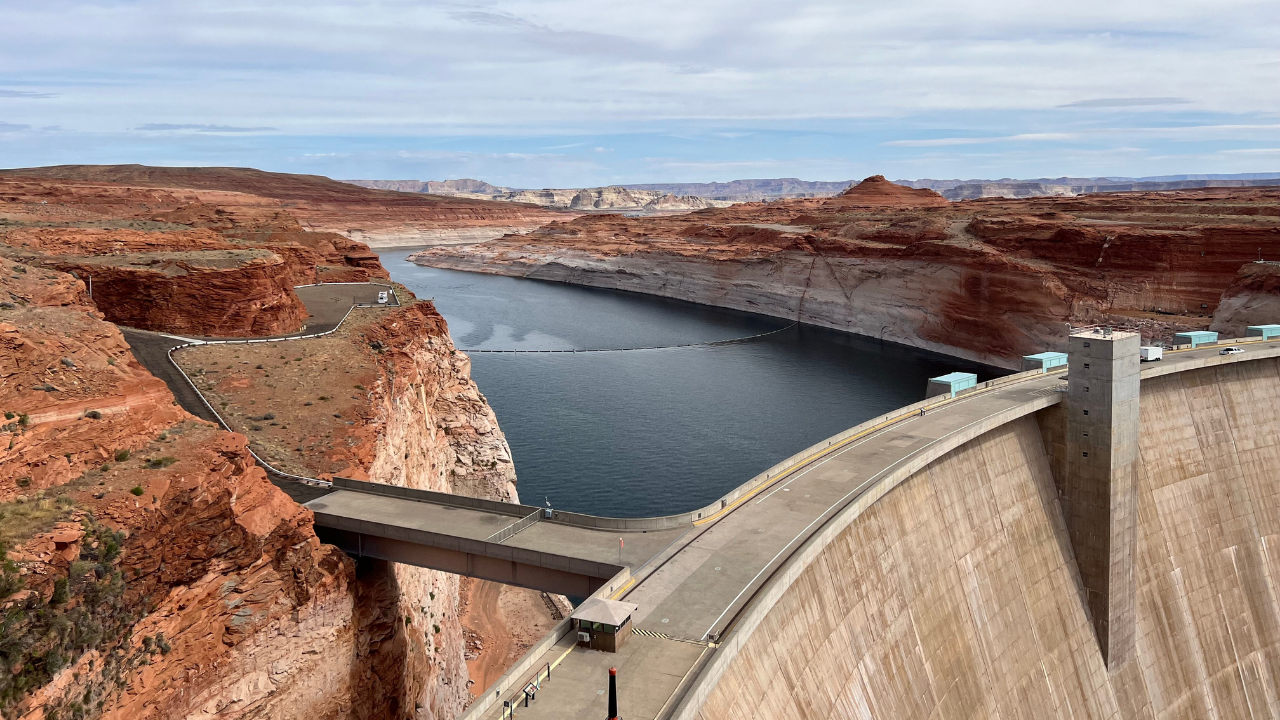
Engineering interventions on regulated rivers create permanent geomorphic disequilibrium. When the Bureau of Reclamation completed the Glen Canyon Dam in 1963, it severed the continuity of sediment transport down the Colorado River. The reservoir behind the wall, Lake Powell, trapped approximately ninety percent of the incoming bed material and suspended load. Deprived of its natural sediment supply while subjected to continuous clear-water releases for hydropower generation, the downstream channel through Marble and Grand Canyons began an aggressive armoring process. Fine sediment, essential for maintaining sub-aerial sandbars, campsites, and native fish habitats, scoured away.
To counteract this systemic erosion, researchers and resource managers executed a radical stress test in March 1996: an engineered high-flow experiment releasing 45,000 cubic feet per second (cfs) over an eight-day period. This intervention sought to determine whether an artificial flood could simulate pre-dam hydrology, remobilize resting channel sediments, and redeposit sand onto high-elevation benches. Deconstructing the mechanics of this release reveals the precise hydraulic parameters governing sediment redistribution, the structural limitations of single-pulse flood management, and the evolution of modern adaptive river operations. Don't miss our recent coverage on this related article.
The Hydrodynamic Baseline and Sediment Deficit
The pre-dam Colorado River operated as a supply-limited and transport-limited system dictated by seasonal hydrographs. Spring snowmelt generated massive volume surges carrying millions of tons of fine sand, silt, and clay derived from the upper basin and major downstream tributaries such as the Paria and Little Colorado rivers. These natural floods saturated valley cross-sections, forcing suspended sediment into low-velocity recirculation zones adjacent to canyon walls, where flow separation created stable sandbars.
Glen Canyon Dam obliterated this sediment budget. Water evacuated from the penstocks and outlet works was largely devoid of suspended sand. Clear water possesses excess kinetic energy relative to sediment load; upon passing downstream, it strips fine particles from the riverbed until it achieves capacity load, a phenomenon known as hungry water. To read more about the background here, USA Today provides an informative breakdown.
Over three decades, this hungry water eroded secondary deposits, coarsened the armored bed surface into a pavement of large cobbles and boulders, and shrank sub-aerial beaches. The 1996 high-flow experiment attempted to bypass this steady-state degradation by forcing a massive volume of water through the system, testing whether high-magnitude discharge alone could force bed sand up onto eroding shorelines.
Mechanics of the 1996 High-Flow Experiment
Operating the dam at 45,000 cfs required utilizing both the power plant turbines and the four large river outlet works. This discharge rate represented roughly triple the standard maximum operating capacity for power generation at the time, simulating the magnitude of historic moderate spring floods.
Monitoring networks consisting of over 120 cross-section survey sites mapped the geomorphic response across a 385-kilometer corridor. The physical response confirmed immediate local deposition. High-velocity flows swept through narrow constrictions, entraining sand from the main channel bed and carrying it into expanding separation eddies downstream of debris fans.
However, the physical mechanics exposed a critical constraint: the system suffered from a severe deficit of stored main-channel sand. Because tributary inputs from the Paria River between dam construction and 1996 had been systematically flushed or trapped without replenishment floods, the 1996 release lacked an adequate pool of loose bed sediment.
Consequently, the high flow did not import new sand from outside the canyon; it merely scavenged existing sand deposits from lower elevations within the channel and redeposited a portion of them at higher elevations. Sandbars grew taller, but they did not gain net mass or lateral width. The operation successfully redistributed sediment vertically while leaving the overall sediment mass balance virtually unchanged or net-negative due to export past Lees Ferry into lower reaches.
The Three Operational Constraints of Artificial Floods
Managing regulated rivers through pulse releases exposes fundamental constraints that separate engineered interventions from natural hydrological cycles.
- Sediment Supply Bottlenecks: A high-flow release is only as effective as the volume of mobile sand resident in the active channel bed prior to the event. Releasing high volumes during periods of low tributary input accelerates downstream export without rebuilding banks.
- Hydrograph Duration Limits: Natural floods persisted for weeks or months, allowing morphological adjustments to stabilize. Operational releases are restricted by reservoir storage capacities, downstream infrastructural tolerances, and economic losses from foregone hydropower generation, capping experiments at several days.
- Ecological Trade-offs: Sudden flow spikes alter thermal regimes and turbidity, creating compounding pressures on native species while inadvertently expanding habitats for non-native predators like rainbow trout that outcompete endangered native fish such as the humpback chub.
Transition to Condition-Based Management
The limitations observed during the 1996 release forced a complete overhaul of adaptive management strategies for the Colorado River ecosystem. Resource managers abandoned the concept of calendar-based or fixed-frequency experimental floods. Instead, protocol shifted toward a condition-based framework governed by strict sediment triggers.
Under modern protocols established through the Glen Canyon Dam Adaptive Management Program, high-flow experiments are authorized only after episodic tributary floods—predominantly from the Paria River and Little Colorado River—deliver measurable quantities of fine sand into the main stem. When tributary sand inputs accumulate on the bed during summer and autumn monsoons, subsequent high-flow releases can efficiently capture and lift that freshly deposited material onto eroding shorelines before it disperses.
This iterative refinement transformed the initial 1996 test from a standalone anomaly into an ongoing operational methodology. Successive high-flow experiments conducted in subsequent decades demonstrated that when sediment accounting precedes hydraulic release, sandbar volume retention improves significantly.
Strategic Execution Protocol
Optimize future dam-controlled flood operations by institutionalizing real-time bedload monitoring tied directly to automated sluice-gate release thresholds. Resource agencies must decouple high-flow scheduling from fixed annual calendars, enforcing a strict prerequisite that min-max volumetric sand accounting thresholds from downstream tributaries are verified via multibeam sonar before any high-flow release is authorized. Tie water release volume dynamically to the measured depth of mobile sand deposits in Marble Canyon to maximize sediment retention efficiency and eliminate clear-water scour wastage.