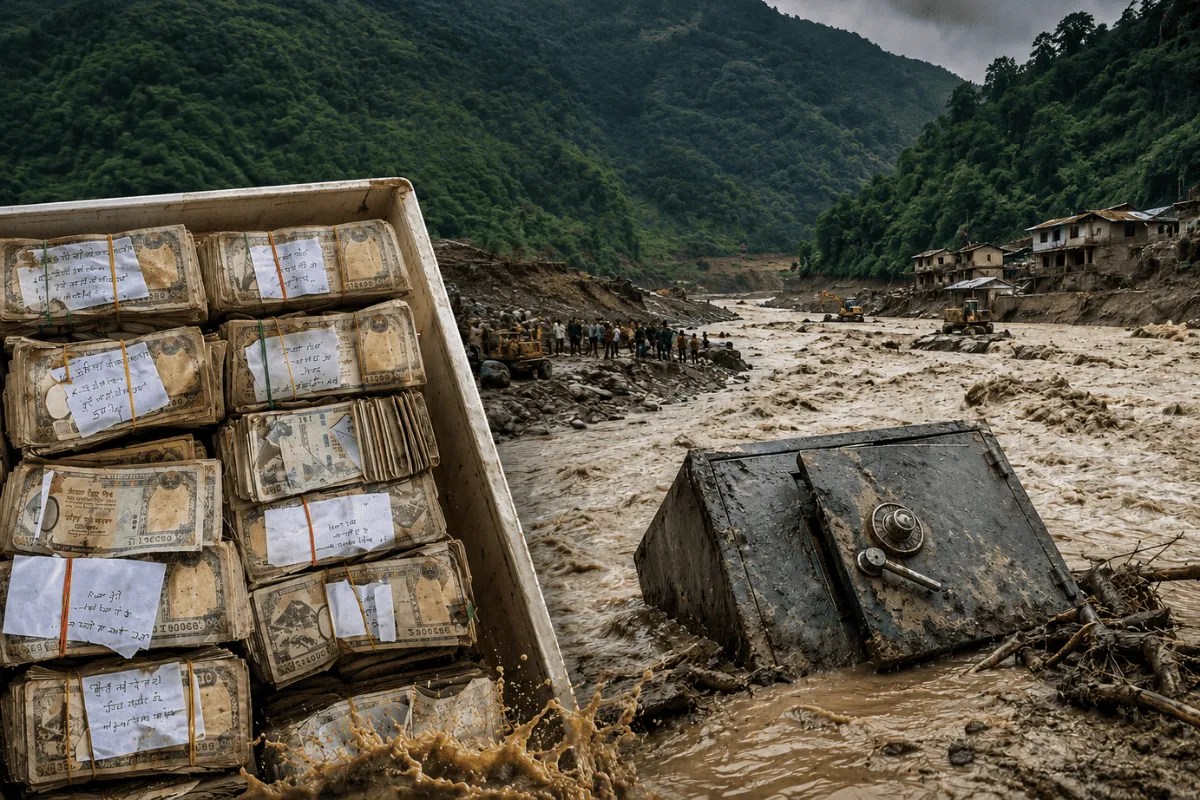
Catastrophic hydrological events do not merely destroy infrastructure; they relocate high-value assets across river basins, creating chaotic decentralized distribution points where institutional security fails and opportunistic extraction begins. When extreme glacial outburst floods and monsoon runoff breach mountainous river corridors, the sheer kinetic energy of the water column exerts immense hydrodynamic pressure capable of mobilizing heavy industrial fixtures over dozens of kilometers.
The movement of a commercial bank safe from the upper Rasuwa district down to the banks of the Trishuli River in the Dhading district illustrates a profound failure in disaster asset containment. This incident, which resulted in the detention of 29 individuals and the recovery of 92.68 million Nepali rupees, exposes the systemic vulnerabilities inherent in post-disaster logistics, institutional chain of custody, and crowd psychology under conditions of resource scarcity.
The Hydrodynamic Transport Mechanism
Understanding how a heavily secured steel receptacle travels miles downstream requires examining the specific physics of flash floods originating in steep alpine terrain. When the Bhotekoshi river system experiences sudden volume spikes due to upstream glacial destabilization or heavy precipitation, the flow regime transitions from subcritical to hyper-turbulent debris flow.
- Kinetic Energy Multipliers: The fluid density increases dramatically as soil, rock, and organic matter mix with water, multiplying the impact force against stationary objects like structural vaults or branch bank fortifications.
- Lateral Displacement Vectors: As the torrent funnels through narrow mountain gorges into wider riverbeds, secondary eddies and lateral currents push heavy submerged objects toward riverbanks, depositing them in accessible shallows rather than burying them in deep sediment.
- Structural Breach Thresholds: The integrity of a bank locker relies on stationary anchoring systems, concrete reinforcements, and controlled access mechanisms. When extreme hydraulic shear strips these foundational anchors away, the vault becomes an unmoored container subject entirely to the velocity profile of the river.
The Social Dynamics of Asset Scavenging
The discovery of the displaced vault on the banks of the Trishuli River triggered an immediate breakdown of social order, transitioning rapidly from an accidental finding to coordinated extraction. In macro-economic terms, catastrophic disasters instantly deflate the local availability of currency and essential goods, creating localized hyper-scarcity.
When residents from areas such as Galchhi and Siddhalek encountered the breached safe, the immediate incentive structure favored rapid appropriation over institutional reporting. The demographic profile of the 29 detained individuals, spanning ages 19 to 49, indicates a broad cross-section of local economic actors rather than organized criminal syndicates. This behavior aligns with game-theoretic models of commons tragedies during state failure: when property rights enforcement mechanisms collapse due to overwhelmed emergency services, the marginal utility of acquiring unsecured capital drastically outweighs the perceived risk of delayed law enforcement intervention.
Institutional Response and Forensic Recovery
Law enforcement agencies faced a dual operational burden: managing active search and rescue operations for thousands of missing persons while simultaneously establishing forensic control over illicitly distributed capital. The recovery operation yielded precisely 92,68,505 Nepali rupees—equivalent to roughly 58 million Indian rupees—distributed across multiple local custodians.
- Chain of Custody Reconstruction: Investigators must systematically trace the recovered notes back to specific institutional serial numbers recorded by the originating bank branch in Rasuwa, separating legitimate salvage claims from unlawful appropriation.
- Jurisdictional Overload: Local police units were simultaneously forced to deploy resources to secondary moral degradation incidents, such as opportunistic thefts from deceased flood victims in downstream basins like the Narayani River, highlighting the complete exhaustion of municipal security apparatuses.
Operational Vulnerabilities in Emergency Banking Infrastructure
The transport and subsequent looting of the Rasuwa bank locker point to critical design flaws in financial risk management protocols for high-risk flood zones. Standard disaster recovery plans for financial institutions focus on digital data redundancy and vault fireproofing, but they consistently underestimate hydrodynamic displacement risks.
Financial institutions operating in high-gradient Himalayan watersheds must re-engineer asset placement strategies. Vault architecture must incorporate deep bedrock subterranean anchoring or automated geofencing transponders that allow real-time tracking of heavy assets during catastrophic hydrological displacement. Without these structural upgrades, future extreme weather events will continue to transform institutional reserves into decentralized liquid windfalls, testing the limits of civil obedience when state infrastructure is paralyzed by natural disaster.