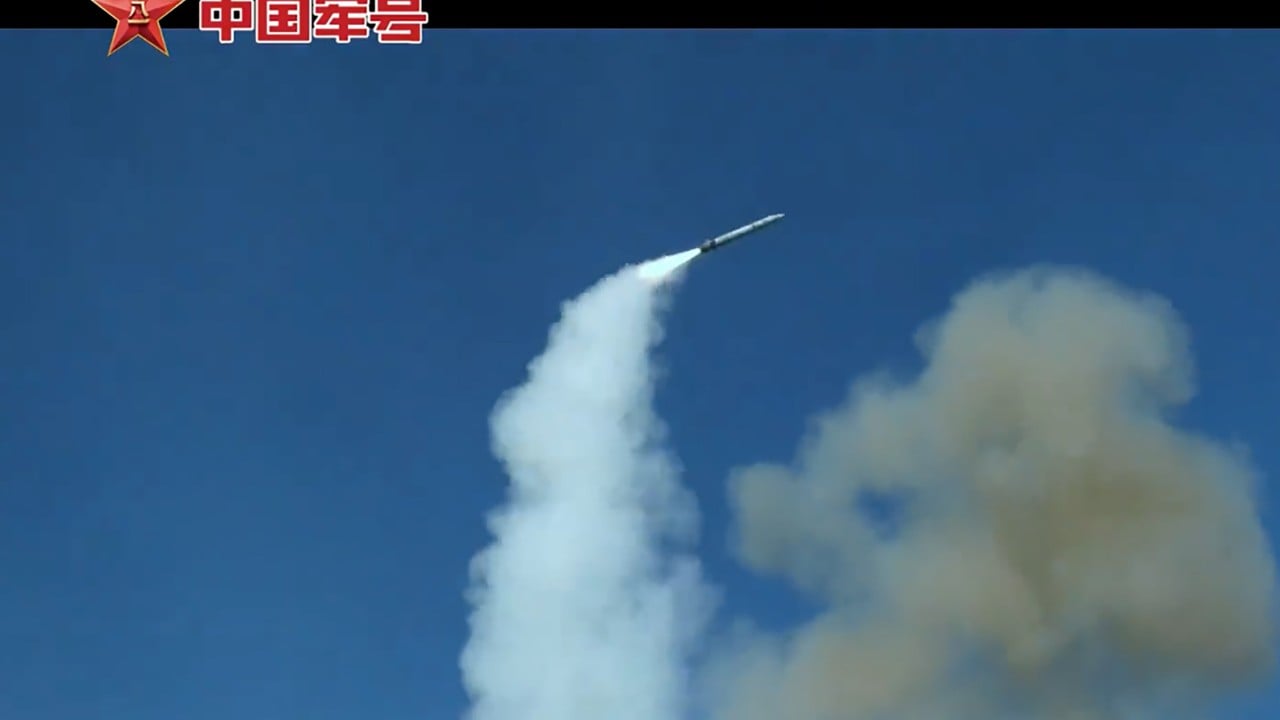
The People's Liberation Army Navy has quietly erased the exclusivity of its heavy maritime strike architecture. When state media broadcast footage of a Type 052D destroyer launching the YJ-20 hypersonic anti-ship missile, naval analysts tracking the Western Pacific witnessed a fundamental tactical pivot.
For years, military intelligence assumed that shipborne hypersonic weapons—specifically the massive anti-ship ballistic missiles capable of threatening high-value surface combatants—would remain restricted to elite, oversized hulls. Those assumptions are now obsolete. By pushing its premier carrier-killer down to a 7,500-ton general-purpose destroyer, Beijing has transformed a boutique strategic capability into a distributed, mass-producible surface warfare hazard.
The Weight Class Fallacy
Military analysts often obsess over raw tonnage. The rationale is simple: bigger ships carry bigger power plants, larger radars, and heavier munitions boxes.
When the 13,000-ton Type 055 cruiser first demonstrated the ability to fire these high-end hypersonic systems, defense planners categorized the weapon as a specialized heavy-cruiser attribute. It required a massive hull to absorb the volumetric footprint of an extended-range ballistic system. Or so conventional wisdom dictated.
The Type 052D displaces roughly half that weight. It is a workhorse, not a capital ship designed to anchor a multi-vessel strike group. Yet its universal vertical launch system cells have proven capable of accommodating the cold-launched YJ-20.
This decoupling of heavy weaponry from heavy displacement changes the mathematics of naval deployment. China has built dozens of Type 052 hull variants. They patrol the Taiwan Strait, push deep into the South China Sea, and operate routinely across the Philippine Sea.
Multiply a strategic strike package across forty-plus routine hulls, and the defensive problem facing opposing fleets multiplies exponentially.
Engineering the Cold Launch
To understand why this shift matters, look at the physics of the vertical launch system.
Heavy ballistic and aero-ballistic weapons require significant expulsion energy to clear a ship's deck safely before their rocket motors ignite. A hot-launch system—where the missile fires its own primary motor inside the cell—places severe thermal and structural stress on the surrounding launcher infrastructure.
The YJ-20 utilizes a cold-launch canister mechanism, ejecting the missile clear of the platform using compressed gas or a localized ejection charge before ignition occurs safely in open air.
This engineering choice is the enabler. By cold-launching from the universal cells of a smaller destroyer, the platform avoids the catastrophic thermal damage that would otherwise warp delicate superstructure electronics or overstress a compact deck layout.
The missile itself relies on a boost-glide or high-speed aero-ballistic trajectory, achieving terminal speeds exceeding Mach 6, with estimates pointing toward terminal phases approaching Mach 10. At those velocities, kinetic energy alone ensures severe structural damage to an adversary's carrier or amphibious assault ship, even before factoring in conventional warhead detonation.
Distributed Lethality and the Targeting Dilemma
Naval warfare traditionally relies on tracking the heavy hitters. If an adversary knows which specific cruisers or submarines carry long-range strategic strike assets, defense networks can prioritize those high-value signatures during an engagement.
Spreading the YJ-20 across the Type 052D fleet breaks that calculus.
Consider a hypothetical scenario in a contested regional flashpoint. An opposing carrier strike group operating within the First Island Chain can no longer afford to treat a standard destroyer escort as a secondary threat limited to localized air defense and anti-submarine sweeps. Every single hull stamped out of Shanghai and Dalian shipyards now carries an equivalent strategic deterrence vector.
Targeting architecture shifts from tracking a distinct class of capital ships to assuming every gray hull on the horizon poses an immediate, multi-hundred-mile anti-surface threat.
The defense industrial base advantage is equally stark. Heavy cruisers take years to provision, wire, and field. They are expensive, prestige assets that a navy protects fiercely. Destroyers of the Type 052 series are built in parallel across multiple shipyards with assembly-line efficiency.
When a military scales up its most lethal offensive armament by mating it to the most numerous medium-weight destroyer in its inventory, it signals an industrial transition from experimental parity to volume dominance.
The Radar Horizon Reality
Placing a hyper-velocity weapon on a smaller ship introduces inherent compromises that promotional state media rarely advertise.
A missile with a claimed range exceeding one thousand kilometers requires targeting data far beyond the horizon of the launching ship's own radar suite. The Type 052D carries advanced active electronically scanned array systems, but tracking moving targets at extreme maritime distances demands an external kill chain—airborne early warning aircraft, maritime patrol drones, over-the-horizon surface wave radars, or satellite constellations.
The destroyer is merely the final punctuation mark in a vast, integrated reconnaissance-strike complex.
If the data network feeding coordinates to the destroyer suffers severe electronic attack or kinetic disruption, the raw launch capability of the ship is functionally blinded. Massing the missile across forty hulls does not solve the underlying physics of target acquisition at extreme ranges. It merely provides more delivery mechanisms for an information network that must remain unbroken under heavy combat conditions.
Yet, ignoring the structural reality of this deployment pattern is a tactical error. The Chinese navy is not building a showcase fleet of isolated flagships; it is engineering a redundant, highly distributed surface combat arm where lethal assets are interchangeable across hull sizes.
The strategic monopoly of the heavy cruiser is finished. The future of long-range maritime strike belongs to whichever fleet can cram high-velocity deterrence into its most common denominators.

/GettyImages-157526585-93425538070d4422ad42d22af28c0758.jpg)