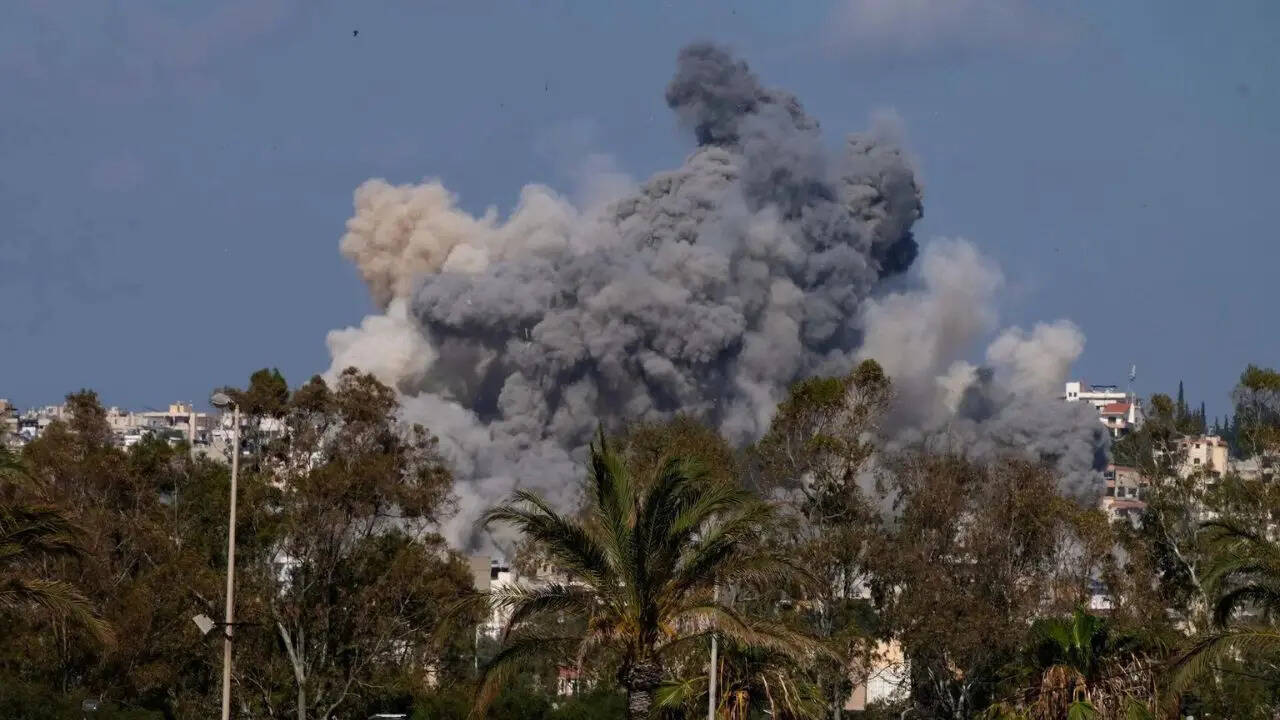
The Islamic Revolutionary Guard Corps recently declared a series of retaliatory strikes against American installations in the Persian Gulf, accompanied by warnings of an expanded military campaign. This escalation follows months of subterranean friction, highlighting the fragility of security frameworks in the world's most critical energy corridor. While official communiqués from Washington downplay the operational impact of these actions, the strategic reality tells a different story. The current framework of containment is breaking down under the weight of asymmetric pressure.
Western security strategies have long rested on the assumption that conventional military superiority acts as an absolute shield. That assumption is proving false. By utilizing low-cost, deniable mechanisms of friction, regional actors can disrupt global trade and alter diplomatic calculations without triggering a full-scale conventional response. Understanding this shift requires looking past the immediate rhetoric of state media and analyzing the specific operational realities that govern the waters of the Middle East.
The Strategy of Managed Friction
The geography of the Persian Gulf favors the practitioner of asymmetric naval warfare. It is a confined body of water, shallow in many sectors and highly congested with commercial shipping. Standard naval doctrines built around large carrier strike groups face inherent geometric constraints in these narrow passages.
Iran has spent three decades optimizing its forces for this specific environment. Rather than attempting to build a blue-water navy capable of matching Western fleets hull for hull, the state focused its resources on a triad of capabilities consisting of anti-ship cruise missiles, fast attack craft, and unmanned aerial vehicles. These assets are cheap to manufacture, easy to conceal along the rugged coastline of the Zagros Mountains, and highly lethal when deployed in dense swarms.
The recent operations demonstrate a deliberate calibration of force designed to expose vulnerabilities without crossing the threshold that would mandate a devastating counter-offensive. This is managed friction. By targeting specific facilities or tracking vessels with precision, the forces demonstrate their reach while leaving a diplomatic exit ramp available for all parties.
The Economic Chokepoint and Global Markets
At the center of this geopolitical friction sits the Strait of Hormuz. A narrow waterway through which roughly one-fifth of the world’s petroleum consumption passes daily, the strait represents a critical vulnerability for the global economy.
When tensions rise in this sector, the consequences extend far beyond the immediate military theater. Insurance underwriters immediately recalculate risk premiums for commercial vessels operating in the region. These added costs ripple through global supply chains, ultimately manifesting as increased prices at fuel pumps and manufacturing plants worldwide.
The true objective of these harassments is often economic coercion rather than outright military destruction. By proving that they possess the capability to halt or significantly restrict the flow of energy products, regional actors gain substantial leverage in international negotiations. They demonstrate that the cost of maintaining a hardline diplomatic stance against them includes systemic economic instability for the West.
The Limits of Conventional Air Defense
Modern naval vessels and military installations are equipped with highly sophisticated air defense systems designed to intercept incoming threats. However, these systems face a mathematical problem when confronting saturation attacks.
An advanced interceptor missile can cost millions of dollars to produce and requires a sophisticated logistics chain to replace. Conversely, a loitering munition or a small attack drone can be assembled for a fraction of that cost using commercially available components. When dozens of these cheaper assets are launched simultaneously, they can overwhelm radar tracking capabilities and deplete the magazine capacity of defending forces.
Furthermore, the short distances involved in the Gulf mean that reaction times are reduced to minutes or even seconds. A missile launched from a coastal battery near Bandar Abbas can reach shipping lanes in the strait almost instantly. This proximity reduces the effectiveness of early warning networks and places immense psychological strain on personnel stationed aboard vessels or at exposed littoral facilities.
Proxy Networks and Blurred Attribution
A foundational element of regional strategy involves the deployment of non-state actors across multiple theaters. By transferring technology and operational expertise to various groups throughout the region, a network of distributed capability is established.
This distribution serves two primary purposes. First, it complicates the task of military planners who must decide where to direct retaliatory measures following an incident. If a strike originates from an unaligned faction using manufactured hardware, assigning direct state responsibility becomes legally and politically complex.
Second, this network provides geographic depth. An adversary attempting to contain a threat in the Persian Gulf may suddenly find themselves facing parallel challenges in the Red Sea, the Levant, or the Gulf of Oman. This multi-front reality dilutes the concentration of defensive assets and forces Western powers to distribute their surveillance and strike capabilities across a vast, unstable geography.
The Flaw in Current Deterrence Doctrine
The persistent recurrence of these clashes reveals a deeper conceptual failure in Western deterrence doctrine. For deterrence to function effectively, the threat of retaliation must be credible, and the cost imposed must outweigh the benefit gained by the challenger.
In the context of asymmetric confrontation, this calculus breaks down. Western nations are hesitant to employ massive conventional force in response to minor provocations because they fear triggering a wider regional conflagration that could close the shipping lanes entirely. The challenger recognizes this hesitation and operates with relative impunity within the zone just below the threshold of open warfare.
Consequently, periodic deployments of additional naval assets or public declarations of resolve rarely achieve permanent stability. They provide a temporary pause in hostilities but fail to alter the underlying strategic calculations that drive the confrontation. The cycle of friction, escalation, temporary de-escalation, and renewed provocation remains unbroken.
The Realities of Regional Alignments
The shifting dynamics of global politics have also altered the regional landscape, introducing new variables that complicate traditional security arrangements. Historical partnerships that once guaranteed stable operational environments are undergoing significant reassessment as regional capitals seek to diversify their diplomatic options.
Many states bordering the Gulf are no longer willing to rely exclusively on Western security guarantees. They are actively pursuing diplomatic normalization with historical rivals while simultaneously strengthening economic ties with major energy consumers in Asia. This diversification reduces the effectiveness of international sanctions regimes and provides regional actors with alternative avenues for economic survival and political legitimacy.
As these alternative alignments solidify, the ability of Western nations to organize cohesive international coalitions to counter regional provocations diminishes. Countries that depend on stable energy imports are often more inclined to favor quiet diplomacy and accommodation rather than participating in measures that could lead to open conflict.
Operational Readiness in a High Threat Zone
For the personnel stationed at installations throughout the region, the threat environment requires constant vigilance and continuous adaptation of defensive postures. Base infrastructure must be hardened against indirect fire, and personnel must train constantly to counter unexpected asymmetric incursions.
The challenge is not merely technological but also structural. Traditional military hierarchies and procurement cycles are often too slow to adapt to the rapid iterations of drone and missile technology observed in the field. While a state military might take years to field a new defensive system, asymmetric actors can modify their tactics and software in a matter of weeks based on real-world performance data.
This agility gap presents a constant challenge for forces on the ground. Maintaining operational readiness means anticipating the next tactical evolution rather than simply preparing to counter the methods used in the previous engagement.
The Failure of Economic Insulation
Attempts to insulate the global economy from these localized disruptions through the construction of bypass pipelines have yielded mixed results. While facilities exist to transport crude oil across the Arabian Peninsula to ports on the Red Sea, these alternative routes possess finite capacity and are themselves vulnerable to interdiction by regional proxy networks.
Furthermore, the global nature of commodity pricing means that an interruption anywhere within the supply network influences prices everywhere. Even if a specific nation does not import a single barrel of oil through the Strait of Hormuz, its domestic economy remains bound to the global market price, which reacts instantaneously to any perceived threat to shipping security.
The concept of complete energy independence or total insulation from Gulf security crises is an illusion. The interconnectedness of modern financial and resource markets ensures that stability in these waters remains a matter of direct national interest for every industrialized society.
The Path of Permanent Friction
The situation in the Persian Gulf is unlikely to resolve through a decisive military victory or a comprehensive diplomatic breakthrough. The underlying structural drivers of the conflict—geographic constraints, ideological imperatives, and the economic value of the chokepoints—are too deeply entrenched.
Instead, the region faces a future characterized by permanent friction. This environment demands a shift in mindset away from the expectation of absolute security and toward the management of persistent risk. Success in this environment will not be measured by the total elimination of threats, but by the ability to maintain operational resilience and economic stability in the face of continuous, calculated provocations.
Military deployments must become more agile, focusing on distributed defense networks and cost-effective counter-drone measures rather than relying solely on high-cost conventional platforms. At the same time, diplomatic strategies must recognize that the leverage held by regional actors is a permanent feature of the geography, one that cannot be wished away by declarations of strength or temporary deployments of naval power. The contest for influence and security in these waters is an enduring struggle, where the rules are written not by the party with the largest fleet, but by the one best able to endure and exploit the gray zone of conflict.