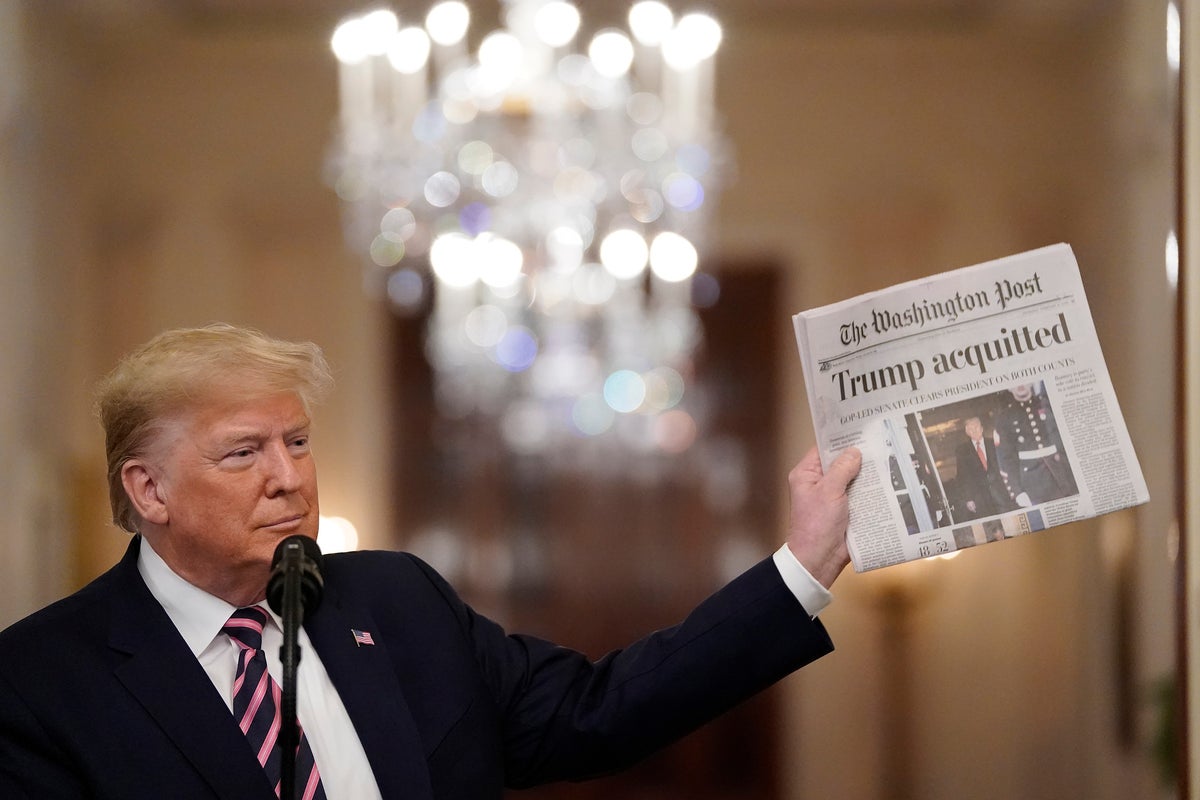
Donald Trump wants his record clean. The current push by the president and his congressional allies for a House resolution to void his two first-term impeachments is a direct attempt to rewrite the historical ledger. Speaker Mike Johnson confirms that leadership has engaged in serious discussions regarding an "expungement" measure, framing the 2019 and 2021 impeachments as hyperpartisan sham operations. Yet, the constitutional reality remains unyielding. Congress possesses no mechanism to legally erase an completed impeachment vote. Once the House passes articles of impeachment, they become an indelible constitutional act, followed by a mandatory trial in the Senate.
This legislative maneuver is not a legal tool, but a high-stakes exercises in political messaging. Because the Senate acquitted Trump in both instances, the impeachments carry no ongoing legal penalties to overturn. A successful resolution will not change constitutional law, alter the past, or scrub the National Archives. It functions as a formal declaration of party loyalty, designed to challenge the legitimacy of the historical record itself.
The Myth of Legislative Erasure
The core argument put forward by Trump and his defenders rests on a fundamental misunderstanding of congressional record-keeping. The Constitution grants the House the "sole Power of Impeachment" under Article I, Section 2. It does not, however, grant the House the power of retroactive retraction.
Legal scholars across the political spectrum have noted that an impeachment is not an administrative blemish that can be expunged like a juvenile criminal record. It is a historical event. When the House voted to impeach in 2019 over the Ukraine controversy, and again in 2021 following the events of January 6, it triggered a constitutional mechanism that immediately moved the matter to the Senate.
[House of Representatives: Votes to Impeach]
                   │
                   ▼
[Constitutional Record Established] ──► [Senate Trial Conducted]
                   │
                   ▼
[Expungement Resolution: Symbolic Only (Cannot Undo Past Proceedings)]
The House cannot reach back into a previous legislative session and pretend a structural interaction with the Senate never occurred. To assert that a simple resolution can make these events vanish "as if such Articles had never passed" is to misunderstand how the machinery of the state operates.
The Broken Precedent of Andrew Jackson
Proponents of the resolution frequently point to the 1837 expungement of President Andrew Jackson’s censure as historical precedent. This comparison fails under close scrutiny.
In 1834, the Whig-controlled Senate censured Jackson over his removal of federal deposits from the Bank of the United States. Three years later, a newly dominant Democratic majority voted to physically draw black lines around the censure resolution in the Senate journal, declaring it expunged.
The critical distinction lies in the nature of the action. A censure is a unilateral, non-binding expression of disapproval by a single chamber. It is not mentioned in the Constitution. Impeachment, conversely, is a explicit constitutional process requiring distinct actions from both houses of Congress. The House acts as the grand jury; the Senate acts as the court. A later House cannot unilaterally dissolve a process that required the participation of the upper chamber, nor can it invalidate the subsequent Senate trials.
The Political Mathematics of the House floor
While the legal theory behind expungement is hollow, the political calculation is very real. Speaker Johnson has indicated that while the resolution is on his agenda, it is unlikely to see floor action until after the upcoming November elections.
The delay reveals the fragile reality of the current Republican majority. Passing such a resolution requires a unified front, yet several moderate Republicans facing tough reelection bids in competitive districts view the vote as a political liability. Forcing vulnerable members to vote on a controversial, purely symbolic measure right before an election risks fracturing the party’s narrow control of the lower chamber.
┌───────────────────────────────────────────────────────────┐
│              The Expungement Dilemma                      │
├─────────────────────────────┬─────────────────────────────┤
│ Proponents' View            │ Moderates' Reality          │
├─────────────────────────────┼─────────────────────────────┤
│ • Validates executive claim │ • Vulnerable in swing seats │
│ • Solidifies party loyalty  │ • Reopens polarizing debates│
│ • Rebukes past opposition   │ • Offers no policy gains    │
└─────────────────────────────┴─────────────────────────────┘
For Trump, the timing serves a different purpose. By keeping the issue alive in conversations with leadership, he maintains pressure on his legislative conference to reinforce his narrative of total vindication. The effort coincides with his ongoing legal battles to overturn his New York state court conviction, signaling a coordinated strategy to systematically challenge any official institutional rebuke of his conduct.
The Weaponization of the Congressional Record
If passed, an expungement resolution would enter the Congressional Record not as a deletion of history, but as an addition to it. The original votes, the floor debates, and the transcripts of the Senate trials would remain fully intact within the official annals of government.
The true target of this initiative is the public consciousness. In a media ecosystem driven by competing narratives, the word "expunged" provides a powerful rhetorical shield. It allows surrogates to argue that the historic stigma of a double impeachment has been formally repudiated by the United States government.
This represents a broader trend in modern governance where legislative tools are used primarily for narrative curation rather than policy creation. When the business of Congress shifts from passing statutory law to editing historical perceptions, the line between governance and public relations disappears entirely. The resolution cannot change the past, but it can reshape the terms of future political combat.
The push to void the impeachments demonstrates that in contemporary politics, history is viewed as a draft that can be edited by whoever holds the majority. The fight is not over a legal remedy, because no legal remedy exists. It is a battle for the definitive archive, waged with symbolic votes that leave the constitutional architecture completely unchanged.


