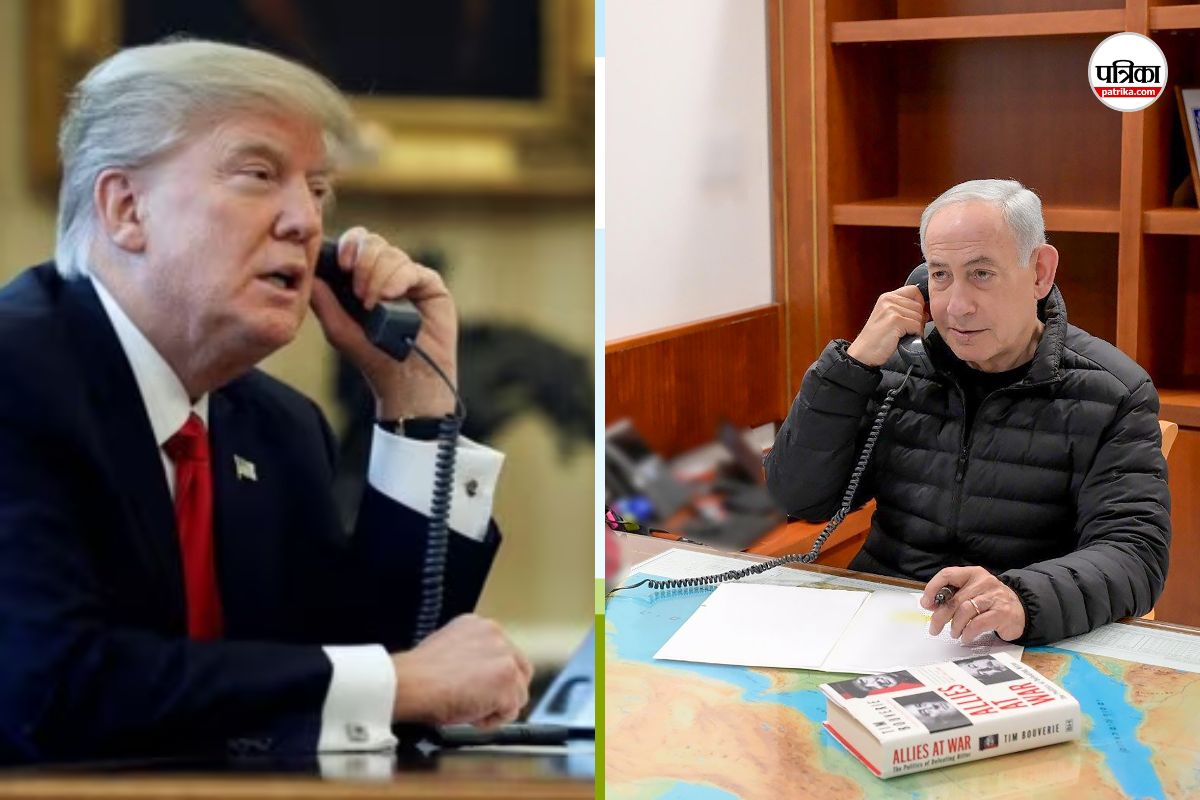
Mainstream newsrooms love a good melodrama. They thrive on the image of a chaotic global theater where a single phone call from Washington can halt the gears of war. The latest headline tracking an alleged "emergency call" from Donald Trump to Israeli Prime Minister Benjamin Netanyahu—warning him not to strike Iran or risk "ending it all"—is a prime example of this lazy, reactive journalism. It frames geopolitics like a reality TV cliffhanger. It assumes global superpowers operate on raw emotion and sudden panic.
It is entirely wrong.
The media consensus wants you to believe that Washington is desperately pulling back an out-of-control Tel Aviv. This narrative misreads the structural realities of the US-Israel alliance, the mechanics of modern deterrence, and the calculated theater of escalation management. Trump is not playing the panicked pacifist. Netanyahu is not acting as a rogue agent. What we are witnessing is not a frantic plea for restraint, but a highly coordinated, strategic division of labor disguised as diplomatic friction.
If you analyze the Middle East through the lens of frantic phone calls and emotional outbursts, you are asking the wrong questions. The real game is about leveraging the threat of unrestrained violence to achieve calculated diplomatic leverage.
The Strategic Myth of the Rogue Ally
The foundational flaw in the current media coverage is the "rogue ally" premise. Mainstream commentators love to paint Israel as a wildcard state dragging a reluctant United States into a regional conflagration. This perspective ignores decades of military integration, intelligence sharing, and strategic alignment.
When a US leader publicly or semi-privately warns Israel against hitting Iran’s critical infrastructure, it serves a distinct tactical purpose. It gives Washington plausible deniability on the global stage, particularly with Gulf Arab partners and European allies. It creates a "good cop, bad cop" dynamic. The United States plays the rational arbiter seeking stability; Israel plays the existential actor willing to take disproportionate risks.
Strategic leverage is not built on predictable diplomacy. It is built on the credible threat of irrational behavior.
By signaling that Trump is holding Netanyahu back, the administration achieves two things simultaneously:
- It signals to Tehran that the only thing standing between them and catastrophic infrastructure destruction is American diplomatic intervention, forcing Iran to negotiate with Washington.
- It allows Israel to maintain maximum deterrence posture without forcing the US into an immediate, unwanted kinetic entry into the conflict.
I have watched defense analysts and beltway pundits misread this dynamic across multiple administrations. They mistake tactical posturing for strategic division. In 2020, during the height of maximum pressure campaigns, the public rhetoric was consistently decoupled from the back-room military coordination. The current news cycle is no different. It is a orchestrated leak designed to manage market expectations and keep adversaries guessing.
The Economics of Deterrence: Why a Total Strike Was Never the Plan
Let us dismantle the premise that an unrestricted, all-out strike on Iran was ever on the immediate table to be stopped by a phone call. Warfare at this level is governed by logistical and economic realities, not impulsive directives.
An unmitigated strike on Iran’s primary energy or nuclear facilities carries immense operational costs and retaliation risks that defense planners calculate months—not hours—in advance.
| Target Type | Immediate Operational Risk | Global Economic Ripple Effect | Strategic Outcome |
|---|---|---|---|
| Nuclear Facilities (Fordow/Natanz) | Deeply buried targets; requires massive ordnance and sustained campaigns. | Minimal immediate commodity shock, high long-term escalation. | Delays program but solidifies domestic resolve for a weapon. |
| Energy Infrastructure (Kharg Island) | Vulnerable to conventional strikes; high success probability. | Immediate spike in global crude prices; disruption of Strait of Hormuz. | Economic crippling of the regime, but severe blow to Western inflation targets. |
| Military/IRGC Command Nodes | Highly fluid targets; requires precise, real-time intelligence. | Low immediate economic impact; localized retaliation. | Degrades command capability without triggering immediate total war. |
A sudden "emergency call" does not shift these variables. Israel's military calculus relies heavily on American logistical support, specifically refueling capabilities and munitions replenishment. Netanyahu cannot execute a sustained campaign against a regional power like Iran completely in a vacuum. Therefore, the idea that a single warning from Trump "saved the region from total war" ignores the fact that any operational plan was already constrained by what the Pentagon was willing to underwrite.
Dismantling the "What Happens Next" Panic
The public regularly searches for answers to a flawed question: Will a US-Israel disagreement leave Israel vulnerable?
This question assumes that public disagreement equals strategic weakness. The opposite is true. Calculated friction creates strategic ambiguity. When the Kremlin or the Supreme Leader’s office in Tehran looks at Washington and Tel Aviv, they cannot be entirely certain where the red lines actually sit. Is the US truly going to withhold intelligence if Israel pushes too far? Is Trump genuinely willing to cut off defense flows?
This uncertainty is a feature, not a bug, of great power politics.
Consider the historical precedent of the 1981 Osirak strike. Publicly, the Reagan administration expressed shock and temporarily suspended aircraft deliveries to Israel. Privately, the strategic landscape shifted permanently in favor of Western interests, and the bilateral security relationship recovered almost instantly. The public theater of condemnation or restraint is a necessary tax paid to maintain global diplomatic networks.
The Flawed Premise of the Pacifist Trump Narrative
The contrarian truth that partisans on both sides refuse to admit is that Donald Trump’s foreign policy has never been inherently non-interventionist; it is transactional. The media interprets "don't attack" as a sudden shift toward pacifism or fear of escalation.
It is an issue of leverage. Trump prefers deals negotiated from positions of overwhelming asymmetry. A premature Israeli strike that locks the region into an unpredictable escalatory spiral ruins the transaction. It spends military capital before the political bargaining even begins.
Trump's warning to Netanyahu isn't about avoiding war because war is bad. It is about preserving the threat of war as an active asset. Once you launch the missiles, the leverage is spent. You are then at the mercy of kinetic momentum and operational friction. The threat of destruction is always more useful at the negotiating table than the smoking ruin.
The Real Risk Everyone is Ignoring
If the conventional worry—that Israel will ignore the US and spark World War III—is wrong, what is the actual risk?
The real danger is miscalculation born from believing your own public relations. When leadership structures rely too heavily on public theater to project deterrence, the risk of an adversary calling the bluff increases exponentially. If Tehran genuinely believes that Washington has completely tied Netanyahu's hands, they may miscalculate and launch an aggressive gray-zone operation, assuming Israel cannot or will not respond due to American pressure.
This is the downside of the contrarian approach to strategic ambiguity. When you perform restraint too convincingly for the international press, your adversary might actually believe you.
Stop reading the transcripts of leaked phone calls as if they are genuine transcripts of strategic intent. They are press releases wrapped in diplomatic drama, designed to keep oil markets steady and adversaries off balance. The alliance remains intact, the operational planning continues, and the theater plays on for an audience that insists on seeing a crisis where there is only a calculation.
Go look at the deployment maps of US carrier strike groups and the logistical manifests of ammunition transfers. That is where the real policy is written. The rest is just noise for the front page.