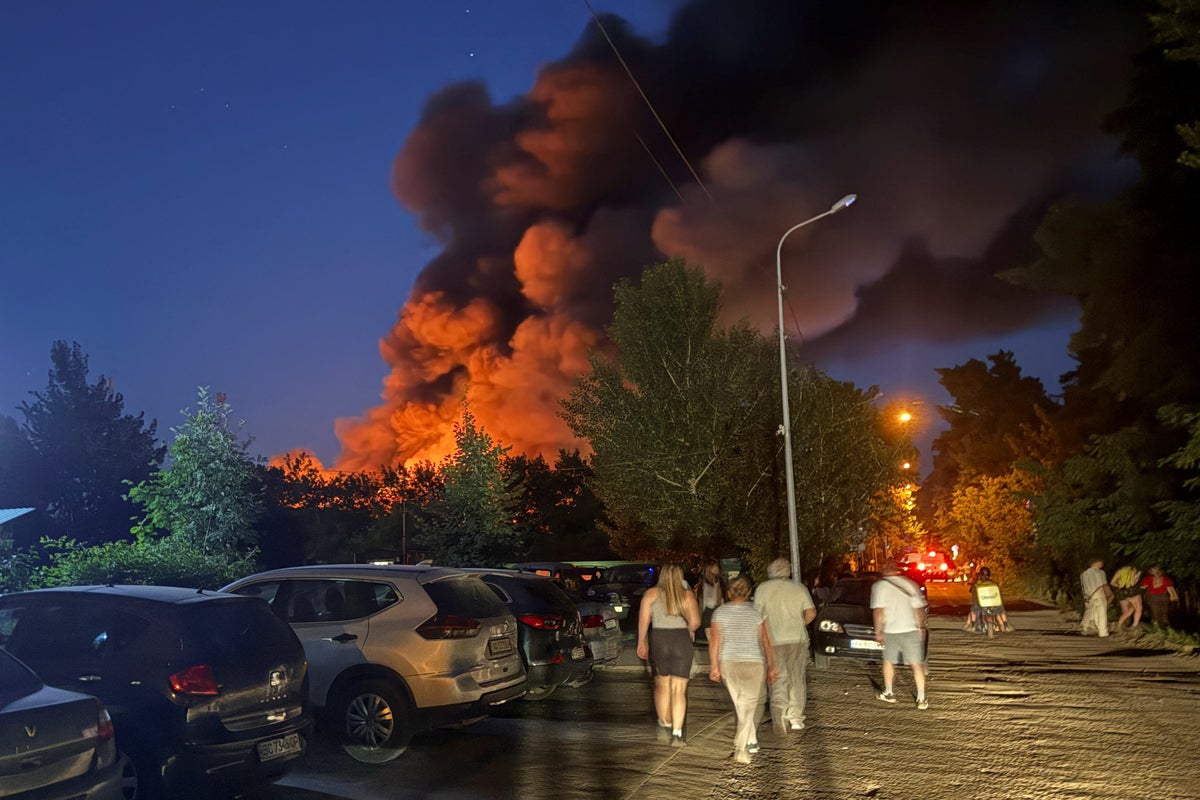
A smoke plume rising over Cheboksary, an industrial city more than six hundred miles from the Ukrainian border, has shattered the carefully managed fiction of Russian domestic security. When Ukrainian tactical assets struck a critical military manufacturing plant deep inside Russian territory, the operation did more than damage a facility that feeds components to Moscow's missile and drone programs. It exposed the stark asymmetry between Russia's front-line aggression and its exposed internal infrastructure. Ukrainian President Volodymyr Zelensky explicitly framed the deep strike as a direct response to Russian diplomatic intransigence, calling on Vladimir Putin to make a tangible move toward peace or face the systematic dismantling of his war economy from within.
This operation represents a calculated pivot in the attrition strategy. For over four years, the conflict remained largely contained within Ukrainian borders, defined by grueling trench warfare and devastating missile barrages against Ukrainian civilian infrastructure. Now, Kyiv is systematically executing a long-range campaign designed to bring the direct economic and material costs of the war home to the Russian public and its political elite. The striking element of the Cheboksary raid was the weapon itself: an indigenous Ukrainian missile system known as the Flamingo, demonstrating that Kyiv no longer relies solely on Western-supplied weaponry or simple loitering munitions to hit high-value targets deep inside the Russian interior.
Shifting the Geography of Attrition
The facility targeted in Cheboksary is not a random target. It serves as a vital node in the supply chain for advanced electronic components, providing the specialized wiring, relays, and guidance circuitry required for Russia’s precision-guided munitions. By disrupting production at this specific facility, Ukraine is targeting the structural bottlenecks within the Russian defense ministry's industrial base.
Military industrial complexes depend heavily on specialized manufacturing hubs that cannot be easily replaced or relocated. When a facility hundreds of miles from the combat zone is damaged, the secondary effects ripple across multiple assembly lines. Rocket engines require highly specific components; drone guidance systems require precise microprocessors and specialized sensors. By picking apart these specific targets, Ukraine is exploiting a vulnerability that Russia cannot easily fix with its current air defense posture.
Moscow has spent decades organizing its air defense systems around a traditional perimeter model, assuming that any significant threat would come from predictable vectors. The deployment of low-altitude, long-range indigenous systems completely circumvents these defensive nets. To protect every industrial facility, oil refinery, and satellite tracking station between St. Petersburg and the Urals, Russia would have to strip its front-line units of mobile anti-air systems, a choice that would leave its occupied territories highly vulnerable to Ukrainian tactical aviation and drone strikes.
The Mirage of Unilateral Ceasefires
The political theater surrounding this escalation highlights the deep distrust blocking any path to a negotiated settlement. Days before the Cheboksary strike, the Kremlin announced a brief, unilateral ceasefire intended to coincide with traditional victory celebrations in Red Square. Kyiv immediately dismissed the move as a tactical ruse designed to give Russian forces time to regroup, restock front-line ammunition depots, and reposition artillery assets without fear of counter-battery fire.
Historical precedent supports Ukraine's skepticism. Unilateral ceasefires in modern warfare rarely serve as genuine preludes to peace negotiations. Instead, they are frequently used as diplomatic leverage or operational pauses disguised as humanitarian gestures. While Russian state media portrayed the planned pause as an act of goodwill, Russian forces continued their heavy bombardment of logistics hubs in eastern Ukraine, demonstrating that the political rhetoric coming from Moscow has little bearing on operational realities on the ground.
By launching a high-profile strike during this exact window, Kyiv sent an unambiguous message to both the Kremlin and international observers. Ukraine will not accept a frozen conflict on Russian terms, nor will it allow Moscow to dictate the tempo of operations through symbolic diplomatic maneuvers. The strategy is to force a choice: engage in authentic, bilateral negotiations that respect Ukrainian sovereignty, or watch the industrial machinery that sustains the occupation burn.
Western Hesitation versus Indigenous Capability
The development and deployment of the Flamingo missile system marks a crucial turning point in Ukraine’s strategic independence. Throughout the conflict, Western allies have placed strict geographical limitations on the use of long-range weapons like ATACMS and Storm Shadow missiles, fearing that strikes deep inside internationally recognized Russian territory could trigger a wider regional escalation.
These restrictions created a sanctuary for Russian military planners, who could safely accumulate armor, store ammunition, and launch strategic bombers from bases located just beyond the reach of Western-supplied artillery. Ukraine’s response was to build its own long-range strike catalog. By investing heavily in domestic defense industries, utilizing commercial technology alongside salvaged military hardware, Kyiv developed a domestic strike capability that operates completely outside the veto power of foreign capitals.
The political implications are significant. When Ukraine uses its own hardware to strike an industrial target in central Russia, it deprives the Kremlin of its favorite diplomatic counter-argument. Moscow cannot credibly threaten direct retaliation against NATO members when the missiles hitting its factories are stamped with Ukrainian serial numbers and funded by domestic defense initiatives. This reality leaves Russian leadership with fewer escalation options, forcing them to confront the material limitations of their own domestic defense systems.
Economic Fractures in the Russian Rear
Beyond the immediate material damage to the defense plant, these long-range strikes are applying severe pressure to the broader Russian economy. Industrial facilities require specialized labor, stable power grids, and predictable insurance markets to function. When deep strikes become a regular occurrence rather than an anomaly, the structural costs of doing business inside Russia skyrocket.
Consider the domestic energy market. Parallel strikes targeting major natural gas processing plants and oil storage depots have caused localized fuel shortages, forcing the Russian government to implement export bans and ration supplies in sensitive border regions. When an industrial complex is forced to divert resources toward private security, localized air defense arrays, and emergency infrastructure repair, its overall productivity drops.
Furthermore, these actions expose the domestic populace to the realities of a conflict that the state media has spent years downplaying as a distant security operation. When air raid sirens sound in cities like Cheboksary or Voronezh, the psychological barrier separating the civilian population from the front lines dissolves. This shift does not necessarily mean an immediate outbreak of domestic unrest, but it erodes public confidence in the state’s ability to guarantee basic security, creating long-term political vulnerabilities for the regime.
Logistics Bottlenecks and the Infrastructure War
The war has evolved into a competition between logistics networks. Ukraine is focusing its campaign on three distinct categories of targets:
- Micro-electronics and manufacturing plants that produce guidance systems for cruise missiles.
- Energy infrastructure, specifically gas processing facilities that generate export revenue and fuel military transport.
- Military satellite communication centers that coordinate battlefield intelligence and drone operations.
By striking all three pillars simultaneously, Ukraine prevents Russia from concentrating its repair and defense resources. If the Kremlin moves its top-tier air defense systems to protect its energy assets, its manufacturing sectors are left exposed. If it prioritizes the capital city and high-value political targets, the regional supply hubs that feed the front lines become soft targets.
This dilemma is further complicated by the ongoing strain on Russia's transportation network. Moving heavy military hardware across vast distances requires a functioning, uninterrupted railway system and stable logistics nodes. By threatening these nodes from the air, Ukraine forces Russia to adopt inefficient, decentralized supply methods, slowing the arrival of reinforcements to critical sectors like the Donbas and southern Ukraine.
The Diplomatic Deadlock
The diplomatic arena remains deadlocked because the two sides are operating on fundamentally incompatible premises. The current U.S. administration has pushed for a settlement based on existing battle lines, attempting to broker a halt to the fighting through economic pressure and diplomatic mediation. Ukraine has consistently rejected any proposal that requires the formal surrender of territory or fails to provide binding international security guarantees against future aggression.
The Kremlin view is equally rigid. Moscow demands the complete demilitarization of Ukraine and the recognition of its illegal annexations as a prerequisite for formal talks. By launching these deep strikes, Ukraine is attempting to alter Putin’s cost-benefit analysis. The goal is to demonstrate that holding onto occupied Ukrainian territory will cost Russia its own industrial sovereignty over time.
This strategy carries inherent risks. A cornered adversary may choose to escalate through asymmetric means, utilizing cyber warfare against Western infrastructure or increasing the brutality of its long-range attacks against Ukrainian cities. Yet for Kyiv, the risk of inaction is far greater. Allowing Russia to wage a war of attrition from a position of domestic safety would guarantee the gradual exhaustion of Ukraine’s resources. By bringing the fire to the Russian interior, Ukraine is rewriting the rules of the engagement, forcing the Kremlin to face the consequences of its choices.