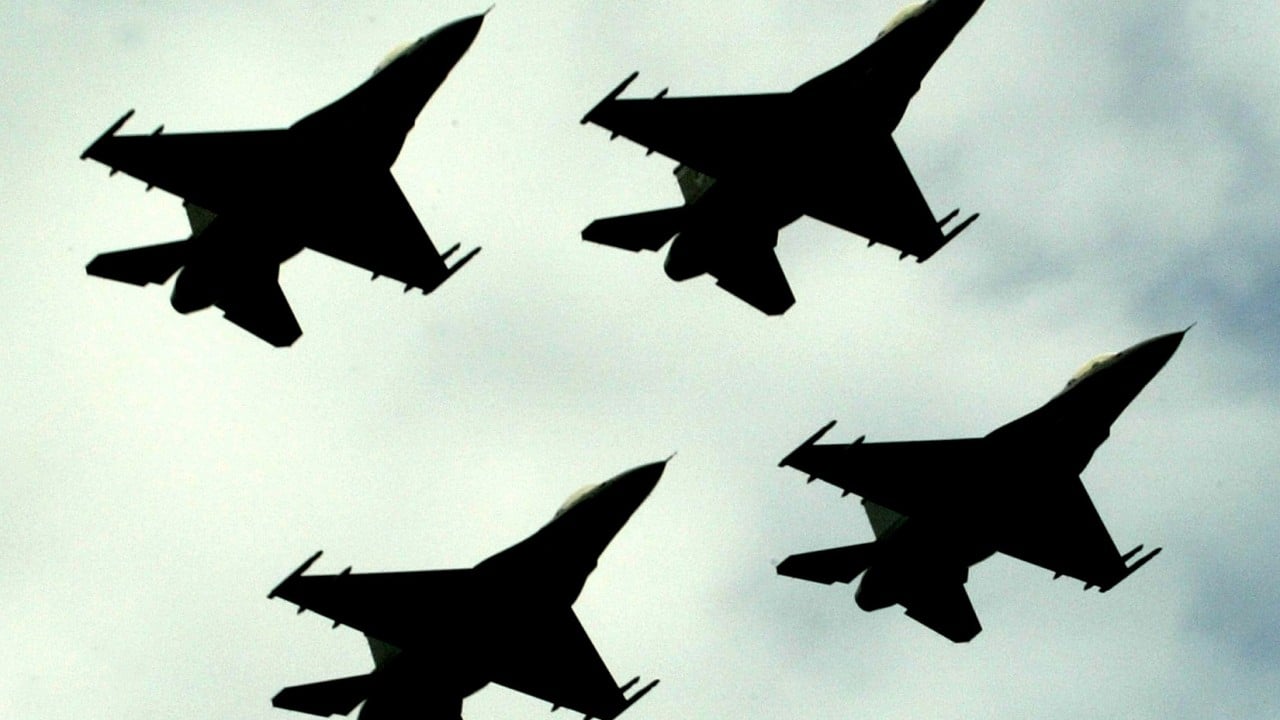
Washington approves a sustainment package for Pakistan’s F-16 fleet, and New Delhi immediately reaches for the fainting couch.
The script is predictable. Every time the Pentagon clears a dime for Islamabad’s aging fighter jets, Indian commentators, former diplomats, and op-ed factories churn out the exact same moralizing outrage. They call it hypocrisy. They accuse the White House of stabbing a Quad partner in the back while funding cross-border terrorism. They frame the transaction as a zero-sum betrayal of the US-India strategic partnership.
That consensus is lazy, emotionally driven, and completely divorced from how defense economics actually works.
If you look past the diplomatic theater, you will find an uncomfortable truth that neither Washington nor New Delhi wants to say out loud. The US is not arming Pakistan to hurt India. Washington is charging Islamabad hundreds of millions of dollars to keep a leash on an unstable nuclear state, prevent Chinese defense contractors from taking over Pakistani airbases, and maintain an intelligence window into the region. More importantly, New Delhi’s public fury isn't rooted in genuine military fear—it is a calculated negotiating tactic designed to extract better technology transfers from American defense giants.
The Sustainment Myth vs. Offensive Capability
Start with the hardware itself, because the public debate treats a routine maintenance contract like a nuclear transfer.
When the US Defense Security Cooperation Agency notifies Congress of a Foreign Military Sales package for Pakistan’s F-16s, headlines scream about "fighter jet upgrades." In reality, these packages—such as the $450 million sustainment deal approved in recent years—cover life-cycle maintenance, structural integrity inspections, spare parts, and cryptographic key updates. They do not include new airframes. They do not include advanced beyond-visual-range missiles like the AIM-120D. They do not include Active Electronically Scanned Array radars.
In military aviation, there is a massive gap between sustainment and modernization. Sustainment keeps a 1980s-era airframe from falling out of the sky during a training sortie. Modernization turns it into a peer-level threat.
I have sat across the table from defense procurement officials in South Asia who privately admit that Pakistan’s F-16 fleet is flying on borrowed time. Without continuous American logistical support—specifically the Technical Security Team stationed inside Pakistan to monitor the jets—those aircraft lose combat readiness within months.
Compare that reality to the Indian Air Force’s current trajectory. India operates 36 Dassault Rafales equipped with Meteor missiles, over 250 Su-30MKIs, and is actively inducting indigenous Tejas Mk1A fighters while negotiating co-production deals for GE F414 jet engines. An aging fleet of roughly 75 Pakistani F-16s—many of which are Block 15 variants from the Cold War—does not alter the conventional military balance in South Asia. Not even slightly.
Why Washington Actually Signs the Checks
If the jets don't change the military balance, why does the US risk diplomatic friction with India to maintain them? The answer comes down to cold, transactional realpolitik.
Washington operates on a simple rule in South Asia: total disengagement from Pakistan creates a vacuum that Beijing fills immediately.
Pakistan’s air force is already heavily dependent on China. The JF-17 Thunder, co-developed by the Pakistan Aeronautical Complex and China’s Chengdu Aircraft Corporation, forms the backbone of Islamabad’s fleet. Pakistan has also inducted the Chinese J-10C, armed with PL-15 long-range missiles, specifically to counter India’s Rafales.
Imagine a scenario where the US cuts off F-16 support entirely. Within two years, Pakistan’s F-16s become expensive hangar queens. Islamabad immediately hands the keys to its premier airbases—like Sargodha and Jacobabad—over to Chinese engineers to replace the lost capacity with more J-10Cs and potentially the stealth J-35.
By keeping the F-16 program alive on a strict sustainment-only diet, the Pentagon achieves three objectives:
- On-the-ground visibility: Under the End-Use Monitoring agreements tied to the F-16 program, US personnel maintain physical access to Pakistani military installations. They track every bolt, every flight hour, and every weapon load. If Washington walks away, that intelligence aperture slams shut.
- Leverage over nuclear delivery: The F-16 is one of Pakistan’s primary platforms capable of delivering tactical nuclear weapons. Keeping those airframes tied to American software, spare parts, and inspection regimes gives Washington a structural veto over how they are deployed.
- Counter-terrorism compliance: Despite the collapse of the US-backed government in Kabul, Washington still relies on Pakistani airspace and intelligence cooperation for over-the-horizon counter-terrorism operations against ISIS-K and Al-Qaeda remnants. You do not get overflight rights from Rawalpindi if you are actively starving their air force of spare parts.
Calling this "double standards" misses the point entirely. Great powers do not have standards; they have interests. Washington’s interest is preventing a total Chinese monopoly over Pakistan’s military infrastructure while keeping a nuclear-armed state from collapsing into complete economic and military desperation.
New Delhi’s Strategic Outrage Machine
Now look at the other side of the equation. If Indian military planners know the F-16s are not a game-changing threat, why does South Block issue sternly worded statements every time a deal is announced?
Because outrage is currency in bilateral negotiations.
India’s Ministry of External Affairs and Ministry of Defence have mastered the art of transactional diplomacy. Whenever Washington makes a move toward Islamabad, New Delhi weaponizes the resulting domestic media firestorm to demand concessions from the US.
Look at the timeline of US-India defense deals over the last decade. Every period of public friction over Pakistan has been followed by accelerated American clearances for India:
- Clearance for MQ-9B SeaGuardian and SkyGuardian armed drones.
- Full transfer of technology agreements for manufacturing GE F414 engines in India—a level of sensitive propulsion tech the US rarely shares even with treaty allies.
- Deepening intelligence sharing through foundational agreements like BECA and COMCASA.
New Delhi’s outrage is not a sign of diplomatic failure. It is a negotiating lever. By publicly accusing the US of hypocrisy, Indian officials force American diplomats to overcompensate to prove their commitment to the bilateral relationship. It keeps Washington on the defensive and drives down the political price India pays for maintaining its own strategic autonomy—such as buying discounted Russian crude oil and operating the Russian S-400 air defense system despite US sanctions threats.
Dismantling the "Zero-Sum" Fallacy
The loudest voices in this debate—on both sides—are trapped in a Cold War mindset. Let's tear down the three most common myths driving this narrative.
Myth 1: The US is "funding" Pakistan’s military
The reality: Pakistan pays for these packages out of its own national treasury. Foreign Military Sales (FMS) are not foreign aid. When the US approves a $450 million sustainment package, Islamabad has to wire $450 million to American defense contractors like Lockheed Martin and Pratt & Whitney. In a country teetering on the edge of sovereign default and begging the IMF for bailout tranches, forcing Pakistan to spend scarce foreign exchange reserves on spare parts actually drains resources away from its offensive procurement budget.
Myth 2: F-16s are exclusively used for terrorism against India
The reality: The US State Department justifies these packages under counter-terrorism operations, which triggers endless mockery in New Delhi. Yes, Pakistan used F-16s during the February 2019 Balakot skirmish against the Indian Air Force. That was a direct violation of the spirit of US end-use agreements, even if Washington never formally penalized Islamabad for it. However, Pakistan has also flown thousands of F-16 sorties in Khyber Pakhtunkhwa and Balochistan against the Tehrik-i-Taliban Pakistan (TTP). Both things are true simultaneously. Pretending the jets sit idle until an India crisis erupts is factually false.
Myth 3: Washington has to choose between India and Pakistan
The reality: Washington already chose. The US National Security Strategy explicitly identifies India as a major defense partner and a vital counterweight to China in the Indo-Pacific. Pakistan is not even in the same strategic category. Washington treats India as a rising global power to be integrated into Western supply chains and defense ecosystems. It treats Pakistan as a localized security problem to be managed and contained. Confusing crisis management in Islamabad with strategic alignment is a rookie analytical error.
The Real Threat New Delhi Should Worry About
While Indian television panels spend hours hyperventilating over 40-year-old American jets in Pakistan, they routinely ignore the actual shift happening across their northern and western borders.
The real danger to Indian air superiority is not the F-16. It is the deep, structural integration between the People’s Liberation Army Air Force (PLAAF) and the Pakistan Air Force (PAF).
Over the past five years, China and Pakistan have conducted joint exercises like Shaheen where pilots train on shared data links, integrated air defense networks, and unified command-and-control protocols. When Pakistan buys Chinese J-10Cs, HQ-9 air defense batteries, and ZDK-03 AWACS aircraft, it is plugging directly into a Chinese kill chain.
In a two-front conflict scenario, a Pakistani radar in Punjab could theoretically feed targeting data to a Chinese missile battery in Tibet, or vice versa. That kind of interoperability is a genuine nightmare for Indian military planners.
An American-built F-16 cannot plug into that Chinese network. The US strictly prohibits any integration of non-NATO hardware or software onto the F-16’s mission computer. In fact, the presence of American F-16s in Pakistan’s inventory actually complicates Islamabad’s ability to standardize its fleet around Chinese architecture. It forces the PAF to maintain two completely incompatible logistical ecosystems, two separate training pipelines, and two distinct doctrine sets.
From a purely cold-blooded strategic perspective, New Delhi should want Pakistan to keep flying F-16s. Every dollar Islamabad spends keeping Lockheed Martin engineers happy is a dollar not spent buying stealth fighters from Chengdu.
The Downside of Cold Realism
Admitting this reality requires acknowledging an uncomfortable flaw in the purely transactional approach to geopolitics: it erodes public trust.
Foreign policy does not happen in a vacuum. When Washington justifies F-16 sustainment as a "counter-terrorism" measure just years after those exact jets tangled with Indian MiGs over Kashmir, it insults the intelligence of the Indian public. That erosion of trust matters. Democratic governments in New Delhi cannot easily sell deeper military alliances with the US to their voters when Washington’s messaging sounds patently dishonest.
Similarly, Washington’s willingness to look the other way on end-use violations sets a dangerous precedent. If Islamabad faces zero consequences for deploying US-monitored aircraft in offensive border skirmishes, the deterrence value of American end-use monitoring drops to zero.
Both governments are guilty of playing a double game. Washington pretends it isn't subsidizing a rival's air force; New Delhi pretends a routine maintenance contract is an existential threat.
Stop Watching the Press Releases
If you want to understand where US-India-Pakistan relations are actually heading, stop reading diplomatic condemnations and start tracking defense supply chains.
Watch the joint ventures between Indian private sector firms—like Tata, Mahindra, and Bharat Forge—and US aerospace primes. Watch the co-development of artillery, armored vehicles, and jet engines. Watch the quiet expansion of US Navy logistics agreements allowing American warships to repair and refuel at Indian shipyards in Chennai and Kochi.
That is the real signal. The outrage over F-16 spare parts is just noise designed to keep domestic audiences entertained while the adults in the room redraw the strategic map of Asia.
New Delhi doesn't need Washington to abandon Pakistan to secure its borders. It just needs to keep doing what it is already doing: using American guilt over Islamabad to buy the keys to the Pentagon's technology vault at a discount.