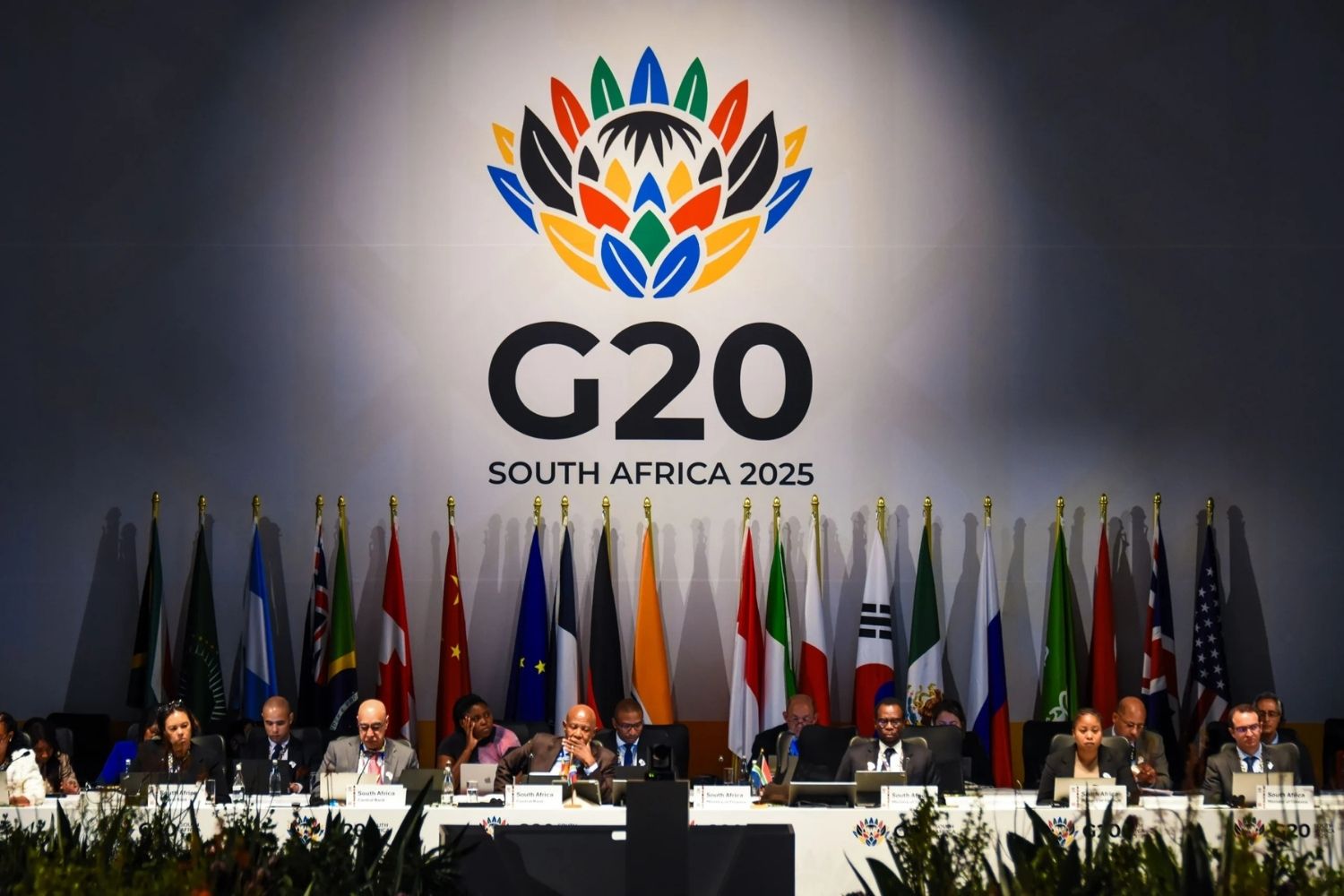
At the G20 Foreign Ministers' Meeting, Indian External Affairs Minister S. Jaishankar drew a hard line in the sand for the Global South. He demanded an explicit right to industrialise and called on developing nations to resist predatory practices within global supply chains. While standard diplomatic coverage treated the remarks as routine multilateral posturing, the statement marks a sharp escalation in a simmering economic cold war. Emerging economies are no longer content serving as raw material quarries or low-margin assembly lines for wealthy nations, and New Delhi is positioning itself as the chief architect of a new, self-reliant industrial order.
To understand why this speech matters, you have to look past the polite handshakes of international summits and examine the ledger books of global trade. For the past three decades, globalization operated on an unspoken, deeply asymmetric bargain. Western consumer markets and advanced East Asian manufacturing hubs outsourced heavy, polluting, and labor-intensive production to the developing world. In exchange, developing nations received foreign direct investment, low-wage employment, and access to cheap consumer goods.
That bargain has collapsed. The COVID-19 pandemic, followed by geopolitical shocks in Eastern Europe and the Middle East, exposed how fragile concentrated supply chains truly are. Suddenly, single-source dependencies became national security liabilities. Wealthy nations responded by pouring hundreds of billions of dollars into domestic subsidies, reshoring critical manufacturing, and erecting green trade barriers.
The Architecture of Predatory Supply Chains
When Jaishankar warned against predatory practices, he was pointing directly at the structural traps baked into modern trade. These practices rarely look like overt coercion. Instead, they manifest through weaponized overcapacity, opaque lending terms, and punitive regulatory standards that lock developing countries out of high-value manufacturing.
Consider how state-backed industrial overcapacity works in practice. When a dominant manufacturing power subsidizes its domestic factories far beyond what global demand can absorb, it floods international markets with artificially cheap goods. For a developing nation trying to nurture its own nascent solar panel, steel, or electronics sector, competing against below-cost imports is a death sentence. Local factories shutter before they can achieve economies of scale. Once domestic competitors are wiped out, the foreign supplier controls the market, dictating prices and supply terms at will.
Then there is the trap of resource extraction without value addition. Across Africa, Latin America, and parts of Asia, foreign entities routinely finance infrastructure projects tied to the extraction of critical minerals like lithium, cobalt, and rare earth elements. The raw ore is dug out of the ground, loaded onto ships, and sent abroad for refining and battery manufacturing. The host country is left with environmental degradation, sovereign debt, and minimal technological transfer, while the vast majority of the economic profit is captured thousands of miles away.
Green Protectionism and the New Trade Walls
The friction between the Global North and the Global South becomes even sharper when climate policy enters the room. Developed economies spent over a century burning cheap fossil fuels to build their highways, power grids, and heavy industries. Now, having achieved high per-capita incomes and service-based economies, many of those same nations are imposing strict carbon border taxes and environmental compliance mandates on imports.
From New Delhi’s perspective, this amounts to kicking away the ladder. A hypothetical steel mill in Odisha or a cement plant in Gujarat cannot decarbonize overnight using expensive, proprietary European green hydrogen technology without pricing itself out of existence. When wealthy blocs penalize imports from developing nations for having higher carbon footprints—while simultaneously failing to deliver on promised climate finance—they effectively tax industrialization in the Global South.
Jaishankar’s insistence on the right to industrialise is a direct rebuttal to this regulatory squeeze. India’s position is straightforward. You cannot lift hundreds of millions of people out of poverty through software exports and agricultural subsidies alone. Mass employment requires factories. Factories require affordable energy, accessible capital, and room to grow without being suffocated by retroactive compliance rules designed for post-industrial economies.
India’s Domestic Playbook in Action
New Delhi is not merely lecturing the G20 from a podium; it is actively rewriting its own industrial policy to break free from external dependencies. Over the past several years, the Indian government has deployed aggressive, targeted interventions designed to force supply chain localization.
The cornerstone of this strategy is the Production Linked Incentive (PLI) scheme. Rather than handing out blank checks, the Indian state offers financial rebates tied strictly to incremental sales of goods manufactured domestically. This policy has targeted fourteen key sectors, including mobile phones, pharmaceuticals, medical devices, specialty steel, and semiconductors.
The results in mobile manufacturing illustrate the mechanics of this shift. A decade ago, India imported the vast majority of its smartphones. By combining tariff adjustments on finished devices with PLI incentives for local assembly and component manufacturing, New Delhi compelled global giants like Apple and Samsung—alongside their vast networks of tier-one and tier-two suppliers—to establish deep manufacturing footprints in states like Tamil Nadu and Uttar Pradesh. India transformed from a net importer into one of the world’s largest exporters of mobile handsets.
Simultaneously, India has moved aggressively to secure the upstream inputs of modern industry. Recognizing its vulnerability in active pharmaceutical ingredients (APIs) and specialty chemicals—where supply chains had become dangerously concentrated in a single neighboring country—the government funded bulk drug parks and chemical clusters. The goal is simple: ensure that no foreign power can paralyze Indian healthcare or manufacturing by turning off a supply valve during a diplomatic dispute.
The Semiconductor Gamble
Nowhere are the stakes of this industrial push higher than in semiconductors. Modern economies run on silicon. Everything from smartphones and electric vehicles to missile guidance systems relies on microchips. Yet, the global semiconductor supply chain is one of the most concentrated and capital-intensive ecosystems ever built, dominated by a handful of players in Taiwan, South Korea, the United States, Japan, and the Netherlands.
India missed the first wave of the semiconductor revolution decades ago due to bureaucratic inertia, erratic power grids, and a lack of capital. Today, New Delhi is spending over ten billion dollars in fiscal incentives to buy its way back into the game. By partnering with established global players to build fabrication plants and assembly, testing, marking, and packaging (ATMP) facilities in Gujarat and Assam, India is attempting to compress decades of industrial evolution into a few years.
Critics rightly point out the immense risks. Semiconductor fabs consume staggering amounts of ultra-pure water and uninterrupted electricity. They require specialized chemical supply chains and a deep bench of experienced process engineers—all areas where India is still building capacity from scratch. Furthermore, subsidizing legacy chips (28-nanometer and above) while global leaders race toward 2-nanometer nodes leaves India vulnerable to rapid technological obsolescence.
Yet, from a strategic standpoint, New Delhi views the financial risk as secondary to the geopolitical danger of total dependency. Even producing mature-node chips domestically insulates India’s automotive, defense, and consumer electronics sectors from global chokepoints.
The Friction Within the Global South
While Jaishankar frequently speaks on behalf of the Global South, assuming a unified front among developing nations is a mistake. Beneath the shared rhetoric against Western protectionism and predatory lending lies fierce competition.
Countries like Vietnam, Indonesia, Thailand, Mexico, and Brazil are hunting for the exact same "China Plus One" manufacturing investments that India is courting. When multinational corporations look to diversify their supply chains, they weigh India’s massive domestic market and engineering talent against Vietnam’s superior port infrastructure, trade agreements, and faster bureaucratic clearances.
Indonesia, meanwhile, has taken an even more aggressive approach to resource nationalism than India. By banning the export of unprocessed nickel ore, Jakarta forced foreign companies—primarily Chinese firms—to build smelters and battery precursor plants directly on Indonesian soil. That policy turned Indonesia into an indispensable link in the global electric vehicle supply chain, though at a heavy environmental and social cost.
India’s challenge is that it lacks the vast mineral reserves of Indonesia or the frictionless export treaties of Vietnam. To win supply chain share, India must rely on the sheer gravitational pull of its 1.4 billion consumers, using market access as its primary bargaining chip. If you want to sell to the Indian middle class, New Delhi argues, you must build in India.
The Infrastructure and Bureaucratic Bottlenecks
Declaring a right to industrialise at the G20 is the easy part. Executing it on the factory floor is infinitely harder, and India’s domestic record reveals significant vulnerabilities that no amount of diplomatic rhetoric can paper over.
For decades, India’s manufacturing sector stagnated at roughly 15 to 17 percent of GDP, failing to absorb the millions of young workers entering the labor force every year. The reasons are deeply structural:
- Logistics Costs: Moving a container from an inland factory in North India to a port has historically cost significantly more than shipping it across the ocean. While massive investments in dedicated freight corridors, expressways, and port modernization are narrowing this gap, last-mile connectivity remains uneven.
- Land and Labor Rigidities: Acquiring contiguous parcels of land for large-scale industrial parks remains a legal and political minefield. Similarly, while the central government consolidated dozens of archaic labor laws into four streamlined codes, implementation across individual Indian states has been sluggish.
- Tariff Dependency: In an effort to protect domestic manufacturers, India raised import duties on a wide range of intermediate components over the last several years. Economists warn that high tariffs on inputs make Indian exports uncompetitive globally. You cannot become a world-class exporter of finished electronics if you tax the imported sub-assemblies needed to build them.
- The R&D Deficit: True industrial sovereignty requires intellectual property, not just assembly lines. India’s spending on research and development hovers below 0.7 percent of GDP—a fraction of what South Korea, China, or the United States invests. Without domestic innovation, factories risk remaining stuck at the low-margin assembly stage.
The G20 as a Battleground for Economic Rules
By bringing these issues to the G20, Jaishankar is attempting to change the rules of engagement before they are permanently codified against developing economies. The G20 was originally elevated to a leaders' summit during the 2008 financial crisis because Western powers realized they could no longer manage the global economy without China, India, Brazil, and other emerging markets.
Today, the forum is paralyzed by geopolitical rivalries. Yet, for India, it remains a vital platform to challenge the dominance of Western-led standard-setting bodies. Whether the topic is artificial intelligence governance, digital public infrastructure, cross-border payment systems, or supply chain resilience, New Delhi is pushing for open, interoperable standards that do not lock developing nations into proprietary, high-cost ecosystems.
India’s own Digital Public Infrastructure (DPI)—built around biometric identity (Aadhaar) and real-time payments (UPI)—serves as its proof of concept. By building low-cost, state-backed digital rails and allowing private companies to innovate on top of them, India bypassed traditional, expensive Western banking and credit card networks. New Delhi is now actively exporting this model to other developing nations, offering an alternative to both Silicon Valley’s data-monetization monopolies and Beijing’s state-surveillance technology stacks.
The Inevitable Collision Ahead
The global economy is fracturing into competing blocs, driven by national security anxieties rather than pure economic efficiency. In this environment, the era of frictionless free trade is dead. Every major power is practicing some form of industrial policy, whether they call it "friend-shoring," "de-risking," or "self-reliance."
Jaishankar’s intervention at the G20 strips away the diplomatic euphemisms. It puts both wealthy Western nations and dominant Asian manufacturing powers on notice. The Global South recognizes that control over supply chains equates to geopolitical sovereignty, and developing nations will no longer accept trade architectures that consign them to permanent economic subordination. As tariffs rise, subsidies proliferate, and resource nationalism hardens, the fight over who gets to build the physical world will define international relations for the next generation.