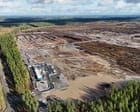
Hyperscale data center development in the Nordic region relies on an arbitrage between cheap renewable energy, cold ambient temperatures, and rapid land acquisition, yet this model fails when capital deployment velocity outpaces statutory environmental permitting. A criminal investigation launched by Finnish authorities into Google’s forest clearing operations for a planned data center site exposes the structural vulnerability of aggressive site-preparation workflows. When infrastructure operators initiate physical site clearance prior to securing final, unappealable environmental and land-use clearances, they convert regulatory compliance from a predictable administrative timeline into an open-ended criminal and operational liability.
The Structural Anatomy of Hyperscale Land Acquisition
Deploying a hyperscale data center requires compressing a multi-year capital expenditure cycle into the shortest possible time-to-compute window. In competitive cloud markets, a six-month delay in commissioning server capacity translates directly into lost enterprise contracts and diminished market share. To compress timelines, infrastructure developers routinely decouple physical site preparation from facility construction, attempting to run land clearing, grading, and utility trenching in parallel with final municipal and environmental permitting.
This parallelization strategy rests on three core operational assumptions:
- Permit Predictability: The assumption that preliminary zoning approvals or municipal support guarantee final environmental clearances under national forestry and nature conservation acts.
- Sunk-Cost Leverage: The implicit calculation that cleared, graded land creates institutional momentum, making regulatory bodies reluctant to halt a project once capital has been visibly deployed on the ground.
- Fine Absorption: The financial modeling of administrative penalties as minor operational expenses rather than existential threats to the project license.
In jurisdictions with strict statutory environmental protections, such as Finland, these assumptions collide with decentralized enforcement mechanisms. While municipal governments actively court foreign direct investment for regional economic revitalization, national environmental agencies, forestry centers, and law enforcement operate independently of local economic development incentives.
The Mechanism of Regulatory Misalignment in Finland
Understanding why a premier technology operator encounters criminal scrutiny in a stable, rule-of-law jurisdiction requires examining the friction between Finnish municipal planning and national environmental statutes. Finland’s land-use framework operates on a tiered hierarchy where local zoning plans (asemakaava or yleiskaava) do not automatically supersede specialized environmental legislation, specifically the Finnish Forest Act (Metsälaki) and the Nature Conservation Act (Luonnonsuojelulaki).
The Permitting Decoupling Trap
In standard Nordic development workflows, a company acquires land options—often spanning hundreds of hectares in regions like Kajaani or Muhos—before full ecological baselines are established. Preliminary site works, including clear-cutting timber and stripping topsoil, are frequently executed under basic forest use declarations (metsänkäyttöilmoitus) rather than comprehensive construction permits.
This creates a severe legal vulnerability. A standard forest use declaration permits commercial silviculture, not industrial land conversion. If an operator clears a forest tract with the documented intent of industrial excavation, road building, or hyperscale facility construction before the relevant municipal building supervision authority grants a landscape work permit (maisematyölupa) or full building permit, the act crosses from routine forestry into unauthorized environmental alteration.
Statutory Triggers for Criminal Liability
Under Finnish law, environmental offenses are not strictly confined to toxic chemical spills or protected species destruction; they encompass unauthorized alterations to protected habitats, waterways, and designated forest zones. When a complaint is filed—either by regional environmental authorities (ELY Centers) or environmental non-governmental organizations—police are legally obligated to initiate a preliminary investigation (esitutkinta) if there is reason to suspect an offense such as an environmental infraction (ympäristörikkomus) or a violation of the Forest Act.
The transition from an administrative dispute to a criminal probe alters the risk profile entirely:
- Corporate Criminal Liability: Under Chapter 9 of the Finnish Criminal Code, a corporation can be sentenced to a corporate fine if a person belonging to its statutory organ or exercising actual decision-making authority has been an accomplice to an offense or allowed the commission of the offense, or if the care and diligence necessary for the prevention of the offense have not been observed in the operations of the corporation.
- Subcontractor Chain Exposure: Hyperscale developers rarely clear land with internal personnel. They contract local forestry and excavation firms. However, outsourcing physical execution does not insulate the principal landowner or project developer from criminal liability if project schedules or imprecise contractual boundaries incentivized premature clearing.
- Evidentiary Permanence: Unlike software deployments that can be rolled back, clear-cutting boreal forest creates an irreversible physical state. Satellite imagery, forestry declarations, and timber transport logs provide law enforcement with an exact, indisputable timeline of when trees were felled relative to when permits were legally valid.
The Cost Function of Premature Site Preparation
Evaluating the decision to clear land prior to exhaustive regulatory sign-off requires modeling the asymmetric payoff matrix of infrastructure deployment.
The Upside: Time-to-Market Compression
In northern latitudes, seasonal constraints dictate civil engineering schedules. Ground frost, heavy snowpack, and spring thaw (kelirikko) severely restrict heavy machinery movement and soil compaction. Missing a late-autumn or early-winter clearing window can delay foundation pouring by an entire calendar year. Securing a cleared site before winter freeze allows civil contractors to begin bedrock blasting and grading immediately upon spring thaw, theoretically saving six to nine months on the critical path to power-on.
The Downside: Compounding Operational Friction
When premature clearing triggers a criminal investigation, the theoretical schedule savings evaporate and invert into compounding delays:
- Immediate Injunctions and Stop-Work Orders: Administrative courts routinely freeze all adjacent site activities while criminal investigations determine the scope of environmental damage. The project loses the exact seasonal window it sought to capture.
- Permit Invalidations and Re-Application Cycles: Ongoing criminal probes into land-use violations poison the administrative well. Environmental authorities subject subsequent applications—such as water abstraction permits for evaporative cooling or high-voltage grid connection approvals—to maximum statutory scrutiny, eliminating discretionary fast-tracking.
- Capital Lock-Up: Hundreds of millions of euros allocated for long-lead electrical equipment—such as high-voltage transformers, switchgear, and backup diesel generators—sit idle in warehouses, incurring storage fees and warranty degradation while the site remains frozen.
- Reputational Erosion with Local Stakeholders: Nordic social license relies heavily on institutional trust and strict adherence to environmental norms. A criminal investigation transforms a celebrated local job creator into an adversary of community conservation standards, fueling organized local opposition that challenges every subsequent zoning amendment in administrative court.
Governance Failures in Third-Party Contractor Management
A recurring failure mode in global infrastructure expansion is the disconnect between corporate compliance policies drafted in headquarters and operational execution on the ground. Global technology firms maintain exhaustive environmental, social, and governance (ESG) frameworks, yet local land-acquisition teams are frequently evaluated on milestone velocity—specifically, achieving "shovel-ready" status by a fixed quarter.
This incentive structure produces predictable operational blind spots:
- Ambiguous Notice-to-Proceed (NTP) Protocols: Project managers issue limited notices to proceed for "site surveying and boundary marking," which civil contractors interpret broadly as authorization to clear access roads and staging areas.
- Due Diligence Delegation: Developers rely on sellers—often municipal development companies or private forestry conglomerates—to warrant that preliminary clearing is legally permissible, failing to conduct independent legal verification of whether the land's zoning status supports industrial clearing rather than commercial logging.
- Siloed Legal Review: Corporate real estate lawyers handle land purchase agreements, while external engineering consultants manage municipal permit filings. Without a unified compliance gatekeeper verifying that every physical intervention on the parcel maps directly to an active, non-appealable permit, site works outrun legal authorization.
Strategic Limits of the Nordic Arbitrage Model
For over a decade, the Nordic region functioned as an frictionless expansion zone for hyperscale compute. Abundant hydroelectric and wind power, combined with naturally cool air that reduces Power Usage Effectiveness (PUE) ratios, created an undeniable economic advantage. However, the Finnish investigation highlights a structural shift in the operating environment.
First, grid capacity and land availability are tightening across Sweden, Finland, and Norway. Prime parcels adjacent to high-voltage substations without ecological constraints have largely been absorbed. Developers are increasingly forced onto secondary tracts bordering protected peatlands, old-growth forests, or sensitive watersheds, where environmental permitting is inherently contentious.
Second, European environmental enforcement is hardening. Driven by EU biodiversity directives and domestic climate targets, national regulators are less willing to grant retroactive exemptions for industrial development. The era in which municipal enthusiasm could smooth over national environmental statutes has ended.
Third, hyperscale operators cannot rely on economic scale to dictate regulatory timelines. A multi-billion-euro investment commitment does not alter the statutory criteria applied by a regional forestry inspector or a district prosecutor. Attempting to apply Silicon Valley "move fast and break things" execution methodologies to physical boreal ecosystems guarantees legal collision.
Tactical Protocol for Zero-Friction Site Development
To eliminate criminal and administrative exposure during hyperscale land development, infrastructure directors must overhaul site-mobilization governance before deploying heavy machinery onto newly acquired parcels.
- Enforce Hard-Gated Permit Verification: Establish an internal compliance protocol prohibiting any physical alteration of a site—including brush clearing, soil testing boreholes, or timber harvesting—until an independent local environmental counsel certifies in writing that the specific activity is covered by an active, unappealable permit valid for industrial end-use, not agricultural or forestry exceptions.
- Decouple Land Purchase from Clearing Timelines: Structure land acquisition contracts with extended closing conditions tied explicitly to the receipt of final landscape and building permits. Absorb the holding cost of unimproved land rather than deploying capital into premature site preparation that carries forfeiture or injunction risk.
- Audit Contractor Incentives and Boundaries: Replace milestone bonuses tied to early site clearance with strict penalty clauses for unauthorized boundary breaches or premature excavation. Require GPS-fenced machinery controls mapped directly to approved permit zones before issuing any notice to proceed.
- Integrate Ecological Baselines Pre-Acquisition: Commission independent four-season biodiversity and hydrological surveys prior to finalizing land selection. Identifying protected habitats, red-listed species, or restricted watershed buffers during due diligence prevents acquiring stranded assets that cannot be legally cleared within commercial timelines.