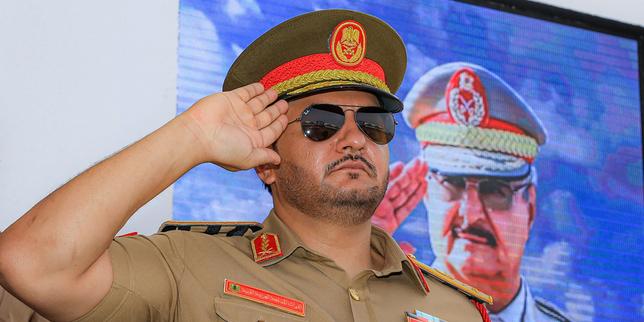
Power in Cyrenaica rarely passes through quiet halls. It moves through tribal pacts, armed battalions, and the cold arithmetic of loyalty to the barrel of a gun. In the east of Libya, Khalifa Haftar built a personal military fiefdom on the ruins of the state. Now, his ambitions face an internal friction point that foreign capitals prefer to ignore. Saddam Haftar, the marshal's son, stands at the center of this fragile ascension.
To understand eastern Libya today, you have to look past the official communiqués issued from Benghazi or the diplomatic handshakes in foreign embassies. The Libyan National Army is not a professional military institution. It is an intricate holding company of ideological hardliners, Madkhali Salafi militias, transactional tribal leaders, and family loyalists. Saddam Haftar operates as the chief operating officer of this conglomerate. His rise is not merely a story of familial succession. It is a calculated consolidation of economic levers and security apparatuses designed to insulate the Haftar clan from internal challengers and external pressure.
For years, eastern authorities operated under severe financial constraints, cut off from the central oil revenues controlled by Tripoli. This bottleneck forced the Haftar leadership to improvise. The rise of Saddam Haftar coincided with a shift toward aggressive domestic resource extraction, banking consolidation, and parallel borrowing. By taking firm control of the military security committees and intelligence units, his faction choked off independent political organizing in Benghazi, Derna, and Ajdabiya. Dissent was categorized as a national security threat.
Yet, controlling territory by force requires constant funding. Eastern Libya is heavily reliant on state subsidies managed through the Central Bank of Libya, a institution that has long served as both a battleground and a clearinghouse for rival factions. Saddam Haftar’s inner circle understands that military supremacy without financial dominance is a temporary illusion. This realization explains the intense maneuvering around national financial institutions, where eastern commanders demand direct access to sovereign funds while maintaining an autonomous armed force. It is an arrangement that defies standard governance models, functioning instead as a protection racket on a national scale.
Foreign sponsors watch this transition with nervous calculation. Moscow, Cairo, and Abu Dhabi have all invested heavily in the Haftar vertical of power. Russian military contractors secure logistical hubs across the desert, while regional capitals view the eastern administration as a necessary bulwark against western Islamist networks. Yet, these external backers harbor deep skepticism regarding dynastic succession. Khalifa Haftar’s older sons and inner circle rivals view Saddam’s rapid accumulation of power with quiet alarm. The marshal has managed to maintain a fragile equilibrium by balancing these factions against one another, but the underlying tensions remain unresolved.
The social fabric of Cyrenaica complicates the family's calculus further. Powerful local tribes retain independent armed wings and deep historical grievances. While financial patronage buys temporary compliance, it does not guarantee ideological alignment. When economic hardship pinches local populations—manifested through fuel shortages, inflation, and crumbling public infrastructure—the veneer of stability begins to crack. The younger Haftar’s security forces have proven adept at suppressing public protests, but coercion is an expensive and unstable substitute for legitimacy.
External actors often misread eastern Libya as a monolithic bloc. In reality, it is a pressurized container. The security apparatus that Saddam Haftar oversees is simultaneously strong enough to crush localized armed opposition and brittle enough to fracture under severe economic shock. Every appointment of a loyalist commander to a lucrative border post or a strategic security brigade shifts the internal balance of power, alienating traditional tribal leaders who feel bypassed by the younger generation.
Economic restructuring in the east has taken on a predatory character. Smuggling networks, previously decentralized, have been funneled through centralized security structures under the direct supervision of the Haftar family. Fuel diversion, illicit trade, and currency arbitrage provide the liquid capital necessary to pay salaries and maintain the loyalty of frontline battalions. This illicit economy is not a side effect of the conflict; it is the primary engine keeping the administration afloat. When international monitors issue reports detailing these financial flows, they document a system built not to reform the state, but to harvest its remains.
The international community continues to pursue the illusion of a unified national election, treating eastern governance as a temporary obstacle to be negotiated away. This approach fundamentally misunderstands the incentives at play. For Saddam Haftar and his inner circle, relinquishing operational control of Cyrenaica is not an option. The stakes are too high, and the regional precedent for deposed strongmen is too grim. The ascension is fragile precisely because it relies on personal dominion rather than constitutional predictability.
As the political stalemate persists, the physical landscape of eastern Libya reflects this militarized reality. Checkpoints manned by heavily armed young men proliferate along the coastal highway. Abandoned reconstruction projects stand as monuments to chronic corruption and mismanaged foreign aid. Beneath the surface quiet of Benghazi lies an anxious awareness that the current architecture of power depends entirely on the biological and political longevity of a single family.
When the inevitable transition arrives, the machinery assembled by Saddam Haftar will face its true test. It will not be measured by the loyalty of foreign patrons or the volume of press releases, but by its ability to survive an internal reckoning among armed factions that have spent a decade learning how to take what they want by force. The illusion of permanent stability in the east remains just that—an illusion sustained by cash, coercion, and the temporary exhaustion of a population caught in the crossfire of dynastic ambition.