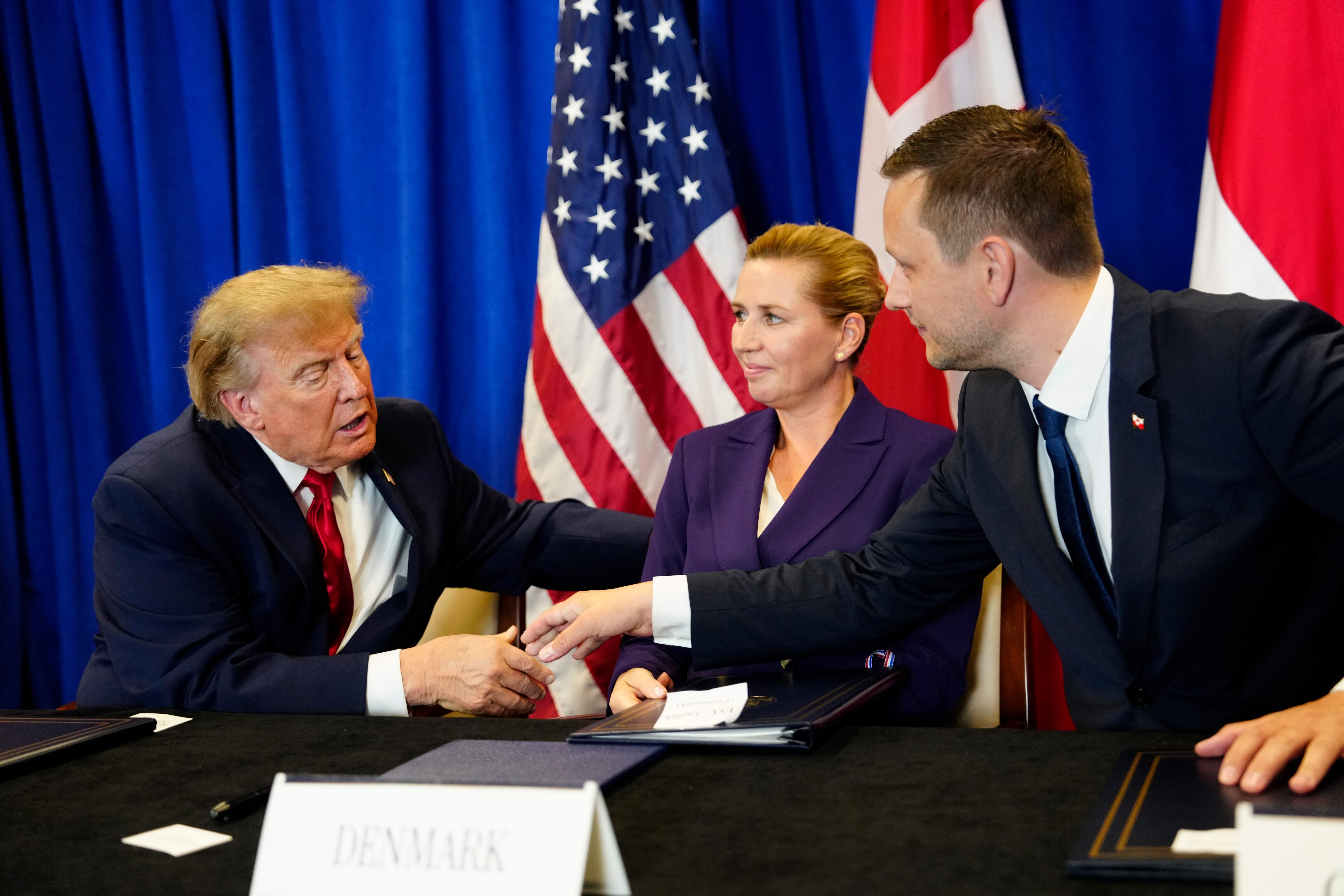
On September 22, 2026, on the sidelines of the United Nations General Assembly in New York, Donald Trump, Danish Prime Minister Mette Frederiksen, and Greenlandic Prime Minister Jens-Frederik Nielsen signed a trilateral Arctic security deal that ended months of transatlantic brinkmanship. Washington gained explicit authority to expand its military footprint, deploy elements of its proposed Golden Dome missile defense system, and screen foreign investments in critical minerals. Copenhagen and Nuuk kept sovereignty, avoided a territorial annexation crisis, and bound Washington to existing NATO guardrails.
Look past the press conference smiles, however, and a sharper reality emerges. Both sides walked away claiming victory because the agreement functions less like a territorial transfer and more like a high-stakes legal patch over a 75-year-old Cold War treaty.
The Illusion of a Brand New Conquest
White House messaging framed the accord as an unprecedented triumph. Trump told reporters the pact delivers permanent American control over Greenland's security and defense needs at zero cost to taxpayers. That sales pitch works well on cable news, yet anyone who has spent time reading the 1951 Defense of Greenland Agreement recognizes the underlying architecture.
For more than seven decades, the Pentagon has already enjoyed broad authority to build, upgrade, and operate defense areas across the island, provided Copenhagen agreed within a NATO framework. During the height of the Cold War, the United States maintained dozens of installations and thousands of troops on the ice sheet before scaling back to Pituffik Space Base. The 2026 treaty does not invent American military access out of thin air. Instead, it updates the 1951 baseline—which was previously amended in 1981 and 2004—to reflect modern missile trajectories, undersea warfare, and Chinese capital flows.
What Actually Changed on the Ground
If the core framework dates back to the Truman administration, why did Washington push Copenhagen and Nuuk to the edge of a diplomatic rupture earlier in 2026? Four concrete shifts separate the new trilateral pact from the old status quo.
- Expanded Defense Areas and Golden Dome: The agreement authorizes two additional U.S. military bases and explicitly references infrastructure for Trump's proposed Golden Dome missile shield. While the text avoids naming specific interceptor batteries or radar arrays, the geographic logic is obvious. Greenland sits directly beneath the shortest polar flight paths for intercontinental ballistic missiles launched from Eurasia toward the American East Coast.
- Unrestricted Undersea and Air Transit: American vessels and aircraft now hold codified rights to move freely between defense areas, including explicit undersea access through Greenland's territorial waters. As melting sea ice opens the GIUK gap—the strategic maritime chokepoint between Greenland, Iceland, and the United Kingdom—tracking Russian submarines requires permanent acoustic and naval reach.
- A Formal Veto Over Adversary Capital: Non-NATO nations are barred from establishing manned or unmanned military installations or maintaining a persistent troop presence unless all three signatories consent. More importantly, Washington secured a formal consultative seat at the table whenever countries outside NATO, NATO partner networks, or the European Union attempt to invest in sensitive Greenlandic sectors. That clause targets Beijing's long-standing interest in rare earth mining and dual-use port infrastructure.
- The Independence Continuity Lock: Perhaps the single most consequential line in the document governs what happens if Greenland leaves the Kingdom of Denmark. Under the 2009 Self-Government Act, Greenlanders hold the legal right to vote for full independence. The 2026 treaty stipulates that if Nuuk breaks away from Copenhagen, the security agreement remains permanently binding and an independent Greenland stays inside NATO.
Why Coercion Gave Way to Paperwork
Earlier in 2026, Trump repeatedly suggested the United States would take control of Greenland one way or another, refusing to rule out economic or military pressure against a founding NATO ally. Those threats triggered shockwaves across European capitals. Danish officials scrambled to rally support from Berlin, London, and Brussels, while European Union leaders floated emergency investment packages to reassure Nuuk.
By late summer, the math in Washington had shifted. Attempting to seize or force the sale of a self-governing European territory would have detonated NATO from the inside, jeopardized U.S. basing rights from Ramstein to Rota, and turned a cooperative local population into a hostile one. At the same time, Danish and Greenlandic leaders recognized that stonewalling Washington indefinitely risked unilateral American action or a collapse in Arctic deterrence.
Diplomats in Copenhagen and Nuuk executed a classic containment strategy. They gave Trump the optics of a sweeping, open-ended security triumph—complete with Golden Dome language and strict anti-China investment screens—while anchoring every clause inside existing international law. Frederiksen called it a deal that can last forever precisely because it affirms Danish territorial integrity and Greenlandic self-determination in its opening lines.
The Economic Bargain Hidden in the Fine Print
Public debate around Greenland almost always fixates on maps and missiles, yet the sharpest friction in Nuuk revolves around money and local jobs. Greenland's economy relies heavily on fishing and an annual block grant from Copenhagen. Developing mines or defense hubs in extreme Arctic conditions costs billions of dollars and strains fragile municipal infrastructure.
Under the 2026 accord, Washington avoided paying direct rent or sovereign lease fees—allowing Trump to boast that the deal costs America nothing. In exchange, the treaty obligates the Pentagon to award contracts for construction, goods, and services at existing and future bases to Greenlandic companies to the maximum extent possible.
The Local Capacity Bottleneck
On paper, preferential contracting looks like an economic windfall for a population of roughly 56,000 people. In practice, veteran defense contractors know how this plays out in remote jurisdictions.
When the U.S. military builds high-security radar facilities or deep-water piers, local firms rarely possess the specialized engineering clearances, heavy ice-class equipment, or bonded workforce required to execute primary contracts. Without strict subcontracting enforcement and workforce training funds, preferential sourcing rules often funnel money through local shell partnerships while major American engineering conglomerates capture the actual margin. Greenland's parliament, Inatsisartut, ratified the agreement in early November 2026 after intense committee scrutiny, while Denmark's Folketing scheduled its own final vote for November 19. Opposition lawmakers from the pro-independence Naleraq party attacked the pact precisely because it lacks guaranteed fixed financial compensation.
The Invisible Bill Sent to Washington
Strategic agreements are measured not only by the ink on the page, but by the trust spent to get the signatures. For decades, Denmark was among Washington's most dependable military partners, dispatching troops to high-casualty zones in Iraq and Afghanistan per capita at rates matching major powers.
That reservoir of automatic goodwill is gone. Greenlandic Foreign Minister Múte B. Egede openly described the months of American pressure as a serious breach of trust that will take years to repair. Even as European leaders welcomed the September signing as a victory for patient diplomacy, defense ministries across the continent drew a sobering lesson. If an American administration is willing to threaten a treaty ally's borders to extract basing concessions, European strategic autonomy stops being an academic debate in Brussels and becomes an urgent procurement priority.
Constraints on a Future Independent Greenland
Consider the long-term political trap built into the continuity clause. If Greenlanders vote for independence ten or twenty years from now, their brand-new state will inherit two expanded U.S. military installations, an American veto over non-Western resource investors, and an agreement with no expiration date that can only be amended if Washington says yes.
Proponents argue that automatic NATO membership and U.S. security guarantees protect a small, resource-rich nation from Russian or Chinese coercion. Critics in Nuuk counter that locking in permanent security and investment restrictions before statehood even begins narrows the sovereign choices of future generations.
What Matters When the Construction Crews Arrive
The diplomatic theater in New York is finished, and the parliamentary votes in Nuuk and Copenhagen are nearly complete. Now comes the hard part—turning legal text into steel and concrete on permafrost.
Deploying Golden Dome sensors and expanding Arctic airfields will test Pentagon budgets, environmental guardrails, and the daily patience of Greenlandic communities whose hunting and fishing grounds sit beside designated defense zones. Washington secured the legal right to lock adversaries out of the top of the world, but holding that position without alienating the people who actually live on the ice will require far more discipline than threatening to buy the island ever did.