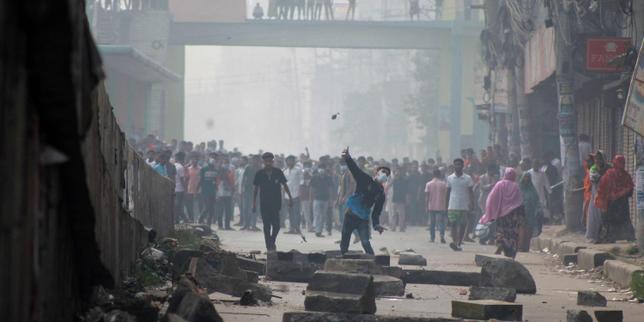
Clashes between garment workers and security forces in Bangladesh rarely happen in a vacuum. When street protests erupt in industrial hubs like Ashulia, Gazipur, or Savar, the immediate trigger is almost always unpaid wages, sudden factory closures, or a minimum wage floor that fails to cover basic caloric survival. Yet focusing strictly on the street-level confrontation misses the real story. These recurring explosions of labor unrest are the direct, predictable consequence of a global apparel supply chain engineered to push financial risk downward onto the most vulnerable link in the chain.
Every time tear gas clears from a Dhaka industrial corridor, international buyers issue statements expressing concern. Then the purchase orders resume under the exact same pricing structures that caused the unrest in the first place. To understand why workers keep taking to the streets despite the high personal risk of arrest, blacklisting, or physical injury, you have to look past the factory gates and examine the unit economics of fast fashion.
The Anatomy of a Wage Dispute
Bangladesh sits as the second-largest garment exporter in the world, behind only China. The ready-made garment sector accounts for over eighty percent of the country's total export earnings and employs roughly four million people, the majority of whom are women. On paper, this is an economic success story that lifted millions out of extreme rural poverty over three decades. On the factory floor, the math tells a much harsher story.
When the government revises the minimum wage—a process that happens roughly once every five years—the resulting figure is almost always a political compromise rather than a calculation based on the actual cost of living. During the high-profile wage protests in late 2023, workers demanded a monthly minimum of 23,000 taka. The wage board settled on 12,500 taka, roughly 113 US dollars at the time.
Inflation in Bangladesh does not wait five years to adjust. Food prices, housing rents in cramped industrial suburbs, and utility costs climb steadily month after month. When a worker's base pay covers only sixty percent of a basic family budget, overtime stops being a choice and becomes a survival mechanism. A standard eight-hour shift becomes ten or twelve hours, six days a week, just to break even.
The Mechanics of Delayed Pay and Sudden Closures
Street protests rarely start over abstract macroeconomic policy. They ignite over immediate breaches of trust. A factory owner delays a monthly paycheck by two weeks. An annual Eid bonus is cut in half without notice. Or, worst of all, workers arrive at the gate on a Monday morning to find the building locked, the machinery removed overnight, and the management unreachable.
When a factory shuts down abruptly, workers lose not only their final month of wages but also their legally mandated severance pay and accrued leave compensation. In an environment where workers live paycheck to paycheck with zero savings buffer, a single missed pay cycle means immediate eviction from landlord-controlled boarding houses and an inability to buy rice and lentils. Taking to the highway to block traffic is not a tactical preference for these workers. It is the only lever they possess that forces local authorities and factory associations to pay attention.
The Sourcing Squeeze from Western Brands
Factory owners in Dhaka and Chittagong are often cast as the sole villains in these labor disputes, and many indeed engage in union-busting, wage theft, and intimidation. However, treating local manufacturers as independent actors ignores how global apparel sourcing actually works.
Western fashion brands and major retailers operate on a hyper-competitive model built on speed and margin preservation. Over the past twenty years, while retail inflation has pushed up the price of groceries, electronics, and housing in North America and Europe, the average retail price of a cotton t-shirt or a pair of denim jeans has remained remarkably flat—or even declined in real terms.
This price stability is not the result of magical manufacturing efficiencies. It is achieved through aggressive price compression enforced by multinational buyers.
Consider how a typical sourcing negotiation unfolds. A brand approaches a Bangladeshi supplier with a target price per garment—known in the industry as the Free on Board (FOB) price. The supplier calculates the cost of imported fabric, trims, energy, compliance audits, and labor. Often, the brand's target price barely covers raw materials and overhead. If the factory owner pushes back, citing higher minimum wages or rising electricity tariffs, the buyer threatens to move the order to a competing factory down the street, or to another low-cost hub like Vietnam, Cambodia, or Ethiopia.
How Payment Terms Weaponize Cash Flow
The financial pressure goes beyond the unit price of a garment. Western brands routinely impose extended payment terms on their suppliers, demanding sixty, ninety, or even one hundred and twenty days to pay an invoice after the goods have already been shipped.
To keep the production lines running during those three or four months, the Bangladeshi factory owner has to take out high-interest local bank loans to buy fabric and pay workers. When global interest rates rise, or when a brand suddenly cancels an order or demands a retroactive discount due to slow retail sales in Europe or the United States, the factory's liquidity evaporates overnight. The first casualty of a factory's cash crunch is almost always the payroll.
The Illusion of Social Compliance Audits
Following the catastrophic 2013 Rana Plaza building collapse, which killed over 1,100 garment workers, the global apparel industry poured millions of dollars into safety inspections and compliance programs. Initiatives like the Accord on Fire and Building Safety dramatically improved structural, electrical, and fire safety across hundreds of export-oriented factories.
Yet physical safety is only one dimension of labor rights. On the issues of wages, working hours, and freedom of association, the industry's primary monitoring tool—the third-party social audit—has proven largely ineffective.
Auditors visit factories with checklists, inspect payroll records, and interview selected workers. On paper, everything looks compliant. In reality, many factories maintain dual bookkeeping systems. One set of ledgers shows workers clocking out at 5:00 PM and receiving full overtime pay; the real ledger reflects shifts running until 9:00 PM with unpaid mandatory overtime to meet tight shipping deadlines. Workers are coached by management on how to answer auditor questions, fully aware that speaking honestly could result in immediate termination and being added to an informal industry blacklist shared among factory owners.
Even when audits uncover violations, the consequences are perverse. Instead of helping the supplier fix the root cause—such as adjusting delivery timelines or increasing the FOB price to fund proper overtime—brands often terminate the contract to protect their own public reputation. The factory loses its primary revenue stream, closes its doors, and hundreds of workers are thrown onto the street without severance.
Why Security Forces Escalate So Quickly
When protests spill out of factory compounds onto major arterial roads like the Dhaka-Mymensingh highway, the state response is swift and heavy-handed. Bangladesh has a dedicated Industrial Police force created specifically to maintain order in manufacturing zones, alongside regular police units and paramilitary border guards deployed during major flare-ups.
The state's willingness to use batons, tear gas, water cannons, and occasionally live ammunition stems from a deep structural dependency. Because the garment sector generates the vast majority of the country's foreign currency reserves, any prolonged disruption to export shipments is viewed by the government not as a localized labor dispute, but as an existential threat to national economic stability.
This alignment of interests between factory owners and the state apparatus leaves workers with virtually no institutional recourse. Union registration remains notoriously difficult, and independent labor organizers frequently face surveillance, trumped-up criminal charges, or physical intimidation. When legal avenues for collective bargaining are systematically blocked, spontaneous wildcat strikes and street blockades become the default mechanism for expressing grievances.
The Structural Trap of the Subcontracting Tier
A major blind spot in media coverage of Bangladesh textile unrest is the distinction between Tier 1 export factories and the vast ecosystem of informal subcontractors.
Large, modern facilities in Dhaka's Export Processing Zones generally maintain decent infrastructure and process payrolls digitally. They supply directly to major global brands and undergo regular scrutiny. However, when these Tier 1 factories accept massive peak-season orders with impossible turnaround times, they quietly subcontract portions of the work to smaller, unregistered workshops operating in converted residential buildings or dilapidated sheds.
These subcontracting units operate entirely outside the compliance framework. They lack safety certifications, pay well below the legal minimum wage, and offer zero job security. When a market downturn hits, Tier 1 factories pull their orders back in-house to keep their own lines busy, starving the subcontractors of work. The resulting closures and unpaid wage crises in this shadow tier frequently spark the most violent confrontations in industrial neighborhoods, yet international brands can truthfully claim they have no direct business relationship with the affected facilities.
What Actually Breaks the Cycle
Meaningful change in Bangladesh's garment sector will not come from another round of corporate codes of conduct or voluntary sustainability pledges. Those mechanisms have been tested for decades and have failed to prevent recurring cycles of unrest.
Breaking the deadlock requires altering the commercial rules of engagement between buyers and suppliers. First, purchasing practices must be legally decoupled from wage suppression. If a brand commits to ethical sourcing, its procurement contracts must include ring-fenced labor cost calculations—meaning that when a country's minimum wage increases, the FOB price paid by the brand automatically adjusts upward to absorb the exact difference, rather than forcing the factory owner to eat the cost out of razor-thin margins.
Second, international trade frameworks and domestic regulations need to enforce joint liability for unpaid wages and severance. If a factory goes bankrupt or shuts down overnight while holding active orders from major retailers, those brands should bear legal and financial responsibility for ensuring the workers who produced their goods are paid in full. Binding agreements like the International Accord proved that legally enforceable obligations work where voluntary corporate social responsibility fails.
Until global fashion brands are forced to pay prices that reflect the true cost of human labor, and until Bangladeshi workers are allowed to organize independent unions without fearing state retaliation, the truce in Dhaka's industrial zones will remain temporary. Every shipment of cheap clothing arriving at Western ports carries a hidden subsidy extracted directly from the bodies and bank accounts of the people who stitched it together, and eventually, the bill always comes due in the streets.