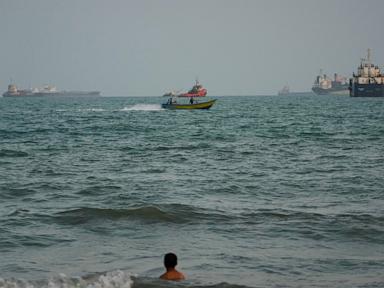
Tehran claimed another strike on an American asset near the mouth of the Persian Gulf, reigniting a theater of war that Washington insists it has under tight operational control. The confrontation in the Strait of Hormuz is no longer a localized exchange of maritime threats. It has settled into a grinding, high-stakes contest of economic endurance where energy flows, radar architectures, and shadow shipping networks dictate the survival of both governments.
Surface accounts of the conflict focus on the daily tally of missile interceptions and disputed ship strikes. Beneath that thin layer of military communiques lies a structural failure of deterrence. The White House ordered a heavy-handed campaign targeting nearly sixty military installations across the Iranian coastline, attempting to blind Tehran's tracking systems and clear the narrow corridor for commercial tankers. Yet, every missile launched by the United States draws an asymmetric counter-punch from the Islamic Revolutionary Guard Corps.
The geography of the waterway heavily favors decentralized harassment. Measuring barely twenty-one miles wide at its narrowest point, the transit channel funnels nearly twenty percent of global petroleum consumption past an array of jagged islands and hidden coves. Iranian commanders spent decades preparing for this exact topography. They built underground missile silos, dispersed mobile rocket launchers, and mastered the art of small-boat swarm tactics. When American strike packages destroy fixed radar sites, Tehran shifts to optical tracking, commercial tracking data, and un-networked shore batteries.
Washington's operational posture has shifted from comprehensive strategic objectives to a singular obsession with the channel. Long-term goals regarding nuclear containment have drifted into the background, pushed aside by the immediate necessity of escorting container ships and crude carriers through a gauntlet of floating mines and anti-ship cruise missiles. United States Central Command recently orchestrated a wartime record by shepherding forty commercial vessels carrying eighteen million barrels of oil through the passage in a single day.
Numbers like those sound like operational victories to desk analysts in Washington. To ship captains and marine insurers, the reality is starkly different. Insurance premiums for Persian Gulf transits remain astronomically elevated. Crew members on commercial tankers operate under constant threat from incoming drones and unidentified projectiles. Commercial traffic moves at a fraction of its pre-war volume.
The Iranian economy has absorbed immense damage, with direct and indirect losses scaling past hundreds of billions of dollars. Leadership turnover in Tehran has not produced a compliant administration eager for American terms. Instead, a harder-line faction has taken root, betting that Western patience for high energy prices and military expenditure will fracture before the Iranian state collapses. To bypass the American naval blockade, Tehran relies on an expanding shadow fleet of aging tankers, turning off transponders and transferring crude in clandestine ship-to-ship operations across the open ocean.
Sanctions enforcement has transformed into an aggressive, secondary economic war targeting any foreign financial institution daring to clear payments for Iranian energy. Treasury officials issue blunt warnings to international partners, creating a chilling effect across Asian and Middle Eastern markets. This diplomatic isolation strategy assumes that financial strangulation will eventually force Tehran to halt its asymmetric campaign in the strait.
History demonstrates that heavily sanctioned petro-states rarely capitulate quickly. They adapt. They cultivate black-market intermediaries, trade through regional proxies, and weaponize geographic bottlenecks. Every time the United States Navy clears a cluster of sea mines or obliterates a coastal launcher near Larak Island, the underlying strategic vulnerability remains untouched. The United States can sink patrol boats and smash radar installations, but it cannot permanently alter the map or remove the Iranian coastline from the northern edge of the strait.
Diplomatic channels remain largely frozen despite backchannel messages floated by regional intermediaries in Qatar and Oman. Both capitals are trapped in a logic of escalation where showing flexibility is interpreted as weakness. Washington demands unhindered navigation and a complete halt to maritime harassment. Tehran demands the lifting of economic blockades and recognition of its regional leverage before a single permanent treaty is entertained.
As long as the waterway remains a contested combat zone, global energy markets will price in a permanent risk premium. The current rhythm of intermittent strikes, high-risk escorts, and disputed casualty reports is not a temporary phase of the conflict. It is the new baseline of maritime commerce in the Persian Gulf, where control of the water is measured hour by hour at the barrel of a gun.


