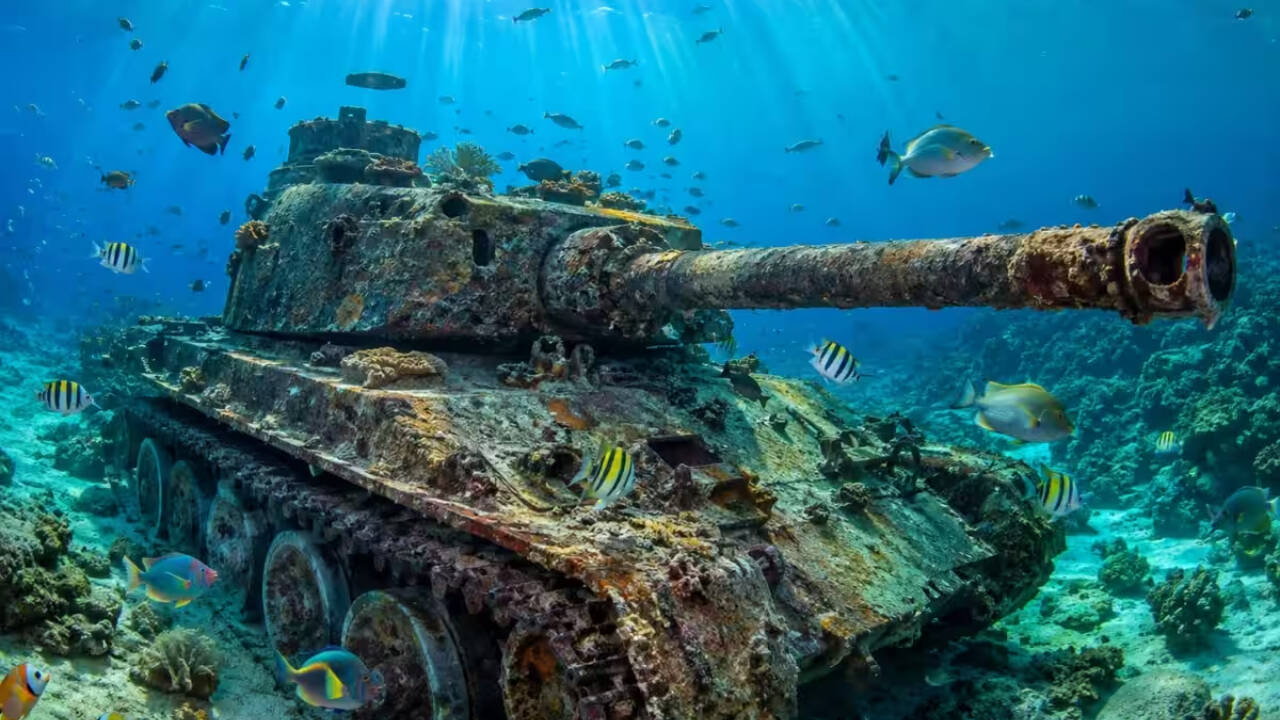
In August 2010, the Royal Thai Army hauled 25 decommissioned Chinese-made battle tanks to the coast of Narathiwat province, loaded them onto barges, and dropped them 80 feet into the murky depths of the Gulf of Thailand. Alongside retired railway cars and scrapped garbage trucks, these heavy steel war machines were intentionally scuttled to build artificial reefs. Years later, marine biologists surveying the wreckage documented 53 distinct fish species belonging to 21 families thriving inside and around the submerged armor. What began as a desperate plea from local fishermen to Queen Sirikit over collapsing coastal stocks transformed into an unconventional masterclass in marine habitat restoration.
The strategy challenges standard conservation orthodoxy. Environmentalists usually champion pristine natural preservation, steering clear of heavy industrial waste. Yet, the Narathiwat project proves that obsolete military surplus can successfully resurrect barren sandy seabeds. Understanding why this worked requires examining the physics of underwater desolation and the biological vacuum left by decades of intensive trawling.
The Problem With Empty Sand
A flat sand seabed is an underwater desert. Without vertical relief, complex crevices, or hard substrates, marine larvae have nowhere to anchor. Algae and barnacles cannot establish a foothold on shifting granules of silica. When bottom trawlers sweep these flat zones year after year, they scour away whatever minor biological complexity exists, leaving behind an aquatic wasteland devoid of shelter.
Local artisanal fishers in southern Thailand watched their yields evaporate through the late 1990s and 2000s. Traditional fishing required traveling further out to sea, burning more diesel, and netting smaller catches. When they petitioned the monarchy for intervention, the response bypassed typical bureaucratic committees. Instead of purchasing expensive, purpose-built concrete reef modules, the government looked at stockpiles of decommissioned state assets.
Tanks were an unorthodox choice, but structurally ideal. Built from thick-gauge steel plates, they weigh tens of tons, ensuring they will not shift during monsoon storm surges. Their internal compartments, turret rings, and hatchways create complex architectural shadows, varying current speeds, and dark refuges that small fish desperately need to evade apex predators.
Inside the Submerged Armory
When researchers from Bangkok's Ramkhamhaeng University descended to study the site, they found a biological community far denser than expected. The survey identified 53 species, dominated by versatile families like snappers, damselfishes, and wrasses.
Yet, a closer look at the data reveals a critical architectural nuance. The project deployed both closed-in battle tanks and open-frame railway wagons. While the sprawling railway cars recorded a marginally higher overall species diversity score due to their massive footprint, the enclosed tanks hosted significantly larger individual fish schools.
Why did the tanks win on density? Tight, dark spaces attract cryptic and gregarious reef species that refuse to inhabit open structures. Small damselfishes settled inside the turret openings by the thousands, forming a localized food web. Within years, apex reef visitors arrived, including commercially vital snappers and even the critically endangered humphead parrotfish.
The metal did not remain metal for long. Coralline algae, sponges, and hard barnacles encrusted the steel plating, effectively tricking the ecosystem into treating the military hardware as native limestone.
The Aggregation Trap
Skeptics of artificial reefs often point to a fundamental ecological question: do these structures actually manufacture new marine life, or do they simply act as magnets that concentrate existing fish from surrounding areas into an easy target?
If a sunken tank merely draws fish away from a wider radius, it leaves the broader population vulnerable. Over-concentration can make fish easier targets for commercial operations, inadvertently turning a conservation site into an overfishing trap.
In Narathiwat, the reality sits in a gray area. Economic data collected from local gillnet operations near the reefs revealed that net incomes were nearly three times higher compared to open-water fishing zones, and catch rates per unit of effort rose by roughly 34 percent. Whether this represents net biomass growth or clever redistribution remains a point of intense debate among marine ecologists.
What is certain is that the structural complexity of the tanks provides safe nursery grounds where juvenile fish can survive past their most vulnerable life stages. In an overfished Gulf, survival space is the ultimate limiting factor.
The Global Blueprint of Scuttled Armor
Thailand is not alone in turning swords into plowshares beneath the waves. Militaries worldwide generate staggering quantities of heavy scrap that cost millions to recycle or store. Sinking obsolete hardware offers a cheap disposal method that simultaneously mitigates coastal erosion and boosts artisanal fishing economies.
The United States Navy has spent decades creating artificial reefs by scuttling decommissioned aircraft carriers, amphibious ships, and battle tanks off the coasts of Florida, New Jersey, and other maritime states. Similar programs operate quietly across parts of Asia and Europe, utilizing everything from old subway cars to battle-worn armored personnel carriers.
Yet, this practice requires strict environmental oversight. Before any vehicle goes into the drink, hazardous materials must be completely stripped. Heavy machinery is laden with toxic hydraulic fluids, battery acids, heavy metal paints, asbestos, and wiring harnesses that can poison a marine ecosystem if left unchecked. The success of the Thai project relied heavily on thorough decontamination before the hatches were welded shut and the cranes dropped the steel into the Gulf.
The rusted hulls resting off Narathiwat prove that human engineering, even when forged for destruction, can inadvertently sponsor rebirth when surrendered to the sea. The tanks will eventually succumb to oxidation, structural collapse, and centuries of biological accretion, dissolving entirely back into the mineral history of the ocean floor. Until then, they remain permanent guardians of a coastline that nearly lost its livelihood.