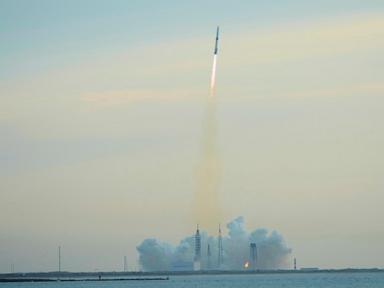
The Sunday morning sun over Cape Canaveral usually signals a win for the private space sector. On April 19, 2026, as the 320-foot New Glenn rocket tore through the Florida sky, it looked like Jeff Bezos had finally achieved parity with his rivals at SpaceX. The first-stage booster, affectionately named "Never Tell Me The Odds," performed a textbook return-to-launch-site maneuver, touching down on the drone ship Jacklyn with the grace of a seasoned veteran.
But as the cheers erupted at Launch Complex 36, a silent catastrophe was unfolding 100 miles up. The rocket’s second stage, tasked with the delicate delivery of AST SpaceMobile’s BlueBird 7 satellite, faltered. A BE-3U engine failed to maintain thrust during its second critical burn, dumping the massive, multi-million-dollar cellular broadband satellite into a shallow, "off-nominal" orbit. Within 24 hours, the U.S. Space Force confirmed the worst. The upper stage and its precious cargo had re-entered the atmosphere, burning up as a streak of expensive debris over the ocean. For a different perspective, see: this related article.
Blue Origin is now grounded. The Federal Aviation Administration (FAA) has halted all New Glenn operations, and while the company is framing this as a learning opportunity, the reality is far more grim. This isn’t just a technical glitch. It is a fundamental blow to the credibility of a heavy-lift platform that is supposed to be the backbone of NASA’s return to the Moon and Amazon’s Project Kuiper.
The Illusion of Reuse
For years, the space industry has been obsessed with the "booster landing." It is the ultimate visual proof of competence. Blue Origin achieved this on Sunday, proving they can recover hardware. However, the obsession with the first stage has masked a recurring vulnerability in the second stage—the part of the rocket that actually finishes the job. Further reporting regarding this has been shared by Reuters Business.
The first stage is a brute. It provides the muscle to escape the thickest parts of the atmosphere. The second stage, however, is a precision instrument. It must operate in a vacuum, restart its engines multiple times, and maintain perfect orientation for hours. On mission NG-3, the first stage was a refurbished unit from the previous year. Blue Origin spent months touting the "refurbishment" process, replacing all seven BE-4 engines on the booster to ensure success. They focused so heavily on the "reusable" narrative that the expendable upper stage—the component that actually failed—seemed like an afterthought in the public-facing mission goals.
Reliability is not a binary state. You can land a hundred boosters, but if your upper stage can’t reach the target coordinates, you aren't a launch provider; you're an expensive fireworks coordinator.
The AST SpaceMobile Collateral Damage
The victim of this failure is AST SpaceMobile, a company attempting to build the world’s first space-based cellular network. Their BlueBird 7 satellite featured a 2,400-square-foot phased array antenna—the largest civilian antenna ever deployed in low-Earth orbit. It was designed to turn every standard smartphone into a satellite phone, bridging the gap for the billions of people living outside the reach of cell towers.
Now, that hardware is ash. While AST SpaceMobile maintains it has insurance and an aggressive launch manifest with other providers, the loss of BlueBird 7 is a massive setback for the "direct-to-device" race.
- Timeline Shifts: Every failed launch adds three to six months of data analysis and hardware lead time.
- Investor Jitters: Satellite constellations require billions in upfront capital. Groundings shake the confidence of the private equity firms funding the hardware.
- Manifest Crowding: With New Glenn grounded, AST must look to SpaceX’s Falcon 9 or India’s LVM3. Both are already booked solid through 2027.
Blue Origin’s failure has effectively handed a head start to competitors like SpaceX’s Starlink and Amazon’s own internal Kuiper project, creating a conflict of interest that few in the industry are willing to discuss openly.
The Shadow of the Moon
The stakes for New Glenn extend far beyond commercial satellites. NASA has bet the farm on this rocket. Under the Artemis program, Blue Origin is contracted to provide the "Blue Moon" lunar lander. That lander is too heavy for any existing rocket other than New Glenn or SpaceX’s Starship.
If the FAA investigation reveals a systemic issue with the BE-3U engines or the second-stage fuel delivery systems, the Artemis III and IV timelines are in jeopardy. NASA cannot certify a human-rated lander if the delivery vehicle is prone to "off-nominal" orbits. The agency is already under fire for the mounting costs and delays of the Space Launch System (SLS). Relying on a commercial partner that is currently grounded by the FAA is a political nightmare for the administration.
Engineering the Way Out
CEO Dave Limp, who took the helm to bring "Amazon-style" efficiency to the rocket company, is now facing his first true trial. The preliminary data points to a thrust deficiency in the upper stage. In aerospace terms, this usually means one of three things:
- Turbo-pump cavitation: A mechanical failure in the high-speed pumps that feed liquid hydrogen and oxygen to the engine.
- Thermal management failure: A leak in the cooling lines that causes the engine to overheat and shut down prematurely to prevent an explosion.
- Software miscalculation: A guidance error that caused the engine to shut down early because it "thought" it had reached the target velocity when it hadn't.
None of these are quick fixes. They require a total teardown of the manufacturing process at the Merritt Island factory.
The "Old Space" approach was to spend a decade testing every bolt. "New Space," led by SpaceX, is to fly, fail, and fix. Blue Origin is trying to exist in the middle—a dangerous "gray zone" where they take the risks of rapid development but lack the launch cadence to iterate through failures quickly. With only three New Glenn launches in the history of the program, every failure carries a 33% statistical weight. That is a terrifying number for a company trying to sell reliability.
The Harsh Reality of the Launch Market
The launch industry is currently a monopoly masquerading as a market. SpaceX dominates the landscape because they have achieved a "launch-land-repeat" cycle that is almost boring in its consistency. Blue Origin was supposed to be the "Great Disruptor," the well-funded challenger that would bring prices down through competition.
Instead, New Glenn is sitting in a hangar.
The company has a backlog of dozens of missions, including a massive commitment to launch half of Amazon’s 3,000-satellite Kuiper constellation. If they cannot resolve the second-stage issues by the end of the year, Amazon may be forced to pay its direct rival, SpaceX, to launch its own satellites. That would be the ultimate humiliation for Bezos, and a signal that the heavy-lift market is still a one-horse race.
The FAA investigation will likely take months. Engineers will pore over telemetry, metallurgy reports, and sensor data. They will find the "why." But the "how"—how Blue Origin recovers its reputation as a reliable partner—is a much more difficult question. In the vacuum of space, there is no room for "almost." You are either in orbit, or you are a very expensive shooting star.
Grounding the rocket is the easy part. Building the trust to let it fly again is the real mission.