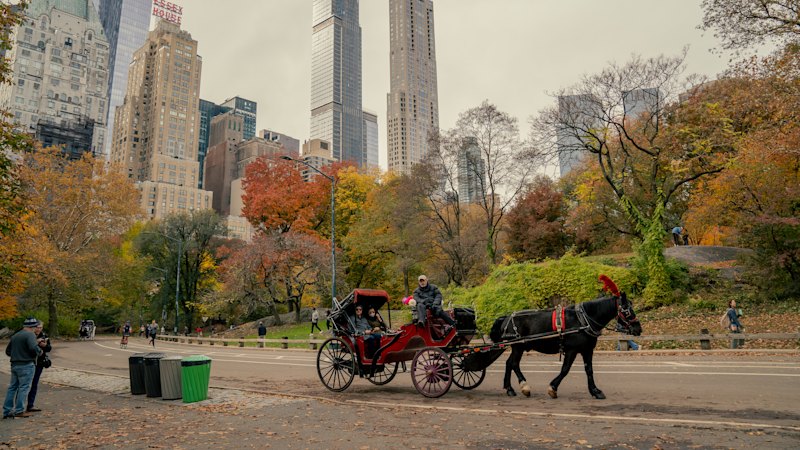
New York City voted in October 2026 to outlaw horse-drawn carriages by June 2028 under Romanch’s Law, ending a 160-year-old street fixture after a fatal carriage crash in Central Park. Yet the real story is not a neat victory of compassion over nostalgia. It is a collision between property rights, municipal liability, and unresolved labor economics that could tie up the city in court long after the June 2028 deadline passes.
For decades, standard coverage of the Central Park horse carriage ban has treated the dispute like a movie script. On one side stand animal welfare groups, celebrity boosters, and politicians promising a gentler park. On the other stand carriage drivers in top hats and flat caps, accused by critics of cruelty and defended by allies as keepers of Old New York.
That framing misses how city hall actually moves. Laws rarely pass on sentiment alone. They pass when political risk, insurance exposure, and tragedy converge at the exact same moment.
What Sparked the Vote After Decades of Stalemate
Mayors have tried to kill the carriages before and failed. Bill de Blasio campaigned on ending the trade on day one back in 2013, only to watch his push stall out amid union resistance, lobbying, and shifting political math.
Then came June 2026. An 18-year-old tourist from India, Romanch Mahajan, died after a horse bolted in Central Park and he was thrown from a carriage. Reports indicated he jumped to help his mother after she fell out when the animal panicked.
One death changed the arithmetic overnight. Advocacy groups rallied around the tragedy, and the City Council moved ahead with legislation bearing Mahajan’s name—Romanch’s Law—passing it by a 40-7 margin in October. Even the Central Park Conservancy, which oversees one of the busiest urban parks in the world with roughly 42 million annual visits, backed the shift as a public health and safety issue.
A public park with tens of millions of walkers, runners, cyclists, and families leaves almost zero margin for a startled horse in heavy traffic or crowded loops.
Having covered New York municipal politics and regulated transit for years, I have watched plenty of symbolic votes fizzle out once lawyers read the fine print. This vote carried real teeth because the liability picture had shifted. When a horse collapses in summer heat, bolts on asphalt, or collides with a vehicle, the city’s regulatory oversight and public safety posture come under immediate scrutiny.
Still, speed in the council chamber does not guarantee clean execution on the pavement. Passing a ban is easy. Unwinding a licensed trade without triggering massive constitutional claims is the hard part.
The Medallion Trap Behind Every Carriage Ride
Most casual readers picture a carriage owner as someone who buys a horse and a wagon, parks near 59th Street, and collects $150 for a 45-minute ride. That is not how a regulated medallion system works.
New York began issuing carriage medallions in the late 1940s, operating a cap-and-license structure roughly analogous to taxi medallions. With roughly 68 carriages, 160 horses, and just over 200 licensed drivers, the sector is small by city standards, yet concentrated around high-value permits.
Medallions cost owners substantial sums over the years—reportedly up to $400,000 apiece in some cases, putting total medallion value around $25 million. For many small operators and immigrant-run family businesses, that permit was not just a business asset. It was their retirement plan.
Here is where the policy gets messy. A municipal ban that wipes out the economic value of a government-issued license invites immediate Takings Clause and due process litigation. If the city says your medallion is worthless in June 2028, owners will argue the government took private property without fair compensation.
Mayor Zohran Mamdani, who took office in January 2026 and faced a late-November deadline to sign the measure after its October passage, unveiled a transition framework in mid-November. The plan promises:
- Medallion buybacks for carriage owners leaving the trade.
- Job training, career guidance, and tuition assistance for roughly 200 workers through a program operated with LaGuardia Community College.
- A full transition blueprint due in April 2027, giving workers a little over a year before the planned June 2028 cutoff.
- Restrictions on horse disposition, barring owners from selling the animals for slaughter or into other horse-carriage operations.
On paper, those pieces sound reasonable. In practice, promises without locked-in appropriations make unions nervous.
Why the Labor Fight Will Outlast the Headlines
Transport Workers Union Local 100 and TWU International President John Samuelsen have not treated the November announcement as a truce. Samuelsen dismissed the legislative language as lacking concrete funding, mandates, or ironclad guarantees, warning that budget shortfalls could leave workers stranded.
Consider a hypothetical example to see how fiscal reality collides with political pledges. Suppose New York faces a tight municipal budget cycle in late 2027 or 2028 as agency costs climb. A non-binding or underfunded buyback program becomes an easy target for budget trimmers, leaving an owner holding a retired carriage, an aging horse, and a voucher that does not cover debt service on a medallion.
Even with good intentions at LaGuardia Community College, retraining veteran carriage drivers is not a simple swap. Driving a horse-drawn carriage requires specific handling skills and irregular outdoor hours. Retraining into another trade takes time, wage stability, and real employer demand—not just a brochure.
Meanwhile, tensions on the street have already flared. Union leaders reported assaults on carriage drivers in mid-November 2026, including an altercation involving an illegal pedicab hawker near Sixth Avenue, demanding steadier police presence at carriage stands during the transition window.
A 19-month countdown to a ban is a long time for a cornered industry to operate in a heated environment. Drivers still have bills to pay today. Critics still see animals on hard pavement. Police are stuck refereeing a policy battle in real time.
Electric Carriages Are No Silver Bullet
Whenever horse carriage bans gain momentum, someone pitches an electric replacement. City officials have indicated they will study electric carriages and electric pedal-assist bicycles as possible substitutes around Central Park.
Anyone who knows urban park management should view that idea with healthy skepticism. Central Park spent years pushing motor vehicles out of its interior drives so pedestrians, runners, and cyclists could move freely without exhaust or engine noise.
Bringing low-speed electric tourist vehicles into those loops creates its own friction. Sightlines get crowded. Pedestrians step off curbs without looking for quiet electric motors. Even if an electric carriage emits zero tailpipe pollution, a heavy tourist vehicle moving through park paths still alters the shared space.
| Factor | Horse-Drawn Carriages | Electric Alternatives |
|---|---|---|
| Primary Risk | Animal startle, heat stress, collisions | Pedestrian congestion, path conflicts, charging logistics |
| Cultural Identity | Longstanding visual icon with deep heritage claims | Newer tourism gadget with no organic history |
| Property & Labor Issue | Medallion buybacks, horse placement, driver retraining | Fleet procurement, maintenance, operator licensing |
| Park Space Impact | Uses designated lanes and stands with distinct presence | Adds motorized/assisted tourist traffic in shared spaces |
Nor does an electric carriage solve the human side of the ledger. A battery-powered phaeton does not automatically carry the same fare premium or sentimental pull as a real horse, and there is no guarantee displaced horse drivers will want—or be offered—roles operating electric tourist fleets.
What Happens Next in Court and City Hall
Lawsuits are almost certain. Union lawyers have already signaled plans to challenge the ban in federal court, arguing improper taking of property without just compensation.
In New York, court battles over municipal bans can drag on for years. A stay, an injunction, or prolonged appellate review could push real-world enforcement well past June 2028—potentially even past the next City Council election cycle in November 2029.
That uncertainty leaves everyone in limbo. Horse owners face decisions about breeding, leasing, or retiring animals without final buyback terms. City officials must draft an April 2027 transition plan that can survive both courtroom scrutiny and comptroller math.
Watch two concrete benchmarks over the coming months: whether the city locks in hard dollar figures for medallion buybacks in the April 2027 plan, and whether a federal judge grants or denies early injunctive relief. Everything else is just noise until the checks—or the court orders—actually arrive.