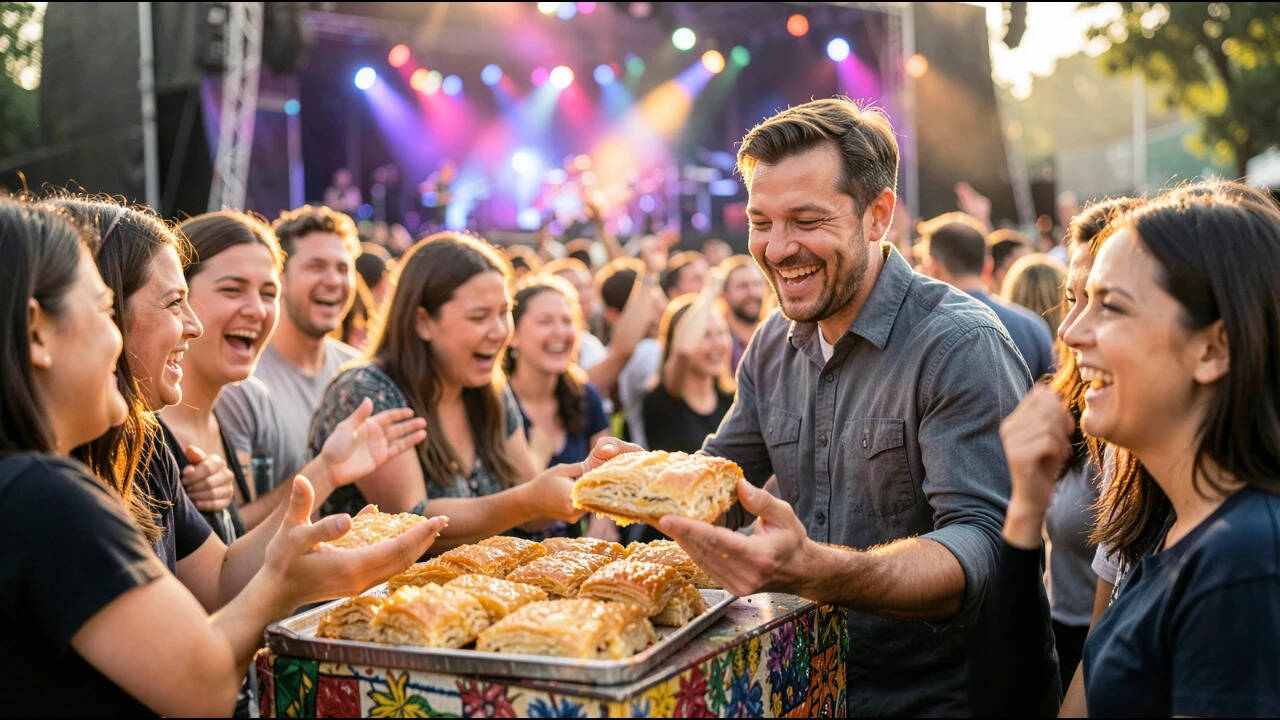
Turning street baklava sales at concerts into a $70,000 monthly operation requires exploiting extreme time compression, high-sugar impulse cravings, and low-perishability unit economics that most mobile food sellers overlook. When thousands of concertgoers pour out of arenas or amphitheaters late at night, traditional hot-food trucks face slow grill times, grease fires, and impatient lines. Baklava flips that bottleneck. Pre-baked, shelf-stable for weeks at room temperature, and easy to hand over in clam shells or wax bags, it turns a two-hour crowd window into pure throughput.
Anyone who has covered street vending for twenty years knows headline revenue numbers rarely tell the whole story. A $70,000 month sounds like a gold rush until you price out commercial kitchen rent, municipal permits, liability insurance, wholesale phyllo, walnuts, pistachios, honey, and the bruised shins of hauling racks across uneven pavement at midnight.
Why Pastry Beats Burgers Outside Live Venues
Hot street food loses money when service speed drags. A smash burger takes three to four minutes on a flat-top, and a taco cart can stall if a customer asks for custom toppings while forty people wait behind them. Baklava is already finished before the first soundcheck ends.
You grab a pre-portioned box, take tap-to-pay or cash, and move the line forward in seconds. Speed matters outside live venues because crowd density peaks in tight bursts—before doors open, during set breaks if the venue is porous, and in the forty-five minutes after the encore when everyone wants a snack on the walk to transit or rideshare pickup.
Sugar and fat also hit differently after a three-hour show. Concertgoers are often dehydrated, mildly fatigued, and running on adrenaline rather than sitting down for a balanced meal. A dense square of crisp phyllo soaked in honey or sugar syrup delivers immediate caloric punch without needing utensils, a table, or a napkin station.
That does not mean every sweet sells. Cupcakes squish in a crowd. Ice cream melts under heat lamps or summer humidity. Chocolate softens and smudges fingers. Baklava holds its shape, tolerates cool night air or warm evenings, and feels artisanal enough to justify a higher price tag than a convenience-store candy bar.
The Unit Economics Behind a $70,000 Month
Let us look at the math using a hypothetical example to see how a street operation could reach $70,000 in gross monthly sales without inventing secret tricks. Suppose a vendor averages $8 per piece or $14 per two-piece box across high-volume event nights. At an average ticket of $12, reaching $70,000 in a thirty-day month requires roughly 5,833 transactions—about 194 transactions a day across the whole month, or closer to 400 to 500 transactions on major concert nights if quieter weekdays bring in less.
That volume is steep. One person working a single cart alone cannot hand out five hundred boxes during a post-show rush without dropping payments, miscounting inventory, or losing sales to impatient walkers. Scaling to that tier almost always requires multi-cart deployment, two-person crews per spot (one handler, one point-of-sale operator), or a wholesale-plus-street hybrid where local cafes and event promoters buy trays alongside direct sidewalk sales.
Gross revenue is not take-home pay. Nut prices swing sharply depending on crop yields and import tariffs, and pistachios or roasted walnuts often account for one of the largest ingredient line items in authentic baklava. Butter or clarified butter, phyllo sheets, honey, sweeteners, packaging, fuel, vehicle maintenance, and commissary kitchen fees all chip away at gross margin.
High gross sales outside a stadium mean very little if commissary storage, spoilage, and late-night labor eat half the margin before tax season arrives.
Consider what happens when a vendor tries to cut ingredient corners to boost margin. Switching from butter to cheap shortening or substituting thin corn-syrup glazes for real honey might save a dollar per batch on paper, yet repeat buyers outside local venues notice the difference immediately. Street food lives or dies on word of mouth among regulars who go to shows every week.
Street Vending Versus Venue Concessions
Concession stands inside arenas and amphitheaters operate under completely different economics than sidewalk or perimeter vendors. Inside the gates, venues charge steep percentage splits, minimum guarantees, or high booth fees, and captive audiences pay whatever the concourse menu lists. Outside the gates, a street vendor pays no cut to the promoter—unless they are set up on private lots with a landowner agreement—but they face constant friction over public right-of-way rules, health department compliance, and police enforcement.
Cities treat mobile vending unevenly. One municipality welcomes permitted carts near transit corridors with clear health grades and fire-extinguisher checks. Another sweeps unpermitted pop-ups the moment a show lets out, confiscating gear or issuing citations that wipe out a week of profit in a single night.
| Operating Factor | Perimeter Street Vendor | Inside Venue Concession |
|---|---|---|
| Upfront Access Cost | Permits, commissary, cart or van, lot fees | High booth fee, guarantee, or revenue share |
| Crowd Capture | Walk-by traffic before and after shows | Captive crowd throughout the entire event |
| Regulatory Friction | Municipal vending laws, health codes, enforcement | Venue contract, insurance, union or staffing rules |
| Pricing Power | Constrained by nearby street food and convenience options | High markups backed by convenience and no exit |
| Weather Exposure | Direct rain, wind, heat, and cold | Mostly indoor or covered concourse protection |
Neither model is a free lunch. Inside venues offer predictable foot traffic when a big act books the building, while outside streets carry weather risk and cancellation exposure if a tour postpones or a storm clears the plaza early. Experienced operators hedge by pairing street nights with farmers' markets, cultural festivals, and pre-orders for local offices or family gatherings.
Hidden Bottlenecks That Break Scaling Vendors
Most street food businesses do not fail because nobody likes the recipe. They stall because baking capacity hits a wall right as demand picks up.
Rolling, layering, brushing fat, scoring, baking, cooling, syruping, and cutting hundreds or thousands of pieces of baklava takes hours of quiet prep work. A small residential or shared commercial oven can bake only so many sheet pans per shift. If you sell out at 9:30 p.m. on a Friday, you leave money on the table—but if you overbake by four hundred pieces and rain washes out Saturday's crowd, you are stuck holding inventory that loses peak crispness over time.
Labor reliability is the second quiet trap. Late-night event shifts run from 5:00 p.m. to past midnight, often in cold wind or sticky heat, with heavy lifting and zero glamour. Finding trustworthy helpers who show up on time, handle cash and card readers cleanly, and stay calm when a crowd surges is harder than perfecting a syrup ratio.
Payment and theft risks rise in dark, crowded environments. Tap-to-pay terminals speed up lines and reduce cash-handling errors, yet dead cellular zones outside concrete arenas can stall card processing at the worst possible moment. Offline payment modes help, though chargebacks and declined cards still happen.
What Makes a Niche Street Concept Stick
Novelty gets a first look; consistency builds a livelihood. Baklava stands out outside concerts precisely because it is unexpected—most people expect hot dogs, pretzels, or fries near a venue. That surprise factor makes passersby stop, look, and ask what it is.
Offering a quick sample or a clear two-tier choice—say, classic walnut and pistachio—prevents decision paralysis when a line is moving fast. Too many flavors slow down ordering and complicate prep batches. Two or three distinct options usually hit the sweet spot between variety and operational sanity.
Packaging also pulls weight in the dark. A sturdy box or grease-resistant sleeve that survives a walk to a parking garage or subway platform protects the pastry and acts as mobile branding on city streets the next morning.
Real street success is rarely an overnight viral fluke. It is usually years of cold hands, early oven starts, bruised shins, and stubborn math that finally clicks when you stop guessing and start counting every pan. Start your next prep run by timing every minute from dough to box—if you cannot scale the bake cleanly, a bigger crowd will only expose the bottleneck faster.