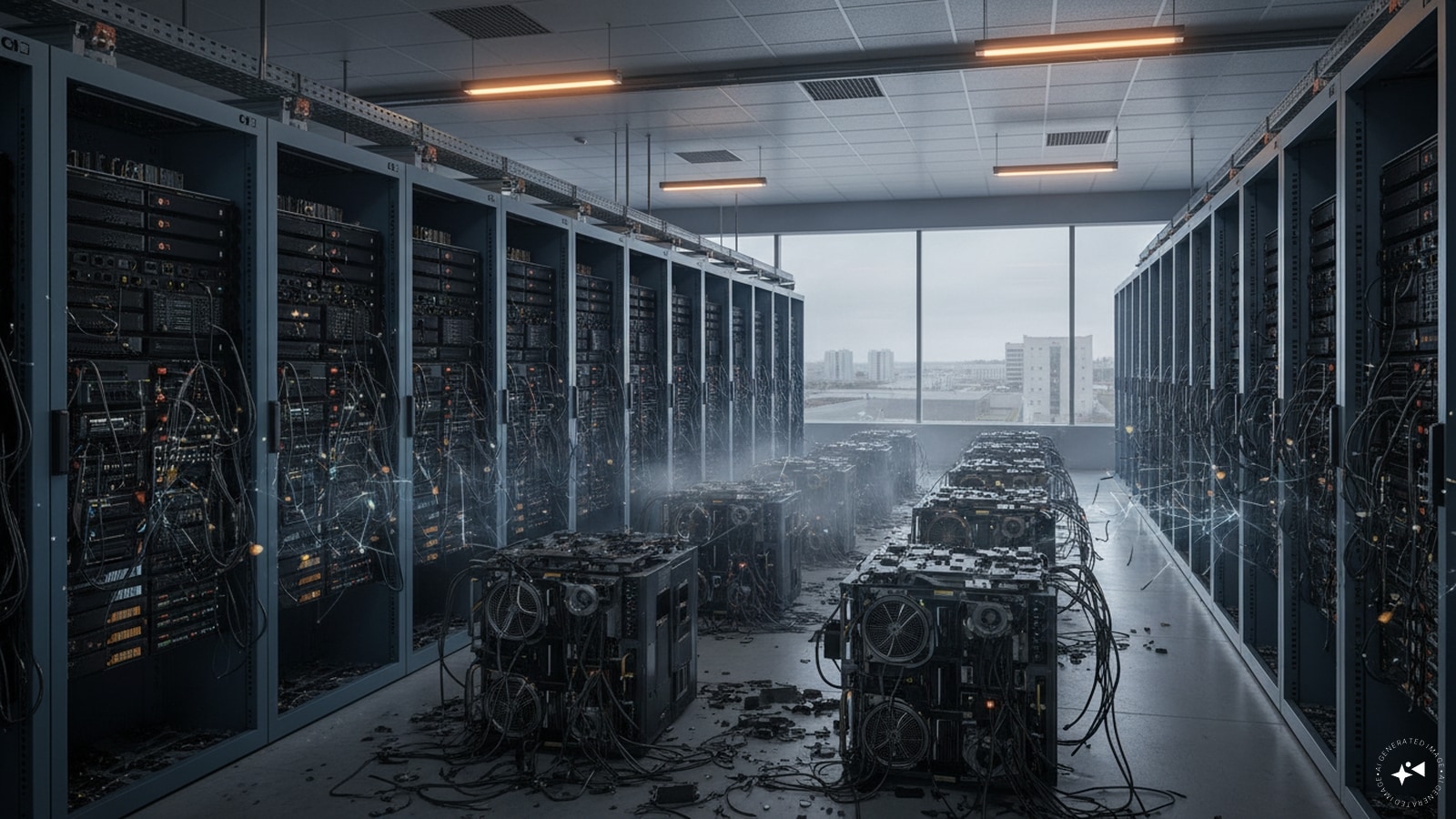
Strikes on Russian data centers target the physical compute clusters, cooling plants, and high-voltage substations that keep civilian digital services online while starving domestic artificial intelligence labs of scarce accelerator hardware. For years, analysts treated modern warfare as a split screen between kinetic frontlines and cyber operations. That neat division is breaking down. When long-range drones and sabotage teams hit server halls, fiber routes, and power feeds, software redundancy runs straight into physical physics.
I have covered infrastructure resilience, telecom buildouts, and compute economics long enough to spot a structural choke point when one opens. Attacking a data center is not like defacing a government portal or knocking a banking app offline for twenty minutes. Code can be recompiled and pushed to a mirror node if the underlying hardware still breathes. Melted power distribution units, ruptured chilled-water loops, and blistered GPU racks do not heal with a software patch. They demand replacement parts, specialized technicians, and continuous megawatts.
The basic premise behind targeting these facilities is straightforward. Modern states run on centralized cloud and colocation hubs, and advanced AI systems depend on dense clusters of specialized processors wired together at high bandwidth. Hit the physical nodes and you degrade both everyday administrative and commercial services and long-term technical ambitions at the same time. Yet treating every strike as a fatal blow to Russian AI research misses how compute workloads actually behave under pressure. Some training runs stall for months. Other workloads simply migrate, throttle, or wait out the storm.
Why Physical Compute Became a Battlefield Target
For over a decade, military doctrine assumed that disrupting digital systems meant writing better exploit code or saturating network links. Kinetic strikes were reserved for airfields, fuel depots, command posts, and rail yards. Data centers sat in a blurry middle ground because they often look like plain industrial warehouses from the outside and house commercial tenants alongside state or defense-linked customers.
Modern long-range strike systems changed the math. Drones with greater range, improved navigation, and lower unit costs allow attackers to reach deeper into rear areas where commercial colocation sites, regional telecom exchanges, and energy substations sit. At the same time, modern AI training has concentrated value inside compact physical footprints. Thousands of high-power chips packed into a few racks represent tens or hundreds of millions of dollars in capital expenditure and years of sanctions-evasion logistics.
A single facility rarely holds one clean purpose. In Russia, as in almost every large economy, server halls mix enterprise hosting, cloud rentals, content delivery caches, and specialized compute clusters under shared roofs or shared power feeders. Striking a hub that serves municipal portals, logistics firms, or financial back-ends creates immediate friction for ordinary operations. If an adjacent or co-located hall houses neural network training nodes or inference servers, the same disruption ripples into research and development.
Still, observers should be careful not to conflate a service outage with a permanent collapse in model development. Large AI training runs are notoriously fragile even in peacetime. Hardware failures, interconnect hiccups, and power sags happen routinely inside well-funded Western clusters. When a strike knocks out a facility or forces an emergency shutdown to protect equipment from thermal damage, the immediate cost is lost wall-clock time and wasted checkpoint cycles. That hurts. It does not automatically erase weights saved to off-site storage or destroy every server in the country.
How Data Center Disruptions Ripple Through Services and AI
To understand what actually breaks when a data center takes a hit, you have to follow the energy and heat before you look at the code. A high-density compute hall is essentially an indoor power plant paired with an industrial refrigerator. Cut either side and the silicon inside goes dark or cooks itself.
Power Feeds and Thermal Fragility
Compute clusters draw massive, steady electrical loads. When strikes target substations, transformer yards, or high-voltage lines feeding a data center district, backup diesel generators kick in. Generators are lifelines, not miracles. They require fuel deliveries, routine maintenance, and proper load balancing. If a generator fails to transfer cleanly, or if fuel logistics tighten under drone threats near energy infrastructure, operators face a grim choice between brownouts, rolling shutdowns, or hardware damage.
Cooling is the quieter killer. Modern AI accelerators push extreme thermal density into tight enclosures. If chillers lose power or coolant lines rupture from blast pressure or debris, temperatures inside a rack climb fast. Automated thermal throttling slows computation to a crawl, and prolonged heat spikes shorten component lifespans or cause outright board failures. Even a strike that misses the main server hall by a few hundred meters can force an orderly power-down that costs days of synchronization and recovery.
Distributed Training Versus Everyday Workloads
Everyday digital services and frontier AI training fail in very different ways. A consumer web service, cloud storage bucket, or enterprise database is usually built around replication across availability zones and regions. When one site goes offline, traffic shifts to surviving nodes, latency rises, queues back up, and some regional functions degrade until failover stabilizes. Users notice slowdowns, login errors, or missing features.
Distributed AI training is far less forgiving. Training a large model across hundreds or thousands of interconnected accelerators relies on high-throughput, low-latency links so gradients and model parameters stay synchronized across nodes. If a strike severs a regional fiber trunk, knocks out a top-of-rack or fabric switch cluster, or forces half the cluster offline due to a local power sag, the remaining nodes often sit idle waiting on stragglers. Training slows dramatically or halts until the topology is repaired and rolled back to a valid checkpoint.
Inference and smaller fine-tuning jobs have more room to maneuver. A company running smaller models for translation, document sorting, surveillance analytics, or customer support can often shift inference traffic to smaller local servers, older hardware generations, or alternative cloud regions. Large-scale foundation model runs do not bend as easily. They need contiguous power, dense cooling, and tight interconnects over long stretches of time.
The Sanctions Bottleneck Behind Every Damaged Rack
Kinetic damage hits hardest where supply chains are already stretched thin. Unlike Western hyperscalers that can order replacement servers, optical transceivers, and power gear through direct vendor contracts with predictable lead times, Russian operators have spent years navigating export controls and gray-market procurement.
Replacement hardware is not just scarce. It is expensive, slow to clear customs or intermediary routes, and often lacks official manufacturer warranties or direct firmware support. When a strike destroys specialized networking gear, liquid-cooling manifolds, or high-end accelerator cards, replacing those specific parts takes longer and costs more than it would in an unrestricted market.
Hardware attrition hits harder when every replacement unit has to travel through indirect supply chains and carries a steep markup.
This reality shapes how infrastructure managers behave. Operators hoard spare parts. They run older servers longer than ideal. They spread workloads across smaller, more dispersed sites rather than betting everything on one flagship mega-campus. Dispersion reduces single-strike devastation, yet it introduces its own penalty. Splitting compute across smaller or geographically separated facilities makes high-bandwidth cluster training harder to coordinate and increases operational overhead.
Consider a hypothetical example to see how those trade-offs collide. Suppose an operator runs a regional compute hub housing both commercial cloud clients and an experimental AI cluster. A drone strike damages a nearby substation and shatters glazing and ductwork on an auxiliary building, leaving the core server vault structurally intact but forcing a twelve-hour thermal and electrical shutdown. Commercial customers experience a rough day of degraded cloud access and delayed batch jobs. For the AI team mid-way through a multi-week training run, twelve hours of downtime plus checkpoint restoration and hardware diagnostics can easily cost a full week of effective progress—and if two liquid-cooling pumps burned out during the transition, the cluster may run at reduced capacity until replacement pumps arrive from abroad.
Counter-Arguments and Overlooked Factors
Any serious assessment has to push back against neat narratives. Two common mistakes show up whenever data center strikes make headlines. The first is assuming strikes alone can cripple an entire national compute base overnight. The second is assuming AI labs are sitting ducks with no room to adapt.
Russia is a vast country with abundant domestic energy resources, established industrial engineering, and a deep pool of systems engineers who know how to keep aging hardware running under adverse conditions. Not every AI project requires bleeding-edge foreign accelerators housed in Western-style tier-four data centers. Applied research, narrow domain models, robotics control experiments, and smaller-scale training can run on more modest hardware or distributed setups.
There is also a strategic trade-off for the side launching strikes. Data centers and power nodes sit on a spectrum between military utility and civilian impact. Hitting infrastructure tied to defense logistics, state networks, or military-relevant compute may be framed as degrading warfighting capacity. Yet when strikes disrupt commercial cloud hosting, financial systems, telecom routing, or municipal services, they affect civilians and non-military businesses too. Escalation dynamics, air-defense reallocation, and international scrutiny all factor into how sustainable and effective such campaigns remain over time.
| Dimension | Everyday Digital Services | Large-Scale AI Training |
|---|---|---|
| Primary failure mode | Latency spikes, regional outages, queued requests | Stalled training runs, lost sync cycles, checkpoint rollbacks |
| Sensitivity to power and cooling | High for uptime; failover can mask brief blips | Extreme; thermal or power drops can halt entire clusters |
| Ability to shift workloads | Moderate to high via replication and routing | Low for large tightly coupled runs; moderate for smaller inference |
| Impact of hardware replacement delays | Slower capacity growth and higher maintenance load | Extended project timelines and forced architectural compromises |
Overlooked operational factors matter just as much as headline strikes. Physical hardening, hardened power routing, underground or reinforced cable entries, air-defense coverage around critical energy and telecom hubs, and decoy or dispersed sites all shape strike outcomes. A facility does not need to be indestructible to frustrate attackers. It only needs enough redundancy and repair speed to keep critical functions limping forward faster than strikes can knock them down.
What This Shift Means for Infrastructure and AI Strategy
Watching physical strikes collide with compute infrastructure changes how defense planners, enterprise architects, and AI researchers think about resilience. For decades, digital resilience meant cloud regions, redundant fiber paths, and automated failover scripts. Those tools still matter, especially against software outages and cyberattacks. They do not repeal the laws of thermodynamics or supply-chain gravity.
Resilient compute requires physical planning alongside digital engineering. Power autonomy, fuel security, thermal buffer capacity, rapid modular replacement, and geographic dispersion are no longer niche concerns for bunkers and industrial plants. They sit right at the center of compute strategy.
For AI developers, the lesson is equally blunt. Concentrate all your eggs in one fragile basket—one power feed, one cooling loop, one hard-to-replace cluster—and a single physical shock can set a roadmap back by months. Build modular pipelines, checkpoint aggressively to resilient storage, keep workloads portable across heterogeneous hardware where feasible, and treat physical infrastructure risk as a first-order engineering constraint rather than an afterthought.
Physical warfare has reached the server rack, turning kilowatts, coolant, and spare parts into front-line variables of technical power.