Since 2015, Houthi forces have surrounded Yemen's third-largest city, cutting off major highways, water supplies, and commercial arteries in a blockade that local officials warn is pushing Taiz back to the stone age. While international headlines focus on Red Sea shipping lanes and regional power plays, the systematic isolation of nearly four million residents inside the Taiz governorate represents one of the longest-running urban sieges in modern warfare, transforming a former industrial and cultural hub into a fractured enclave dependent on treacherous mountain goat tracks for basic survival.
The rhetoric from local leadership is stark, yet it barely scratches the surface of the structural degradation occurring on the ground. Governorate officials have repeatedly sounded the alarm that the blockade is not merely a military tactic designed to force a surrender, but a slow-motion dismantling of modern civic life. When factories close because raw materials cannot cross checkpoints, when hospitals ration fuel for dialysis machines, and when municipal water networks sit dry inside Houthi-controlled territory while residents pay exorbitant rates for trucked water, the regression is literal.
The Geography of a Chokehold
To understand why Taiz has endured over a decade of encirclement without falling or breaking free, one must look at the topography. Nestled in the southwestern highlands of Yemen, the city sits in a basin ringed by rugged mountains. Control the peaks and the passes, and you control the pulse of the valley below.
When the conflict escalated in early 2015, Houthi fighters and allied forces seized the high ground surrounding the city—most notably the hills of Sofitel, Al-Sallal, and the towering Jabal Sabir, though anti-Houthi forces later recaptured parts of the mountain. By positioning snipers and artillery on the remaining ridges and establishing heavily fortified checkpoints along the primary arterial roads connecting Taiz to Sanaa, Hudaydah, and Aden, the besieging forces effectively severed the city from the rest of the country.
Before the war, a commercial truck could travel from the southern port city of Aden to Taiz in roughly two to three hours along the smooth, paved Al-Turbah road or the main highway through Lahj. Those routes were either cut by active frontlines or choked by Houthi blockades.
In their place, commerce and civilians were forced onto Hayjat Al-Abed, a terrifying, hairpin-turn mountain pass never engineered for heavy freight. Imagine navigating a fully loaded eighteen-wheeler down a sheer cliff face where a single mechanical failure means plunging hundreds of feet into a rocky gorge. For years, this single crumbling road served as Taiz's primary lifeline. Frequent rockslides, overturned tankers, and fatal crashes turned basic logistics into a daily gamble with death, multiplying transport costs by five or ten times and passing those expenses directly onto an impoverished population.
Water as a Silent Weapon
Modern cities do not survive on bullets and bread alone; they survive on municipal infrastructure. In Taiz, the division of the city split the urban core—largely held by forces aligned with the internationally recognized Yemeni government—from the outer industrial districts and vital resource basins controlled by the Houthis.
The most devastating consequence of this geographic split involves water. Taiz has always been one of the most water-stressed cities in the Middle East, relying heavily on deep aquifers located in basins outside the central urban perimeter, such as Al-Hawban and Habir.
Because these water fields and the main pumping stations sit behind Houthi lines, the supply to the city center was largely shut off early in the siege. Residents who once turned on a tap now rely on private water trucks that must navigate long detours or pay heavy fees at checkpoints.
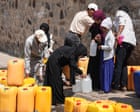
This artificial scarcity has created a brutal secondary economy. Families spend up to a third of their meager monthly incomes just to buy enough water for drinking and basic sanitation. Those who cannot afford private deliveries send children with yellow jerrycans to line up at charitable distribution points, where contaminated water frequently triggers outbreaks of cholera and acute watery diarrhea. Stripping a metropolis of running water does not require bombing every building; it simply requires turning a valve and waiting for disease and exhaustion to do the rest.
The Dismantling of an Industrial Powerhouse
Long before the current war, Taiz was widely regarded as the intellectual and industrial heart of Yemen. Unlike the tribal power centers of the north or the port-focused economy of the south, Taiz boasted the country's highest literacy rates, a vibrant civil society, and a concentration of major manufacturing conglomerates.
The Hayel Saeed Anam Group, Yemen's largest private business conglomerate, originated in the Taiz region, alongside factories producing plastics, dairy products, biscuits, textiles, and pharmaceuticals. These industries employed tens of thousands of workers and generated the tax base that kept municipal services running.
The siege shattered this ecosystem. Major industrial zones in Al-Hawban found themselves on the Houthi side of the frontline, physically separated from the workforce living inside the city center. Conversely, smaller workshops and commercial enterprises inside the besieged enclave were starved of electricity, fuel, and spare parts.
When the central power grid collapsed in 2015, Taiz plunged into darkness. Unlike wealthier cities that could rapidly deploy massive diesel-powered micro-grids, Taiz's isolation made fuel imports astronomically expensive. Today, commercial solar panels dot the rooftops of those who can afford them, while the rest of the city relies on car batteries, candles, or pitch darkness after sunset. Factories that once exported goods across the Arabian Peninsula now sit idle, their machinery rusting, their skilled engineers either displaced abroad or driving motorcycles to earn a few thousand Yemeni rials a day.
The Checkpoints and the War Economy
It would be a mistake, however, to view the suffering in Taiz solely through the lens of Houthi military aggression. A veteran look at any protracted siege reveals an uncomfortable truth: prolonged blockades inevitably breed a domestic war economy where actors on all sides profit from the misery.
While the Houthis maintain the external stranglehold—collecting customs duties at makeshift border crossings like Al-Hawban and taxing every sack of flour entering the city—internal fragmentation within the anti-Houthi camp has compounded the crisis. The forces defending Taiz are not a unified, disciplined army. They are a patchwork of factions, including brigades aligned with the Islah party, Salafist militias, and units backed by the Tariq Saleh-led National Resistance on the western coast.
Checkpoints proliferate not just on the frontlines, but deep inside government-held territory. Merchants moving goods along the tortuous southern routes report paying unofficial levies and "security fees" at multiple stops before their cargo even reaches a Taiz market.
How the Siege Inflates Basic Survival Costs
- Double Taxation: Goods arriving from Aden are taxed by southern authorities, taxed again at internal checkpoints, and subjected to arbitrary levies if they cross near frontline zones.
- Fuel Monopolies: Because diesel and petrol must be smuggled or hauled over mountain passes, informal networks control supply, artificially spiking prices during moments of heightened military tension.
- Currency Manipulation: Yemen's bifurcated central bank system means the rial trades at vastly different rates in Houthi-controlled areas versus government-held Taiz, eroding purchasing power and complicating cross-line trade.
This internal friction has severely undermined public trust. Residents who endured years of shelling out of fierce loyalty to the resistance have increasingly staged protests against local authorities over unpaid salaries, rampant corruption, and the failure to secure basic services. When a governor warns that the Houthis are sending the city back to the stone age, many locals agree—while quietly adding that mismanagement inside the walls is accelerating the slide.
The Illusion of Humanitarian Truces
Whenever international diplomats announce a breakthrough in the broader Yemeni peace process, the reopening of Taiz's roads is invariably placed at the top of the agenda. During the UN-brokered truce in 2022, lifting the siege was a central pillar of the agreement.
Yet, month after month, round after round of negotiations in Amman and Muscat stalled over the exact same streets. The Houthis repeatedly offered to open secondary, unpaved dirt tracks through rugged terrain while refusing to reopen the main arterial highways—such as the Al-Hawban road or the Sittin Street corridor—citing security concerns that government forces would use the paved routes to launch an offensive into their rear lines.
To understand the cynicism of these negotiations, consider a hypothetical example of how road-opening proposals have played out. Imagine a city surrounded by a four-lane interstate highway, and the besieging army offers to let ambulances use a single-lane, unpaved logging trail prone to flooding, while keeping the interstate mined and barricaded. International observers might applaud a "step toward de-escalation," while the residents inside realize nothing about their daily survival has fundamentally changed.
Even when localized, temporary openings of specific crossings—such as the Jabal Jaras or Al-Qasr routes during Eid holidays—have occurred, they have largely been restricted to passenger vehicles and pedestrians during daylight hours. Commercial freight trucks remain largely barred from the most efficient routes, ensuring that the economic siege remains firmly intact even when the artillery falls quiet.
A Generation Raised Behind Sandbags
The physical destruction of Taiz is visible in the pockmarked facades of buildings along Jamal Street and the rubble of the Cairo Citadel, which overlooks the city and suffered heavy damage from airstrikes and shelling. Less visible, but far more permanent, is the sociological and educational toll.
Taiz was once known across Yemen as the "City of Culture," a place where bookshops outnumbered gun shops and where young men and women from rural provinces migrated to attend university. Ten years of siege have hollowed out that identity.
Hundreds of schools were either destroyed by shelling, converted into military barracks, or forced to close because teachers went years without regular salaries. Landmines and unexploded ordnance litter the outskirts of the city, particularly in agricultural valleys and near former frontlines, maiming children who venture out to collect firewood or herd goats.
Healthcare has suffered a parallel collapse. Major public facilities like Al-Thawra Hospital have been repeatedly hit by artillery fire over the years, operating with skeleton staffs, broken imaging equipment, and chronic shortages of anesthesia and antibiotics. For a resident of Taiz diagnosed with cancer or requiring complex cardiac surgery, the siege is often a death sentence; obtaining the necessary medical clearance and surviving the grueling twelve-to-fifteen-hour journey to Aden or Sanaa is beyond the physical and financial reach of most families.
The governor's warning about a return to the stone age is not hyperbole—it is an operational reality measured in dry pipes, dark streets, and closed classrooms. Unless international mediators treat the complete, unconditional reopening of Taiz's commercial highways and water infrastructure as a non-negotiable baseline rather than a bargaining chip to be traded away for quiet in the Red Sea, Yemen's former industrial heart will remain trapped in a medieval stasis long after the guns officially stop firing.