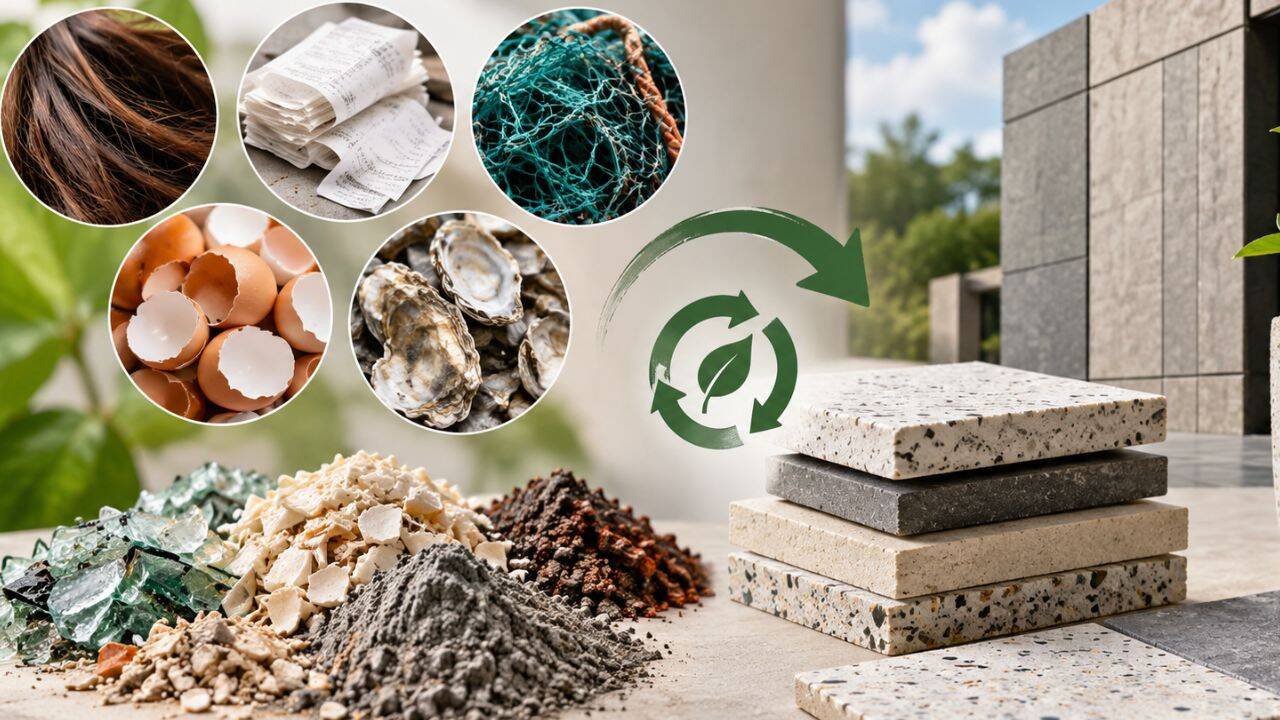
The global construction sector is burning through natural sand at a rate that defies planetary math, and the traditional cement industry remains responsible for roughly eight percent of worldwide carbon dioxide emissions. Desperation has officially set in across architectural laboratories. Recent material science trials evaluated seventeen different everyday waste items—ranging from discarded fishing nets and thermal paper receipts to human hair and crushed eggshells—as potential low-carbon aggregate replacements.
Most of these experimental formulas failed immediately. Human hair, for instance, disintegrated into a structural liability when exposed to the intensely alkaline chemistry of wet cement. Wood chips absorbed excessive amounts of mixing water, destroying the cure integrity. Yet out of this chaotic trash-heap screening, a handful of surviving components—including recycled ceramics, glass, oyster shells, and industrial iron oxide dust—demonstrated bending strengths reaching 16.1 newtons per square millimeter. That performance benchmark routinely beats conventional commercial cement boards, proving that structural integrity does not inherently require virgin quarried rock.
Construction professionals love talking about sustainability until the balance sheet arrives. The dirty secret of green building materials is that performance parity rarely survives commercial scaling. Engineers can brew a brilliant cement panel in a controlled laboratory using crushed porcelain and waste glass, but translating that success to a multi-story job site introduces variables that spreadsheet models ignore.
Take aggregate consistency. Natural sand mined from riverbeds possesses a predictable granular geometry that contractors have relied on for a century. Crushed glass and industrial ceramic waste, by contrast, introduce erratic particle shapes and jagged surface areas. These anomalies demand precise water-to-cement ratios that standard on-site mixing crews struggle to maintain. If a worker adds an extra bucket of water to compensate for a stiff batch of recycled-aggregate mortar, the final compressive strength plunges by thirty percent.
The binder itself presents an equally stubborn bottleneck. Projects experimenting with these high-waste formulas typically rely on Type B blast furnace slag cement to slash carbon output relative to ordinary Portland cement. Slag is an industrial byproduct of steel manufacturing. It works well, but its supply is directly tethered to the economic health of heavy industry. When steel production dips, slag availability dries up, forcing builders back toward carbon-heavy traditional binders.
Laboratories celebrate tensile achievements like 16.1 N/mm² bending thresholds as absolute victories. Real-world builders care more about long-term moisture resistance, freeze-thaw durability, and code compliance.
Consider the inclusion of marine calcium sources such as crushed oyster shells. While calcium carbonate from shells can successfully substitute for traditional limestone aggregates, organic residues left clinging to those shells will rot inside the concrete matrix if they are not thoroughly washed and sterilized. That biological decay creates microscopic voids. Over years of weather exposure, those voids fill with water, freeze, expand, and shatter the building product from the inside out.
Thermal paper receipts tested in these recent trials failed for chemical reasons rather than structural ones. The high concentration of color developers like bisphenol compounds interfered with the hydration kinetics of the cement paste. The material never fully set, curing instead into a crumbly disappointment that lacked even basic load-bearing capacity. These failures highlight a harsh boundary condition for circular construction. Not every piece of municipal trash belongs in a foundation.
Municipalities generate millions of tons of sorted refuse every year, yet the logistics of gathering, cleaning, grading, and routing that waste to regional precast plants remain economically hostile. Virgin sand remains artificially cheap because the environmental and ecological degradation caused by river dredging is rarely priced into the ticket. Until regulatory frameworks penalize riverbed mining or heavily tax the carbon footprint of ordinary Portland cement, structural components made from hair, shells, and glass will remain boutique curiosities rather than mainstream commodities.
Progress will not happen because builders suddenly develop a collective ecological conscience. It will happen because sand pits are running dry and regulatory penalties are making high-emission binders financially untenable. When the cost of virgin aggregate crosses a certain threshold, a factory floor utilizing crushed bathroom tiles and waste iron oxide stops looking like an academic experiment and starts looking like the only way to stay in business.
The next phase of structural material science requires abandoning the fantasy of a universal green concrete. Success depends on hyper-local material loops where regional waste streams dictate regional manufacturing formulas. Coastal cities build with shell aggregates. Urban centers build with crushed architectural glass. The chemistry is proven. The engineering works. Only the economic incentives remain broken.