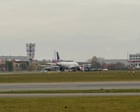
Seven commercial airliners across Europe were recently forced into emergency diversions, tarmac evacuations, and exhaustive security sweeps following a coordinated wave of malicious hoax bomb threats. The immediate operational reality is stark. Even when intelligence agencies suspect a threat is fabricated, aviation safety protocols mandate treating every warning as a live explosive event until physical sweeps prove otherwise.
A single anonymous email or encrypted message can still bring multi-million-dollar transit hubs to a grinding halt. While law enforcement officials quickly labeled the incidents a malicious hoax, the resulting chaos exposed a glaring asymmetry in modern aviation security. The cost to launch an attack is effectively zero, while the financial, psychological, and logistical toll on airlines, airports, and passengers runs into the millions. Expanding on this topic, you can also read: Why Israel’s Political Deadlock Leaves Netanyahu Trapped Between Survival and Collapse.
The Anatomy of an Aviation Security Paralysis
To understand why a digital phantom can ground a Boeing 737 or an Airbus A320, you have to look at the rigid architecture of international aviation law. Under frameworks established by the International Civil Aviation Organization (ICAO) and enforced by national bodies like the European Union Aviation Safety Agency (EASA), ambiguity is not tolerated.
There is no room for guesswork at thirty-five thousand feet. Observers at Al Jazeera have shared their thoughts on this trend.
When an airline operations center, an air traffic control tower, or an airport authority receives a bomb threat, a strict binary protocol triggers immediately. Threat assessment teams—usually comprising airline security directors, national intelligence liaisons, and local law enforcement—have minutes to categorize the risk. They evaluate the specificity of the language, the origin of the communication, and whether the sender possesses non-public operational details.
However, the threshold for triggering a full-scale emergency response remains intentionally low. A threat does not need to be verified as authentic to force a diversion; it merely needs to fail the test of being immediately dismissible. If a message names a specific flight number, route, and timeframe, protocol dictates action.
The aircraft must land at the nearest suitable airport. Once on the ground, the plane is directed to a remote isolation stand, far away from main terminals and fuel depots. Passengers are evacuated—sometimes via emergency slides, which carries a high risk of physical injury—and every piece of luggage, cargo container, and cabin panel is subjected to explosive trace detection and canine sweeps.
Asymmetric Disruption and the Economics of Chaos
The perpetrators behind these waves of European flight diversions understand the mechanics of this system intimately. They are not trying to smuggle contraband past X-ray machines; they are weaponizing the safety protocols themselves.
Consider the sheer financial bleed caused by a single unscheduled diversion. For a narrow-body commercial jet, an emergency landing and subsequent security sweep easily costs an airline upwards of $100,000 to $250,000. Multiply that by seven aircraft across multiple European jurisdictions, and the direct operational losses quickly cross the million-euro mark within a single afternoon.
The expenses stack up relentlessly:
- Fuel and Aircraft Recovery: Diverting an aircraft burns unbudgeted fuel, often requires dumping fuel over designated zones to meet safe landing weights, and strands the airframe out of position. Airlines must then fly in replacement aircraft or deadhead fresh crews to recover the schedule.
- Crew Timeout Limits: Flight attendants and pilots operate under strict legal duty-time limitations. A three-hour tarmac delay during a bomb sweep frequently causes a crew to "time out," making it illegal for them to fly the remainder of the route.
- Passenger Compensation: Under EU Regulation 261/2004, airlines face strict obligations regarding passenger care, rebooking, and hotel accommodations. While extraordinary circumstances like security threats can shield carriers from punitive cash payouts, the baseline cost of housing and rerouting hundreds of stranded travelers per flight remains massive.
- Airport Bottlenecks: Closing a runway or tying up emergency fire and rescue services for an isolated aircraft creates a ripple effect. Arriving flights enter holding patterns, departing flights miss their European slot windows, and entire regional networks suffer cascading delays that take days to untangle.
For the perpetrator sitting behind a virtual private network (VPN) and an encrypted, disposable email provider, the capital expenditure is nothing. The return on investment, measured in media headlines and systemic disruption, is absolute.
Why Attribution Remains a Law Enforcement Nightmare
Whenever a coordinated wave of threats hits European airspace, the public inevitably asks why authorities cannot simply trace the messages and arrest the culprits within hours. The answer lies in the collision between legacy aviation communication channels and modern digital obfuscation.
Many airport authorities and airlines still rely on publicly accessible web forms, general inquiry email addresses, or standard customer service phone lines to receive public communications. Threat actors exploit these open doors. By routing their traffic through decentralized networks like Tor, chaining multiple offshore VPNs, and utilizing end-to-end encrypted email services based in non-cooperative jurisdictions, senders effectively erase their digital footprints.
Furthermore, the geopolitical reality of Europe complicates rapid cross-border cyber investigations. A threat targeting a flight departing from France, operated by a carrier based in Ireland, flying over German airspace, and routed through a server in Eastern Europe requires a labyrinth of Mutual Legal Assistance Treaties (MLATs) just to subpoena basic subscriber data.
By the time a prosecutor in one country secures a warrant to examine metadata held by a tech firm in another, the trail has usually gone cold. The servers have wiped their logs, or the accounts were created using stolen credentials and burner numbers purchased with untraceable cryptocurrency.
The Thin Line Between Boy Who Cried Wolf and Catastrophe
The most insidious danger of repeated hoax waves is not the immediate financial loss, nor is it the ruined vacations of thousands of passengers. It is the psychological erosion of vigilance within the aviation security apparatus itself.
Historians of aviation security point directly to the decades leading up to the 1988 bombing of Pan Am Flight 103 over Lockerbie, Scotland, as a grim reminder of what happens when threat fatigue sets in. In the late 1980s, intelligence agencies and airlines were inundated with hundreds of vague threats monthly. Separating genuine operational intelligence from background noise became an exhausting, nearly impossible task.
When malicious actors flood European systems with dozens of fake bomb threats over a matter of weeks, they introduce a lethal risk of complacency. Security personnel, air traffic controllers, and airline executives are human. After the fifth, sixth, or seventh false alarm in a single month, the institutional pressure to keep planes flying and avoid costly shutdowns becomes immense.
Yet, aviation safety professionals operate under a unforgiving rule: the security apparatus has to be right one hundred percent of the time, while a terrorist only needs to succeed once.
If an airline operations center decides to downgrade a threat because it matches the formatting of recent hoaxes, and that specific flight happens to be the one carrying an actual device, the resulting tragedy would destroy the carrier and shatter public trust in global aviation. Consequently, regulators refuse to allow airlines to lower their guard, trapping the industry in a state of perpetual, expensive vulnerability.
Historical Precedents and Coordinated Swatting
While the scale of seven simultaneous or sequential diversions across Europe grabs immediate headlines, this tactic is an evolution of a well-documented phenomenon. Over the past decade, aviation has increasingly become a target for large-scale "swatting"—the practice of deceiving emergency services into sending tactical teams to a specific location.
In 2021, the international community witnessed a state-level distortion of this exact protocol when Belarusian authorities forced a Ryanair flight to divert to Minsk, citing a fabricated bomb threat, in order to arrest a political dissident on board. That incident proved to the world that the mere utterance of the word "bomb" within international airspace acts as an undeniable override switch for commercial flight paths.
Since then, non-state actors, hacktivist collectives, and extortionists have adopted the playbook. In recent years, coordinated waves of emailed bomb threats have repeatedly targeted schools, courthouses, and major transit hubs across North America and Europe. In several documented cases, perpetrators used automated scripts to blast identical threats to hundreds of institutions simultaneously, testing response times and extorting money in exchange for ceasing the disruptions.
Aviation represents the ultimate escalation of this tactic because aircraft cannot simply pull over to the side of the road. An airliner in flight is a pressurized tube moving at five hundred miles per hour with finite fuel reserves. Any threat directed at it demands immediate, high-stakes physical intervention.
The Structural Flaws in Airport Threat Intake
Addressing this crisis requires looking closely at how threats are received and processed before they ever reach a pilot's headset. Currently, too many aviation stakeholders treat digital communications with the same urgency as a credible intelligence intercept.
A hypothetical scenario illustrates the flaw in current intake systems. Imagine an automated script sends an email to the general press inbox of ten different European airports, claiming a device is hidden in the cargo hold of an afternoon flight to London. Even if the email contains grammatical errors, lacks specific flight numbers, and originates from a known disposable domain, the sheer liability of ignoring it forces local police to notify the relevant airlines. Once the airline is officially notified of a threat against its hull, legal liability shifts. The captain must be informed, and once a pilot-in-command is aware of an unverified bomb threat, standard operating procedures almost universally dictate landing the aircraft.
Industry analysts and security consultants have long argued for more sophisticated pre-screening filters at the intake level. Advanced natural language processing and threat-intelligence sharing platforms can analyze incoming messages in real time, cross-referencing linguistic patterns, metadata anomalies, and known hoax templates within seconds.
If a threat matches the exact digital signature of a known serial hoaxer operating out of a specific server cluster, intelligence agencies can assign it a lower risk profile before it triggers a multi-agency panic.
However, implementing such systems faces massive bureaucratic hurdles. Airlines are fiercely protective of their proprietary operational data, and national intelligence agencies are notoriously reluctant to share real-time threat metrics with private commercial entities or foreign counterparts. Until European aviation authorities mandate a centralized, automated threat-triage clearinghouse, individual airports and carriers will continue fighting these battles in isolation.
The Human Toll on the Tarmac
Lost in the discussions of EU compensation laws, fuel burn rates, and server metadata is the visceral reality experienced by the people trapped inside the cabin.
For a passenger, a bomb threat diversion is indistinguishable from a genuine brush with mortality. The experience begins with an abrupt, steep descent that breaks the normal rhythm of commercial flight. Cabin crew members, trained to maintain calm, suddenly move with clipped urgency, locking down galleys, clearing aisles, and instructing passengers to assume brace positions or leave all personal belongings behind.
When an aircraft lands at an isolation stand surrounded by flashing red and blue lights, armed tactical police, and fire trucks foaming the runway, the psychological trauma is immediate. Evacuating down an inflatable slide from a height of fifteen feet routinely results in broken ankles, severe friction burns, and concussions. Passengers are then held for hours in sterile holding areas, stripped of their phones, medications, and luggage while bomb squads tear apart the aircraft.
These malicious hoaxes are not victimless pranks. They inflict acute psychological distress on hundreds of innocent civilians per flight and divert vital emergency medical and tactical resources away from local communities that genuinely need them.
Why Deterrence Currently Fails
The ultimate solution to any wave of criminal disruption is credible deterrence, yet the legal framework governing aviation hoaxes remains dangerously fragmented.
In many jurisdictions, making a false bomb threat is still prosecuted under general public nuisance or minor telecommunications statutes, resulting in suspended sentences, probation, or modest fines. Even when suspects are identified across borders, extradition for non-violent cyber disruptions rarely takes priority over violent crime or major financial fraud.
For deterrence to work, the consequences must match the systemic damage inflicted. Aviation security experts increasingly advocate for classifying coordinated threats against civil aviation under severe anti-terrorism or critical infrastructure sabotage statutes, regardless of whether an actual explosive device existed. When a perpetrator grounds seven airliners across Europe, they are executing a direct attack on international transit infrastructure.
Until international law enforcement establishes rapid cross-border cyber-triage units capable of unmasking encrypted senders in real time, and until courts impose severe, non-negotiable prison sentences on those caught, the skies over Europe will remain vulnerable to anyone with an internet connection and malicious intent. The industry has spent billions of dollars hardening cockpit doors and screening every bottle of water at security checkpoints, only to leave the front door wide open to an anonymous email.


