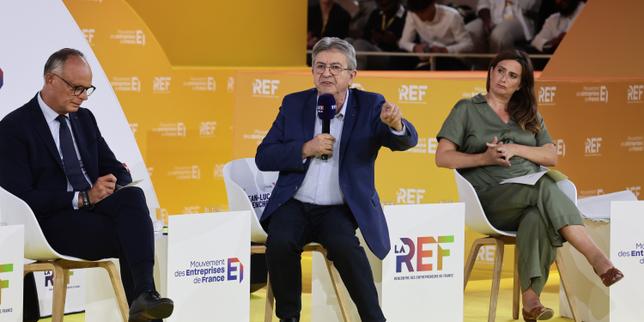
Public debt across the Eurozone has ceased to be a mere accounting metric and has instead evolved into an ideological battleground where political rhetoric routinely collides with the unyielding architecture of European treaties. When political figures like Jean-Luc Mélenchon propose erasing a substantial fraction of state obligations held by central institutions, the proposition immediately triggers fierce resistance from monetary guardians such as the Bundesbank. This friction exposes a profound systemic disagreement over how modern money functions, who controls the printing presses, and whether national sovereignty can coexist with a shared currency framework.
The core of the dispute centers on the portion of French national debt—hovering near historic highs—currently resting on the balance sheet of the central bank. Proponents of cancellation argue that because the state and the central bank both belong to the public sphere, owing money to oneself is an absurdity. In this view, wiping away these obligations requires nothing more than an administrative stroke of a pen, instantly freeing up billions of euros for public investments, ecological transition, and social programs without harming private investors.
Yet this seductive narrative ignores the rigid institutional architecture established by the Maastricht Treaty and subsequent agreements. The European Central Bank operates under a strict mandate focused entirely on price stability, insulated from political interference precisely to prevent governments from monetizing their deficits.
The Mechanics of the Central Bank Balance Sheet
Opening the ledger of a central bank reveals why an outright cancellation is far from straightforward. When the central bank purchases government bonds on the secondary market, it creates reserves. Those bonds sit as assets, while the newly created liquidity sits as liabilities.
Suppose a hypothetical government owes fifty billion euros in bonds currently held by its national central bank. If those bonds vanish through political fiat, the corresponding liability—the bank reserves or commercial bank deposits created during the purchase—does not simply evaporate into thin air.
The central bank must manage its liabilities carefully. If it absorbs massive losses by writing down sovereign assets to zero, its own capital base risks impairment. While central banks can technically operate with negative equity for a period, doing so severely damages their institutional credibility. More importantly, it destroys the separation line between fiscal policy and monetary policy. Once a government realizes it can force its central bank to swallow and erase debt at will, the fiscal restraint imposed by financial markets disappears.
The Treaty Firewall and Institutional Resistance
The leadership of the Bundesbank, joined by fiscal conservatives across the continent, views any talk of debt erasure as an existential threat to the integrity of the euro. Article 123 of the Treaty on the Functioning of the European Union explicitly prohibits monetary financing, forbidding central banks from granting overdraft facilities or any other type of credit facility to public authorities.
While proponents argue that canceling debt already acquired differs legally from purchasing new debt directly from the treasury, institutional watchdogs see it as a semantic loophole designed to bypass the spirit of the law.
Frankfurt and Berlin share a deep-seated fear of moral hazard. If one major economy successfully cancels hundreds of billions of euros in public liabilities, other highly indebted member states will inevitably demand the same treatment. The shared currency area depends on a uniform perception of risk and trust in the monetary anchor. If that anchor starts shifting based on domestic political cycles in member nations, the entire monetary union risks fracturing under speculative pressure.
Market Realities and the Cost of Unilateral Action
Even if a government managed to bypass the legal hurdles through extraordinary political pressure or a renegotiation of European treaties, the secondary effects on private financial markets could prove devastating.
State financing relies entirely on the confidence of private investors, pension funds, and international asset managers who purchase new bond issuances every week. These investors demand a risk premium based on the perceived stability, legal predictability, and financial health of the borrowing nation.
A unilateral debt cancellation would signal to global markets that contracts can be rewritten arbitrarily by political decree. The immediate consequence would likely not be hyperinflation, as some simplistic critiques suggest, but an astronomical spike in borrowing costs.
If the risk premium on French or European sovereign bonds surges, the savings generated by erasing past debt would quickly be eaten up by the punishingly high interest rates demanded on all future debt rollovers. The state would find itself paying significantly more to finance its ongoing operations, neutralizing any initial budgetary relief.
The debate ultimately forces a reckoning with the structural contradictions of a monetary union that pools currency without fully pooling fiscal sovereignty. As long as national budgets remain fragmented while monetary policy remains centralized, clashes between political leaders seeking fiscal breathing room and technocratic central bankers enforcing treaty rules will remain an inevitable feature of European governance.
Unravelling the French Debt Cancellation Debate evaluates the political and economic implications of wiping out portions of public liabilities held by central institutions.
http://googleusercontent.com/youtube_content/1