{
  "component": "Bento",
  "props": {
    "use_case": "soccer-team",
    "cards": "lss"
  },
  "children": [
    {
      "component": "BentoCard",
      "props": {
        "size": "l",
        "heading": "Under Investigation",
        "subheading": "FIFA probe looms over Falklands banner",
        "bgImageUrl": {
          "component": "Image",
          "props": {
            "src": "https://encrypted-tbn0.gstatic.com/licensed-image?q=tbn:ANd9GcRVqN3MPc_GUmZLoaYo6yU28aTaJ-Kbq3UyXZZwFFnLoUzvO4vCcd2SZUQc4HIkQmaKnylLqAu134QGI24"
          }
        },
        "ext": {
          "team": "Argentina"
        }
      },
      "actions": {
        "open_url": "https://www.sbs.com.au/news/article/fifa-world-cup-2026-argentina-faces-fifa-fine-after-players-celebrate-england-win-with-falklands-banner/zfssifaxy"
      }
    },
    {
      "component": "BentoCard",
      "props": {
        "size": "s",
        "heading": "30,000 CHF",
        "subheading": "Fine handed to Argentina for 2014 Falklands banner",
        "bgImageUrl": {
          "component": "Image",
          "props": {
            "src": "https://encrypted-tbn1.gstatic.com/licensed-image?q=tbn:ANd9GcSi4ykRO6HAnvkrR28DAW98R3gwwUoSA1hTDWH0sGm2YHC67Pr7cbQsY4LvDnrfTTWoVzlZCUXrZMu7sR8"
          }
        }
      },
      "actions": {
        "open_url": "https://www.sbs.com.au/news/article/fifa-world-cup-2026-argentina-faces-fifa-fine-after-players-celebrate-england-win-with-falklands-banner/zfssifaxy"
      }
    },
    {
      "component": "BentoCard",
      "props": {
        "size": "s",
        "heading": "2-1 Victory",
        "subheading": "Semifinal win over England sparked the incident"
      },
      "actions": {
        "open_url": "https://www.sbs.com.au/news/article/fifa-world-cup-2026-argentina-faces-fifa-fine-after-players-celebrate-england-win-with-falklands-banner/zfssifaxy"
      }
    }
  ]
}
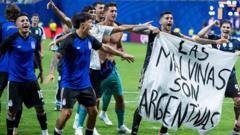
FIFA’s disciplinary committee is quietly reviewing match reports from Atlanta after Argentine players unfurled a banner claiming sovereignty over the Falkland Islands during their World Cup semifinal celebrations. The governing body is desperate to resolve the fallout without disrupting its showpiece tournament, but a growing diplomatic row between London and Buenos Aires has thrust the sport's global administrators into an uncomfortable political arena. With the UK government demanding strong action and Argentine leaders backing their squad, the incident exposes the fragile illusion of football’s strictly non-political rules.
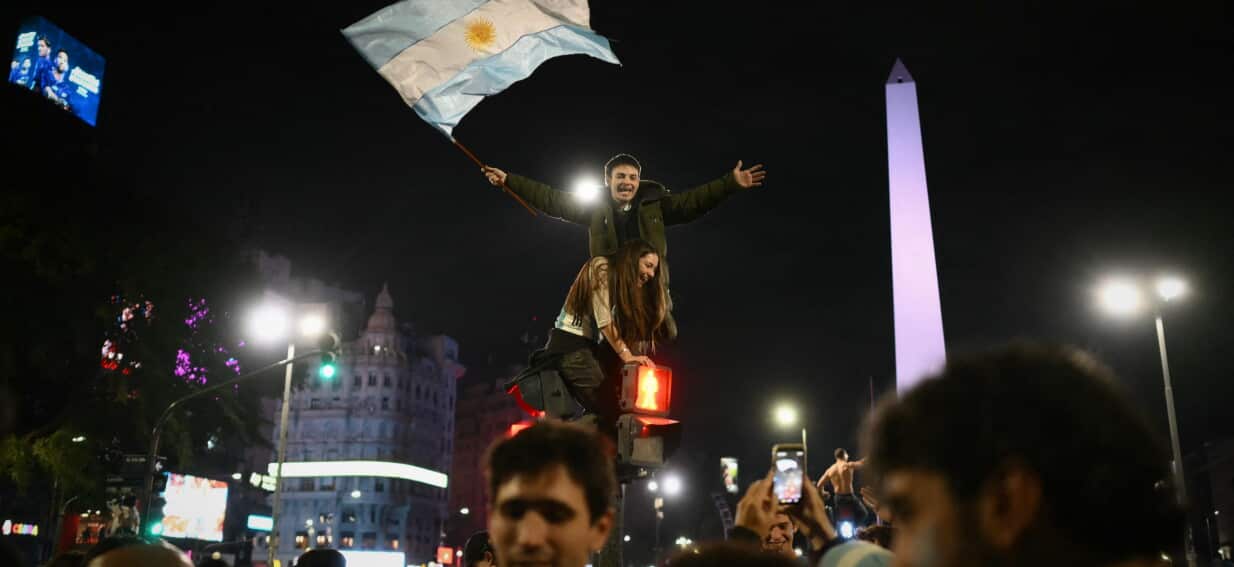
The controversy erupted immediately after Argentina’s 2-1 victory over England at Atlanta Stadium. As fans celebrated in the stands, Lautaro Martínez and Giovani Lo Celso held aloft a banner reading Las Malvinas son Argentinas—asserting that the British-governed Falkland Islands belong to Argentina. What followed was a swift, predictable collision of sporting laws, historical grievances, and modern geopolitical posture.
The Atlanta Flashpoint and the Political Spark
Sporting events between Argentina and England are never just games. The legacy of the 1982 war, fought over the South Atlantic archipelago, still runs through every fixture between these nations. When the final whistle blew in Atlanta, the emotional pressure cooker of a World Cup semifinal burst.
The banner itself, which translates directly to "The Falklands are Argentine," was reportedly handed to the players by traveling supporters. Prior to kickoff, Argentine security officials had attempted to enforce FIFA guidelines by banning fans from bringing flags carrying imagery of the islands into the stadium. Yet, the physical message found its way onto the pitch, held by the very players FIFA holds responsible for upholding the neutral image of the game.
Within hours, the dispute migrated from the locker rooms to the highest offices of government. Prime Minister Keir Starmer’s office issued a sharp statement confirming that while the World Cup trophy might elude them, British sovereignty over the islands remains absolute. Business Secretary Peter Kyle condemned the display as entirely inappropriate. Across the Atlantic, Argentine President Javier Milei praised the squad's actions, calling the display perfectly valid and reflective of a shared national sentiment. Meanwhile, Vice President Victoria Villarruel amplified the message on social media, pairing the team's triumph with military footage from the 1982 conflict.
This is not a simple misunderstanding. It is a highly calculated, domestic political win for Argentine politicians, executed on the most prominent stage in global entertainment.
Why FIFA Will Likely Hide Behind a Fine
The rules of the game are clear on paper. FIFA’s Stadium Code of Conduct and its Disciplinary Code strictly forbid any "messages that are not appropriate for a sports event," explicitly listing political, ideological, and religious statements as prohibited. Furthermore, IFAB Law 4 prohibits players from using equipment containing political messaging.
However, the enforcement of these laws has historically favored convenience over courage.
Historically, soccer's governing bodies have treated political speech as a financial transaction. The closest precedent occurred in 2014, when the Argentine team lined up behind an identical banner before a friendly match against Slovenia. The response from Zurich was a fine of 30,000 Swiss francs. For a national football association with millions in commercial revenue, such a penalty is a minor operational cost. It is a rounding error. It does nothing to deter future displays because the public relations value of standing with the national claim far outweighs the financial slap on the wrist.
The Problem of Selective Precedent
Critics have quickly pointed to UEFA’s recent disciplinary record as a standard of what should happen next. Following Spain's triumph in Euro 2024, players Rodri and Alvaro Morata were suspended for one match after leading fans in chants of "Gibraltar is Spanish" during celebrations in Madrid.
Yet, there are several structural reasons why FIFA is unlikely to issue sporting bans to Argentina's stars ahead of their next major matches.
- Jurisdictional differences: The Gibraltar incident fell under UEFA's disciplinary committee, which operated under a slightly different regulatory framework than FIFA's global World Cup rules.
- The timing of the tournament: Banning star players like Martínez or Lo Celso immediately would disrupt the sporting integrity of upcoming competitive fixtures. Governing bodies notoriously drag their feet to ensure investigations do not overshadow live broadcast packages.
- Lobbying power: The Argentine Football Association (AFA) holds immense sway within FIFA's political structure, and a harsh sporting ban would trigger severe friction between Zurich and South American football's governing body, CONMEBOL.
The Illusion of the Empty Stadium
FIFA has long tried to sell the concept of the football stadium as a sanctuary. A pristine, corporate space free from the complexities of history, war, and border disputes. This is a fantasy.
By expecting players to turn off their national identities at the touchline, FIFA ignores how deeply embedded sport is within national identity. For an Argentine player, the Malvinas claim is not a fringe political position. It is a core tenet of the national curriculum, an undisputed consensus taught in schools from Buenos Aires to Ushuaia. To them, the banner is not a political provocation; it is a statement of geographical reality.
To the British, however, it is a direct insult to the self-determination of the islanders who have repeatedly voted to remain a British Overseas Territory. It is a reminder of a war that cost hundreds of lives.
When these two worldviews collide on a pitch in Atlanta, FIFA’s regulatory framework breaks down. A 20,000-pound fine will not change the minds of the Argentine squad, nor will it satisfy the British public. It is a bureaucratic exit strategy designed to let the tournament proceed while pretending the rules were upheld.
The Cost of Doing Business
The reality of modern football administration is that financial penalties have become a licensing fee for political theater. If a country or a group of players wants to broadcast a controversial message to hundreds of millions of television viewers, they can do so, knowing exactly what the bill will be.
By treating these incidents as minor disciplinary infractions rather than complex geopolitical crises, FIFA ensures they will happen again. The investigation into the Atlanta match reports will wind its way through the committee rooms of Zurich. The lawyers will file their briefs. The AFA will pay its fine. And the next time Argentina faces England on a football pitch, the same banner will be waiting in the wings.