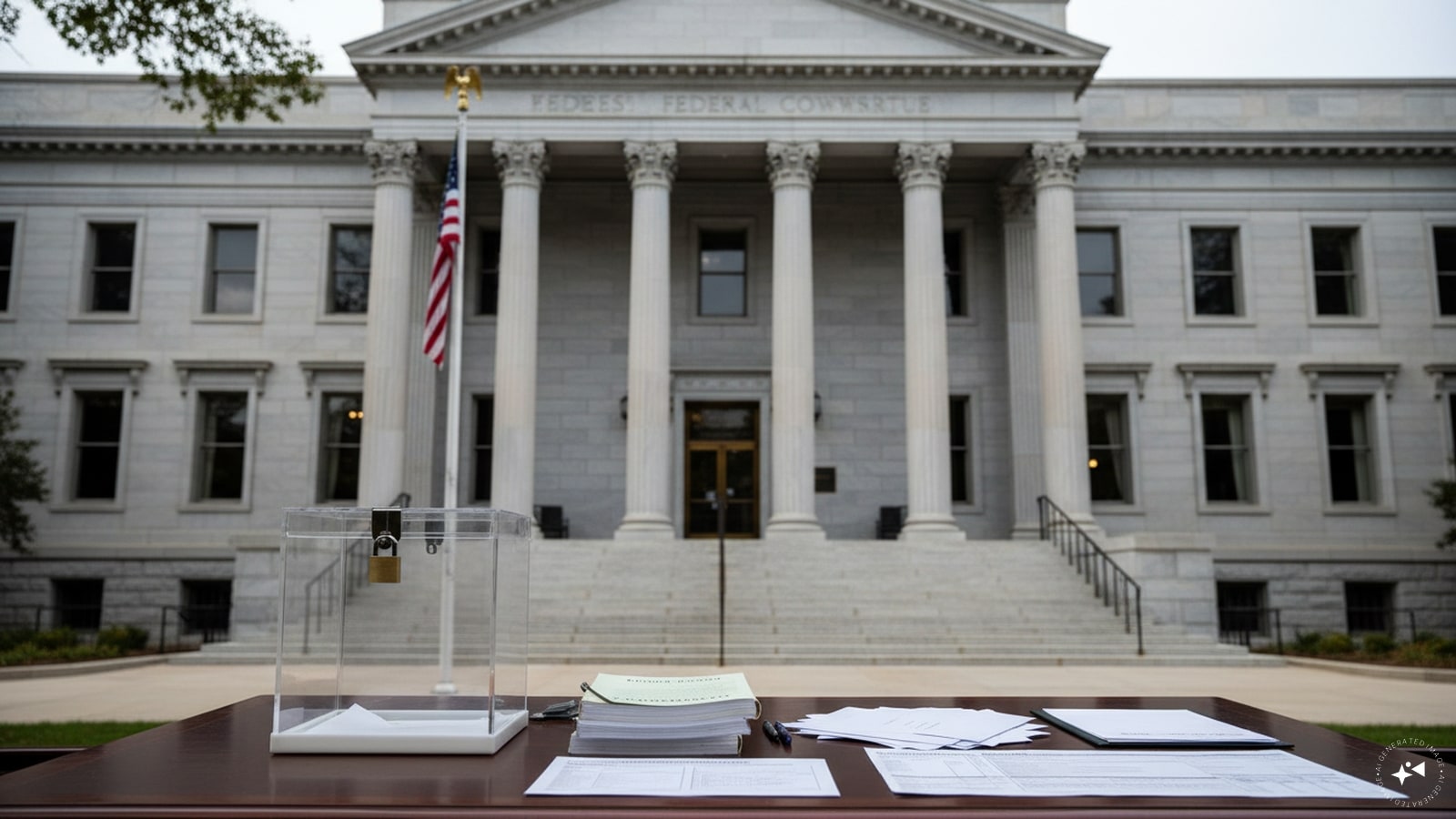
A federal judge has formally barred the Trump administration from threatening local and state election officials with criminal prosecution over routine administrative disputes and election certification procedures. The ruling establishes a clear judicial boundary between legitimate federal law enforcement oversight and unconstitutional coercion aimed at the machinery of American democracy. For years, county clerks and state administrators have operated under the shadow of potential federal indictment simply for executing statutory duties that clash with executive branch narratives. This court order strips away the ambiguity, signaling that the Department of Justice cannot be weaponized as a rhetorical blunt instrument to intimidate civil servants into altering certified results or bypassing state election laws.
To understand why this judicial intervention matters, you have to look at how election administration actually functions on the ground. It is not a centralized, top-down operation run out of Washington. Instead, it is a sprawling, decentralized network of roughly ten thousand local jurisdictions, staffed largely by underpaid county clerks, municipal administrators, and seasonal poll workers. When the executive branch signals that these local officials could face federal felony charges for refusing to decertify a ballot count or for adhering to state-mandated mail-in ballot deadlines, the effect is immediate and chilling. You do not even need to file an actual indictment to disrupt an election. The mere threat of a federal grand jury subpoena is enough to bankrupt a county clerk in legal fees and force seasoned professionals into early retirement.
The Legal Mechanics of Unconstitutional Coercion
Federal courts generally grant immense deference to the executive branch when it comes to prosecutorial discretion. Judges are notoriously reluctant to tell the Attorney General who to investigate or what charges to bring. That separation of powers is baked into the constitutional framework. However, that discretion hits a hard wall when the threat of prosecution is used not to enforce a valid criminal statute, but to compel state officials to violate their own state laws or to chill First Amendment rights.
In issuing the injunction, the court relied on foundational principles of federalism and the Tenth Amendment. Under the Elections Clause of the U.S. Constitution, the primary authority to regulate the times, places, and manner of holding elections rests with the state legislatures, subject only to specific overrides passed by Congress. The President has no constitutional role in certifying state elections or dictating how local boards canvass votes. When administration officials threaten criminal penalties against state administrators who follow state law rather than executive directives, they cross the line from law enforcement into unlawful commandeering.
The legal standard applied here centers on objective chilling effect and bad-faith prosecution. Ordinarily, a plaintiff cannot sue to stop a criminal investigation before charges are filed. Courts tell them to wait and raise their defenses at trial. The exception—carved out in landmark Supreme Court precedents like Dombrowski v. Pfister—applies when the threat of prosecution itself is deployed as an instrument of harassment to deter the exercise of constitutional duties. The judge found that the pattern of public statements, official warnings, and vague references to federal civil rights statutes met this high threshold.
How the Pressure Campaign Operated
The friction did not emerge overnight. It built steadily through a series of escalating administrative maneuvers and public pronouncements designed to blur the line between criminal fraud and bureaucratic error. Election administration is messy. Machines jam, human tally clerks make transposition errors, and provisional ballots require meticulous statutory review. Historically, these issues are resolved through transparent canvassing boards, bipartisan audits, and civil litigation in state courts.
The shift occurred when federal rhetoric began framing these routine administrative disputes as potential federal crimes. Officials pointed to Reconstruction-era civil rights statutes—laws originally enacted to protect Black voters from violent disenfranchisement—and suggested they could be inverted to prosecute election workers over disputed ballot-processing rules. Consider a hypothetical example to see how this trap works in practice. Imagine a county board of elections facing a statutory deadline to certify results while a minor discrepancy exists in a single precinct's poll book. State law explicitly instructs the board to certify the totals and resolve the discrepancy during the post-election audit. If federal officials simultaneously warn that certifying disputed tallies constitutes a federal felony, the local administrators are placed in an impossible bind. Obey state law and risk federal indictment, or obey federal threats and violate their oath of office.
This dynamic created an asymmetric warfare environment. Federal officials wielded the limitless resources of the Department of Justice and the megaphone of the executive branch. Local clerks had modest municipal budgets and no dedicated criminal defense counsel.
The Hidden Toll on Election Infrastructure
While headlines naturally gravitate toward the dramatic clash between a federal judge and the White House, the real story lies in the quiet exodus of institutional knowledge from local election offices. Running an election requires deep, specialized expertise. Administrators must manage complex voter registration databases, coordinate chain-of-custody logistics for thousands of ballot boxes, recruit and train hundreds of poll workers, and comply with shifting cybersecurity mandates.
Over the past several election cycles, turnover among chief local election officials has spiked dramatically. In several key battleground states, more than a third of county election directors who administered the 2020 election had left their posts before the 2024 cycle even began. Many cited personal safety concerns, relentless public records requests designed to paralyze their offices, and the looming fear of politically motivated legal jeopardy.
When a twenty-year veteran clerk walks out the door, they take decades of muscle memory with them. Their replacements are often thrust into high-stakes environments with minimal training. Ironically, the very threats purportedly aimed at ensuring "election integrity" have actively degraded the operational competence required to run error-free elections. A rookie administrator is far more likely to make a procedural mistake—like misprinting a ballot layout or misinterpreting a signature-verification guideline—than a seasoned pro. Those honest mistakes then become fresh ammunition for critics claiming systemic corruption.
Where the Court Order Falls Short
It would be a mistake to view this judicial order as a permanent cure-all for the pressures facing election workers. Court injunctions are powerful, yet they operate within strict procedural boundaries. A judge can bar executive branch officials from issuing explicit threats of prosecution over lawful certification duties, and a judge can hold officials in contempt if they blatantly violate that order. What a court cannot easily police is the gray area of political speech and indirect signaling.
The First Amendment protects the right of public officials, including the President and cabinet members, to criticize election procedures, question the validity of state voting laws, and express skepticism about outcomes. The legal line between protected political rhetoric and an actionable, unconstitutional threat of state coercion is razor-thin. If an administration official stops saying "we will prosecute clerks who certify" and instead says "we are closely watching every clerk for potential violations of federal law," the underlying intimidation remains largely intact, even if the phrasing technically complies with the injunction.
Furthermore, this ruling binds only the named defendants and the federal executive branch. It does nothing to stop state-level actors, partisan investigative committees, or private organizations from launching parallel pressure campaigns. In several states, legislatures have passed laws creating new criminal penalties for election workers who make minor administrative errors, such as accepting an unsolicited mail-in ballot application or failing to remove an observer who violates polling place rules. The federal court order shields local officials from Washington, not from their own state capitals.
The Burden of Proof in Future Disputes
The injunction also shifts the evidentiary burden in future clashes between federal authorities and local administrators. Before this ruling, the presumption of regularity favored the Department of Justice. If federal prosecutors opened a preliminary inquiry into a local election board, courts assumed they were acting in good faith to investigate genuine allegations of fraud or civil rights violations.
Now, within the jurisdiction of this court, that presumption has been inverted regarding the specific conduct covered by the order. If federal officials initiate an investigation or issue warnings targeting election certification or routine administration, they face immediate judicial scrutiny. They will have to demonstrate concrete, particularized evidence of actual criminal intent—such as deliberate ballot stuffing or intentional falsification of records—rather than relying on speculative theories or disagreements over state statutory interpretation.
This distinction is critical. Federal law does criminalize genuine election fraud. Buying votes, casting ballots on behalf of deceased individuals, tampering with voting machines, and intentionally suppressing eligible voters are serious felonies. The court's order does not grant election officials immunity from real crimes. If a county clerk actually alters vote totals in a database, the Justice Department retains full authority to indict, prosecute, and imprison them. The ruling simply restores the traditional bright line between malicious criminal conduct and good-faith administrative execution.
Navigating the Friction Between Federal Oversight and State Control
The broader tension exposed by this litigation is a structural flaw that has existed since the founding of the republic. The American electoral system is intentionally fragmented to prevent any single centralized authority from seizing control of the vote. That fragmentation is its greatest security feature; it is virtually impossible to rig a national election when you have to compromise thousands of independent, bipartisan local boards simultaneously.
Yet that same fragmentation creates immense friction during periods of high political polarization. When the federal government views state election rules as overly permissive or overly restrictive, the temptation to use federal leverage to force compliance is overwhelming. Historically, the Department of Justice has intervened in state elections primarily through civil litigation—suing states under the Voting Rights Act or the National Voter Registration Act to enforce federal statutory baselines. Civil suits take time, involve transparent discovery, and are decided by judges before any penalties attach.
Threatening criminal prosecution bypasses that entire deliberative process. It weaponizes the investigative phase itself as the punishment. By halting those threats, the court has effectively forced the executive branch back into the civil arena. If the administration believes a state's ballot-counting rules violate federal law, it must file a civil lawsuit, argue the merits before a judge, and win an injunction—just like any other litigant.
What Happens Next on the Ground
For the thousands of election administrators preparing for upcoming municipal, state, and federal cycles, the ruling provides immediate legal cover, though not necessarily peace of mind. State associations of county clerks and secretaries of state are already distributing the court's opinion to their members, advising them to document any direct contact from federal agencies and to route all inquiries through state attorneys general or municipal legal counsel.
At the same time, legal defense funds established to support election workers are expanding their operations. These nonpartisan networks connect local officials with pro bono representation from major law firms the moment they receive a subpoena or a threatening letter. The existence of these defense networks, combined with this federal court injunction, significantly raises the political and legal cost of attempting to intimidate election workers.
The administration will almost certainly appeal the ruling, arguing that the injunction improperly intrudes upon core executive branch authority under Article II of the Constitution and prematurely chills legitimate law enforcement inquiries. Appellate courts will scrutinize the exact language of the order to ensure it is narrowly tailored and does not overstep judicial boundaries. Until a higher court stays or modifies the decision, however, the directive stands as a binding constraint on federal power. Local officials must still follow the letter of their state election codes, maintain rigorous audit trails, and brace for intense public scrutiny—only now, they can do their jobs without a federal prosecutor peering over their shoulder waiting for a clerical typo.