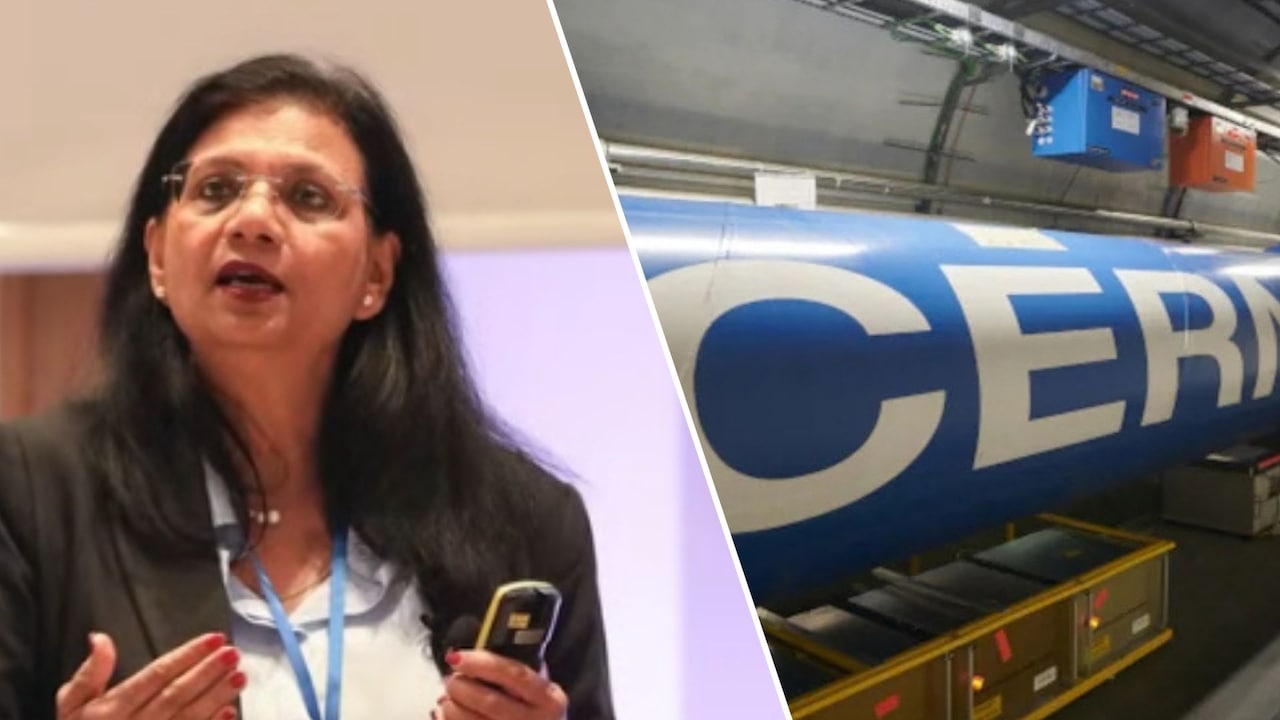
The cafeteria at CERN does not feel like the epicenter of reality. It smells of stale coffee, lukewarm soup, and the distinct corporate anxiety of people whose grant applications are perpetually six months from expiring. Physicists in fleece vests argue over napkin sketches while particle beams circulate three hundred feet beneath their feet at ninety-nine point nine nine nine nine nine nine percent the speed of light.
Out of this bureaucratic and intellectual grind emerge figures who do not fit the old mythology of the lone genius staring at a chalkboard. Archana Sharma is one of them. For decades, while theoretical physicists chase elegant mathematical ghosts in the upper atmosphere of abstraction, Sharma has spent her career down in the mud of engineering. She builds the eyes that let humanity see the invisible.
To understand what Sharma actually does at the European Organization for Nuclear Research, you have to strip away the pop-science gloss about the God particle and alternate dimensions. High-energy physics is fundamentally an engineering crisis. When you smash lead ions together at energies that recreate the conditions of the early universe, you generate a data blizzard so violent that standard electronics instantly fry. You cannot simply buy a better camera at an electronics store. You have to invent new states of matter to capture old ones.
Sharma specializes in Gas Electron Multiplier detectors, known to insiders simply as GEMs. If the Large Hadron Collider is a sledgehammer, a GEM detector is a microscopic net woven out of electric fields and polymer foils, riddled with millions of holes smaller than a human hair. When stray radiation passes through, it triggers an avalanche of electrons. That cascade is read by computers to reconstruct the trajectories of subatomic particles moving at relativistic speeds.
Without these detectors, the discoveries that dominated news cycles over the last twenty years would be invisible noise. Yet, the people who build the instruments rarely make the magazine covers. The public prefers charismatic theorists talking about strings and multiverses. But theory without instrumentation is just philosophy with Greek letters.
The path to the heart of European particle physics was not a straight line for a young woman growing up in India in the 1970s and 1980s. Academic science in that era was fiercely insular, stratified by caste, gender, and institutional pedigree. While pursuing her doctorate at the University of Delhi, Sharma encountered the quiet friction that greets outsiders attempting to break into elite enclaves. Laboratories were often bureaucratic fortresses where access to equipment depended as much on who vouched for your lineage as what you could measure in a beaker.
She packed a suitcase and moved to Geneva. Not as an honored guest with a funded chair, but as an independent researcher surviving on short-term fellowships and sheer stubbornness. CERN in the late twentieth century was an old boys' club dominated by continental European and American institutes. To survive there required an aggressive form of competence. You could not afford to be merely good; your data had to be unassailable because your presence was already being scrutinized.
That underdog stamina shaped her approach to detector physics. While senior physicists fought over high-profile theoretical collaborations, Sharma embedded herself in the unglamorous trenches of hardware development. Detectors degrade. Radiation destroys silicon. Gas mixtures leak. Every upgrade to the accelerator requires redesigning the sensors from the silicon up. It is the physics equivalent of fixing a jet engine while flying it through a hurricane.
The stakes of this work extend far beyond academic bragging rights. The technology developed for particle physics detector tracking does not stay in Geneva. The same micro-pattern gas detectors Sharma spent her life refining have found second lives in medical imaging, specifically in digital radiography and advanced cancer treatment planning. When a hospital uses a low-dose X-ray machine that limits radiation exposure for a pediatric patient, they are utilizing principles derived from high-energy particle tracking.
This transfer of technology is rarely seamless. Academic institutions are notoriously bad at commercialization, wrapped up in patent disputes and bureaucratic inertia. Sharma recognized early on that if laboratory discoveries stayed trapped inside CERN reports, their societal value would rot. She pushed for open-source frameworks and collaborative licensing agreements long before open science became a buzzword on grant application forms.
Her dual citizenship in two distinct scientific worlds—the fiercely competitive Western institutional monolith of CERN and the rapidly expanding, often underfunded research ecosystem of India—has given her a rare vantage point. India has spent decades pumping capital into space exploration and nuclear technology, yet its domestic basic science infrastructure often struggles with brain drain. Young Indian engineers and physicists look at CERN not as a distant star, but as a destination. Sharma became a conduit, opening doors for students and researchers from the Global South who might otherwise have been filtered out by academic gatekeeping.
There is a quiet irony in how modern particle physics is perceived versus how it operates. People imagine a sterile room where elite minds decode the universe. The reality is closer to a sprawling, dysfunctional municipal works project staffed by thousands of technicians, welders, programmers, and physicists who spend most of their days arguing about cable routing and power supplies.
When the Large Hadron Collider upgrades for its High-Luminosity phase, the particle collision rate will increase by an order of magnitude. The existing detectors will be blinded by the sheer volume of debris. Sharma and her global teams are currently racing against a hard operational deadline to install newer, faster, more resilient GEM detectors that can survive the radiation inferno.
This is where the mythology of science hits the pavement. There is no guarantee that the next upgrade will yield a revolutionary discovery. It might just confirm what the Standard Model already predicts with annoying precision. Physicists have spent decades looking for cracks in their theoretical framework, hoping to find supersymmetry or dark matter candidates that refuse to show up in the data.
Yet, the search itself forces technological leaps that change human civilization. The World Wide Web was invented at CERN because particle physicists needed a way to share data across disparate computers. Touchscreens, grid computing, and advanced radiation detectors all trace their lineage back to the desperate engineering demands of high-energy physics.
Sharma represents a dying breed of institutional scientist: the hands-on experimentalist who treats hardware as an art form. In an era where many senior academics spend their time managing budgets and putting their names on papers written by postdocs, she still talks about drift times, avalanche gains, and foil etching with the intensity of a graduate student pulling an all-nighter in the lab.
The universe does not give up its secrets easily, and it certainly does not care about human ambition. It requires massive machines, cold geometry, and thousands of unrecognized laborers willing to spend their lives building traps for ghosts. Archana Sharma spent forty years building those traps. The answers are out there, buried beneath the Swiss countryside, waiting for the detectors to catch up.


