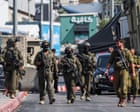
When two Israeli soldiers are killed in or around Hebron, the military response rarely looks like a surgical search for suspects. It looks like a citywide squeeze. Curfews snap shut over neighborhoods, commercial arteries go quiet, checkpoints multiply, and tens of thousands of residents who had nothing to do with an attack suddenly find their daily lives governed by military decree.
Call it collective punishment, call it force protection, or call it area denial. Whatever label a briefing room chooses, the mechanics on the ground are familiar to anyone who has spent decades watching the southern West Bank. After fatal attacks on troops, Israeli security forces routinely expand arrests, seal access roads, impose movement restrictions, and carry out sweeping raids across Hebron, turning an entire urban center into a pressure cooker in hopes of deterring future violence and forcing local compliance. You might also find this similar story interesting: What Most People Get Wrong About the Military Base Asylum Legal Battle.
Headline writers usually treat those crackdowns as sudden explosions of anger or simple reprisal. That framing misses how the system actually works. In Hebron, broad sweeps after soldier deaths are not improvised tantrums. They rest on a layered architecture of administrative authority, military geography, and political incentives that predates any single shooting and outlasts any single operation.
Why Hebron Always Becomes a Test Case
Hebron is not just another West Bank municipality. It is a dense commercial hub of roughly two hundred thousand Palestinians sitting thirty kilometers south of Jerusalem, and it is the only major Palestinian city where a small, heavily guarded Israeli settler enclave lives right inside the historic urban core. As reported in recent reports by NPR, the results are worth noting.
That physical overlap changes everything about how security policy is executed. In most West Bank cities, Israeli forces operate primarily along the perimeter or enter for targeted raids before pulling back. In Hebron, troops and settlers are already embedded near flashpoints like Shuhada Street, the Tel Rumeida area, and the compound known to Jews as the Cave of the Patriarchs and to Muslims as the Ibrahimi Mosque.
When two soldiers die in such a compressed environment, commanders face immediate tactical and political pressure. Soldiers on the ground are anxious, casualties sharpen demands for visible retaliation inside the government, and intelligence teams rush to map out networks before suspects vanish into surrounding hills or family compounds. Casting a wide net becomes the default reflex because officials argue that narrow operations move too slowly when an assailant could still be armed or on the run.
Yet there is a catch that seasoned observers recognize immediately. Broad sweeps do not just disrupt militants. They also sweep up shopkeepers, students, delivery drivers, and elders whose resentment toward the occupation deepens with every closed gate and midnight raid. Over years of repetition, the very measure sold as a deterrent often feeds the hostility that makes the next attack more likely.
The Mechanics Behind a Sweeping Response
To understand what happens after two soldiers are killed in Hebron, look at the tools military authorities reach for first. None of them require a civilian court verdict in advance.
- Movement closures and checkpoints: Flying checkpoints, concrete blocks, and strict permit checks can turn a ten-minute drive across town into a multi-hour ordeal or halt traffic altogether.
- Mass detention and interrogations: Security forces frequently detain dozens of men and youths across targeted quarters, holding some for questioning and placing others under administrative detention, a procedure allowing imprisonment without charge or trial based on secret evidence reviewed by military judges.
- Commercial shutdowns and curfews: Shops along key streets may be ordered closed or shuttered by circumstance when residents stay indoors to avoid clashes, checkpoints, or stray gunfire.
- Home raids and property damage: Nighttime searches of residences are standard during escalations, often leaving families shaken, doors damaged, and neighbors watching soldiers move from block to block.
Legal scholars and human rights monitors point out that punishing an entire population for offenses committed by individuals clashes with basic principles of international humanitarian law, including the prohibition on collective penalties under the Fourth Geneva Convention. Israeli officials, by contrast, contend that military law governing occupied territory permits wide-ranging security measures to protect soldiers and civilians, prevent further attacks, and gather intelligence quickly.
Both sides are arguing from real constraints and competing legal frameworks, which is why the debate rarely moves an inch. International critics see unlawful group punishment inflicted on civilians who bear no personal guilt. Military planners see an urgent counterinsurgency problem in a hostile, labyrinthine city where waiting for airtight legal proof can cost lives.
Deterrence Versus Blowback
Ask ten security analysts whether sweeping crackdowns in Hebron actually make soldiers safer, and you will hear a sharp split rather than a neat consensus.
One argument rests on deterrence and disruption. Proponents of tough, expansive operations argue that when an attack carries an immediate, heavy price for the surrounding area, potential assailants and local facilitators think twice, and security forces gain leverage through sheer presence and arrests. From this viewpoint, restraint can look like weakness in a volatile theater where militants test boundaries constantly.
The counter-argument is rooted in strategic blowback. Critics inside and outside Israel have warned for decades that collective measures blur the line between combatants and ordinary residents. When a teenager who has never touched a weapon spends a night zip-tied on a living room floor, or a family business loses weeks of income because roads are blocked, alienation spreads beyond militant circles into mainstream society.
Consider a hypothetical example to see how those incentives collide on a single street. Suppose a small workshop owner in Hebron relies on morning deliveries from nearby villages to keep his family afloat. A fatal attack on two soldiers occurs several blocks away, and the military seals key access routes for ten days while searching for leads. No one in that workshop had any link to the attackers, yet the owner loses his customers, falls behind on rent, and watches armored vehicles rumble past his shuttered door every night. Even if he never picks up a stone or a rifle, his trust in any prospect of fair treatment evaporates. Multiply that single shop by hundreds of households and businesses, and the long-term cost of the crackdown begins to look very different from the short-term tactical tally.
There is also a third factor that gets too little attention in fast-moving news cycles. Political signaling. Cabinet ministers and coalition partners often watch military responses closely, pressing for visible firmness to satisfy domestic constituencies. Commanders sometimes have to balance operational judgment against political expectations that demand a heavy hand right now.
What Standard Coverage Misses
Fast breaking coverage usually treats a post-attack operation in Hebron as a self-contained story with a clear beginning and end. A few days of raids and closures dominate the wires, then attention shifts elsewhere once the immediate headlines cool.
That approach misses the cumulative reality of life in Hebron. Restrictions in the city's sensitive zones do not simply appear out of nowhere after a shooting and vanish completely when the operation winds down. Over the years, temporary security closures have hardened into semi-permanent fixtures, turning once-bustling lanes into quiet corridors watched by cameras and soldiers.
Another blind spot is the economic strain on a city that already carries heavy structural weight. Hebron is an engine of Palestinian manufacturing, stone cutting, leatherwork, and trade. Every prolonged disruption ripples outward through supply chains, squeezing wages, delaying shipments, and pushing households deeper into debt. Security briefings rarely put a ledger on that economic wear and tear, yet it shapes daily life across the city far longer than a single raid.
Nor do surface-level reports always distinguish between immediate force-protection sweeps and broader political agendas. Some factions in Israeli politics view Hebron's Jewish presence as a historic right to be expanded and fortified at every turn, while Palestinian leadership and international observers view the same enclave as a major obstacle to any viable two-state arrangement. When violence strikes, those deeper battles over sovereignty and control hover right behind every military decision.
Reading the Next Escalation Clearly
Anyone watching Hebron after the death of two soldiers should look past dramatic rhetoric and pay attention to concrete indicators on the ground. How long do the road closures and commercial restrictions stay in place once the initial search phase passes? Are detentions concentrated around specific leads, or do they expand into broad sweeps across entire neighborhoods? How are local merchants, hospital workers, and commuters navigating checkpoints day to day?
Those details tell you whether an operation is narrowly aimed at catching killers or functioning as a wider instrument of control and intimidation. They also show how quickly a localized security crisis can harden into a deeper cycle of grievance and retaliation.
In Hebron, every crackdown leaves behind a ledger written in closed shutters, sleepless nights, and hardened attitudes. Watch what remains standing after the sirens fade, because that is where the real story of the next clash is already taking shape.