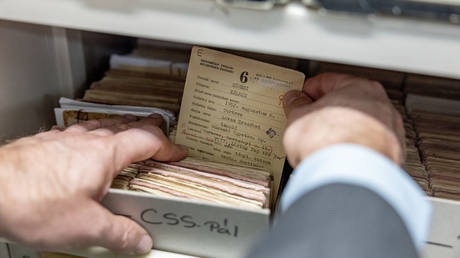
The release of declassified communist spy files in Hungary has triggered fierce public debate, political finger-pointing, and accusations of a modern witch hunt because the documents expose how deeply the former secret police infiltrated everyday life—while leaving critical gaps that make definitive guilt hard to prove. Rather than settling historical scores, the partial opening of Cold War intelligence archives has revived decades-old trauma, weaponized history for contemporary political advantage, and forced Hungarians to confront an uncomfortable truth about who informed on whom during the Soviet era.
History rarely stays buried in Central Europe. In Budapest, it sits in climate-controlled archive rooms, bound in yellowing folders stamped with the faded ink of the State Security Services. Don't forget to check out our earlier post on this related article.
For more than three decades after the collapse of communism in 1989, Hungary handled its secret police legacy differently than many of its neighbors. While countries like Germany, Poland, and the Czech Republic moved aggressively to open their archives and vet public officials, Hungary’s transition was negotiated rather than revolutionary. That compromise protected social peace in the early 1990s. It also left a ticking political time bomb inside the state archives.
When batches of informant files, operational reports, and surveillance logs are declassified or leaked into the public sphere, the reaction is immediate and volatile. Names surface. Reputations fracture overnight. Yet behind the headlines about "witch hunts" lies a far more complicated reality involving missing records, coerced collaboration, and selective transparency. To read more about the context here, BBC News offers an excellent summary.
Why Hungary’s Secret Police Archives Remain So Explosive
To understand why declassified communist spy files cause such intense hysteria in Hungary, you have to look at how the system operated before 1989.
Following the crushed 1956 Hungarian Revolution, János Kádár’s regime built a surveillance apparatus that relied less on mass terror than on pervasive psychological pressure. The III/III Directorate—the domestic intelligence branch responsible for monitoring internal dissent—did not need an army of uniformed officers on every street corner. It relied on ordinary citizens reporting on neighbors, colleagues, classmates, and even family members.
Priests informed on fellow clergy. Rock musicians reported on bandmates. Academics filed summaries on visiting Western scholars.
Because the network was so broad, virtually every cultural, religious, and intellectual institution in Hungary had informants embedded within it. When files from that era become public today, they do not merely implicate obscure bureaucrats. They touch beloved actors, respected historians, church leaders, and veteran politicians across the ideological spectrum.
The shock comes from proximity. Unlike distant espionage scandals involving foreign diplomats, domestic informant files reveal intimate betrayals committed in living rooms, university seminars, and parish halls.
The Architecture of Ambiguity
What makes these documents especially dangerous in modern public debate is how they were written.
An operational file from the 1970s or 1980s is not a neutral historical transcript. It is an internal bureaucratic record created by intelligence officers who had quotas to fill and superiors to impress. Case officers routinely exaggerated the usefulness of their sources, framed casual conversations as formal intelligence briefings, or listed individuals as "contacts" without those individuals ever signing a recruitment pledge.
Consider a hypothetical example to see how easily misinterpretation happens. Imagine a university lecturer in 1978 who was summoned by police after applying for a passport to attend a conference in Vienna. During a two-hour interview, an officer asked questions about foreign colleagues. The officer later wrote a memo summarizing the conversation and assigned the lecturer a codename in an internal registry. Forty-five years later, a researcher finds that registry card. Without the surrounding operational file—which may have been shredded in 1989—the card makes the lecturer look like a willing undercover agent, even if they never agreed to collaborate or received a single forint in payment.
This structural ambiguity is the fuel behind every "witch hunt" accusation. Critics argue that treating raw secret police paperwork as gospel truth turns the perpetrators' own bureaucratic lies into final verdicts against their victims.
How Incomplete Records Distort Accountability
Hungary’s lustration laws—the legal frameworks designed to screen public officials for past ties to communist intelligence—have been repeatedly amended, narrowed, and challenged since the early 1990s.
During the chaotic final months of the regime in 1989 and early 1990, massive quantities of sensitive files were destroyed. Shredders ran around the clock in interior ministry buildings. Magnetic tapes were erased. Microfilms disappeared.
What survived in the Historical Archives of the Hungarian State Security represents a fragmented mosaic rather than a complete picture. Some networks are documented down to expense receipts for coffee and cigarettes. Others have entire years missing.
This asymmetry creates a glaring moral hazard:
- Low-level informants who were coerced into signing agreements under threat of losing their jobs or university spots often left behind extensive paper trails.
- Senior operatives and high-ranking party officials who directed the surveillance apparatus frequently saw their records purged or reclassified before the democratic transition took hold.
- Victims of surveillance sometimes find their own names listed in cross-referenced indexes in ways that confuse casual observers into thinking they were collaborators rather than targets.
When politicians, journalists, or activist groups publish lists of names pulled from these partial archives, the public sees only the fragments that survived the shredder. Those who were pressured at age twenty into reporting on a student club face lifelong public disgrace, while the handlers who orchestrated the blackmail often remain anonymous or shielded by privacy statutes.
The Mechanics of Political Weaponization
In Hungarian politics, history is never merely academic. It is active ammunition.
Over the past twenty years, debates over opening the remaining communist spy files have followed a predictable rhythm. Opposition parties routinely introduce parliamentary bills demanding full, unrestricted disclosure of all surviving agent lists. Governing coalitions—regardless of which party holds power at a given moment—tend to block, delay, or water down those proposals, citing national security, data protection, or constitutional privacy rights.
Then, selective leaks occur.
A name drops in a sympathetic newspaper just before an election. A documentary airs exposing a prominent cultural figure. Social media erupts with demands for total transparency, while defenders of the accused cry foul over character assassination.
This cycle serves clear political functions:
- Moral Delegitimization: Tying an opponent—or an opponent's family member—to the communist secret police remains one of the fastest ways to erode their credibility with conservative and anti-communist voters.
- Deflection: Heated public arguments over 1980s informant networks reliably crowd out coverage of current economic policy, institutional reforms, or governance disputes.
- Factional Leverage: Inside political movements and cultural institutions, unpublished knowledge about who appears in the archives acts as quiet leverage, keeping potential critics cautious.
The word "witch hunt" gets deployed by both sides depending on whose ally is in the crosshairs. When files implicate figures aligned with one political camp, their supporters denounce the release as a partisan smear campaign built on unreliable communist paperwork. When files implicate rivals, the exact same records are hailed as long-overdue historical justice.
What Historians Actually Say About Reading the Files
Spend time talking to serious Cold War archivists in Budapest, and you quickly notice how differently they read these documents compared to cable news commentators.
Professional historians do not dismiss the files as worthless fabrications, nor do they read them as literal transcripts of reality. Instead, they treat them as forensic puzzles that require cross-checking against multiple independent sources.
To verify whether someone genuinely collaborated with the III/III Directorate, researchers look for specific markers:
- Handwritten reports: Did the individual personally write and sign intelligence summaries, or did a case officer merely type up notes after a meeting?
- Financial or material rewards: Are there signed vouchers for cash payments, housing favors, travel permits, or career promotions tied to specific reports?
- Operational consistency: Do the reports contain actionable information that led to arrests, interrogations, or ruined careers, or were they vague, harmless summaries designed to satisfy a handler while protecting friends?
- Recruitment context: Was the person recruited voluntarily out of ideological zeal or greed, or were they blackmailed over a relative's prison sentence, a religious background, or personal vulnerability?
Without that context, a raw list of names tells you almost nothing about moral culpability. Two people can carry identical administrative labels in a 1984 registry—one having actively destroyed colleagues' lives for cash, the other having spent five years feeding useless gossip to a case officer just to keep their children in school.
The Generational Divide Over Reckoning and Closure
More than thirty-five years after the Iron Curtain fell, time itself is reshaping the debate.
Many of the key figures from the late Kádár era are now in their seventies and eighties, or have already passed away. For younger Hungarians born in the 1990s and 2000s, the III/III Directorate feels almost as distant as the Austro-Hungarian Empire. Yet the institutional reflexes shaped by that era—distrust of official narratives, suspicion of public institutions, and fierce polarization—remain deeply embedded in public life.
Defenders of full disclosure argue that secrecy itself is what keeps the poison alive. Their logic is straightforward: as long as files remain locked behind bureaucratic hurdles or selectively leaked for political gain, rumor and paranoia will thrive. Put everything online, let historians annotate the context, and strip the archives of their power to shock or blackmail.
Opponents of blanket publication raise legitimate legal and ethical objections. Under European privacy standards and Hungarian constitutional rulings, individuals have rights over personal data collected illegally by an authoritarian regime. Publishing unverified surveillance logs can expose intimate details about innocent victims—their medical histories, private relationships, and family conflicts—simply because secret police microphones recorded them decades ago.
Both arguments carry real weight. Full transparency risks collateral damage to innocent people; restricted access perpetuates suspicion and selective political leaks.
Why Half-Measures Guarantee Future Scandals
Hungary’s predicament offers a clear lesson about transitional justice: half-measures rarely produce stability.
By choosing neither a comprehensive, rigorously contextualized public reckoning nor a permanent archival seal, successive governments created a grey zone where fragments of the past surface without rules, standards, or institutional guardrails. Every new batch of declassified files triggers the same predictable storm—outrage, denial, partisan scoring, and demands for investigations that rarely yield legal consequences.
Until archives are opened under transparent, scholar-led frameworks that distinguish coercion from active betrayal—and separate targets from perpetrators—every newly released folder from Budapest's Cold War vaults will continue to detonate like a political grenade.