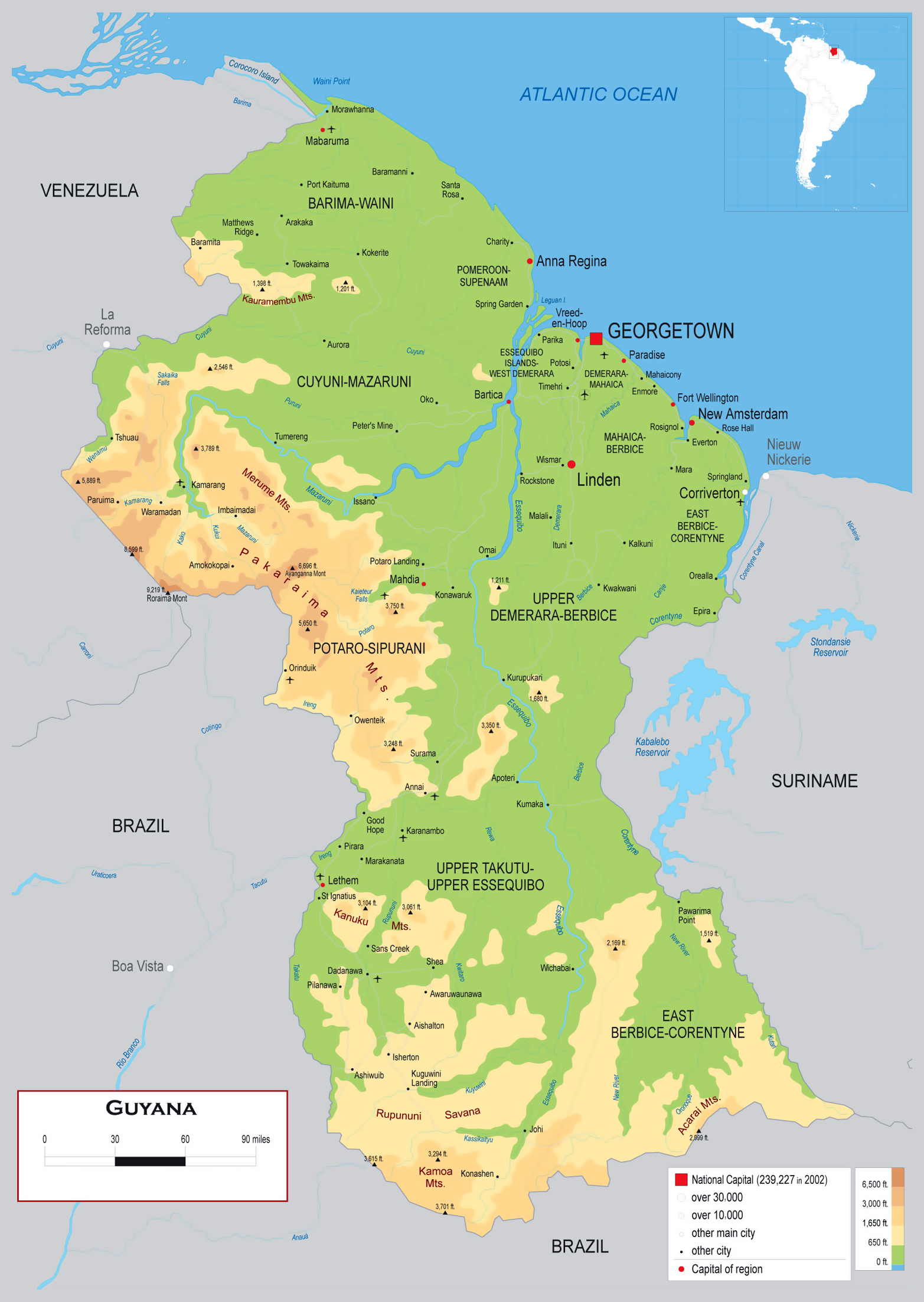
India has extended a $500 million Line of Credit (LoC) to Guyana, earmarked specifically to overhaul the South American nation’s digital infrastructure and inject capital into its small and medium-sized enterprises (SMEs). According to Guyana’s High Commissioner to India, Dharamkumar Seeraj, the financing mechanism is designed to bridge the gap between Guyana's rapid macroeconomic expansion—fueled by massive offshore oil discoveries—and the ground-level technological and industrial capacity required to sustain it.
The deal is far more than a routine bilateral aid package. It is a calculated geopolitical and economic maneuver that pairs India’s export-driven technology sector with the fastest-growing economy in the world.
For decades, Guyana sat on the periphery of global capital flows, an economy tethered to sugar, rice, bauxite, and gold. Everything changed in 2015 when ExxonMobil and its consortium partners struck high-grade crude in the Stabroek Block. Today, with daily oil production surging and sovereign wealth accumulating at a breakneck pace, Georgetown faces a classic resource-curse dilemma. Cash is flowing into the treasury, yet the foundational plumbing of a modern economy—fiber-optic networks, digital payment rails, automated customs systems, and local manufacturing supply chains—remains dangerously underdeveloped.
Enter New Delhi. By structuring this $500 million commitment as a Line of Credit rather than a direct grant or a commercial bank loan, India is deploying a proven instrument of economic statecraft.
The Mechanics of the $500 Million Credit Line
To understand what this money actually does, you have to strip away the diplomatic pleasantries and look at how Indian Lines of Credit operate. Administered primarily through the Export-Import Bank of India (Exim Bank) on behalf of the Indian government, an LoC is not a blank check deposited into Guyana’s central bank.
Instead, it is a tied financing facility. Under standard Indian Exim Bank guidelines, a substantial percentage of the goods, services, and consultancy procured under the credit line—typically around 75 percent, though subject to project-specific waivers—must be sourced from Indian companies.
This structure creates a closed-loop economic benefit. Guyana gains access to concessional financing with lower interest rates and longer repayment tenors than it could secure on open international bond markets, allowing it to preserve its oil revenues for other sovereign priorities. Simultaneously, the Indian government effectively subsidizes its own private sector, underwriting the expansion of Indian tech firms, engineering contractors, and industrial suppliers into the Caribbean and South American markets.
High Commissioner Dharamkumar Seeraj’s emphasis on digital infrastructure and small industries points directly to where the friction in Guyana’s economy is hottest. When a country’s GDP expands by double digits year after year, legacy administrative systems buckle. Paper-based bureaucratic processes slow down port clearances, tax collection, and business registration. Without modernized digital rails, local businesses cannot scale fast enough to capture the lucrative subcontracts generated by multinational energy companies.
Why Digital Infrastructure Is the Real Bottleneck
Oil wealth creates an immediate illusion of prosperity, but it quickly exposes structural deficits. In Georgetown, the influx of foreign contractors and capital has driven up the cost of labor and real estate, squeezing traditional local businesses. If Guyanese SMEs are going to survive—let alone thrive—they need productivity multipliers.
Digital infrastructure is the most immediate multiplier available. India is not exporting theoretical models here; it is exporting a battle-tested playbook. Over the past decade, India built the India Stack—a layer of open APIs and digital public goods encompassing biometric identity (Aadhaar), real-time mobile payments (UPI), and paperless document verification (DigiLocker).
While Guyana’s population of roughly 800,000 is a fraction of India’s 1.4 billion, the operational challenges of financial inclusion and administrative efficiency are remarkably similar. Extending high-speed connectivity to Guyana’s interior regions, digitizing government-to-citizen services, and establishing secure national data centers are foundational steps.
Consider a hypothetical example of how this plays out on the ground. Suppose a small agricultural cooperative in Guyana's Essequibo region wants to supply produce to offshore catering contractors. Currently, without standardized digital invoicing, verifiable credit histories, or reliable broadband to track logistics, that cooperative gets locked out of the supply chain in favor of imported goods. If the LoC funds the deployment of rural digital infrastructure and cloud-based enterprise tools tailored for small businesses, that cooperative suddenly gains the administrative visibility required to pass multinational procurement audits.
The technology transfer, however, is only half the equation. Hardware and software mean very little if the local industrial base lacks the machinery and working capital to produce physical goods.
Revitalizing Small Industries Without Creating Dependency
Seeraj’s focus on small industries addresses a glaring vulnerability in Guyana’s economic boom. Right now, the country imports an unsustainable percentage of its processed foods, construction materials, and light manufactured goods. When oil revenues spike, import bills spike right alongside them, leaking capital out of the domestic economy.
Channeling credit toward SMEs is meant to stimulate domestic value addition. In practice, this means funding agro-processing plants, light manufacturing facilities, packaging units, and renewable energy microgrids. India’s Small Industries Development Bank (SIDBI) and its vast ecosystem of machinery manufacturers specialize in frugal, mid-scale industrial equipment designed for developing markets. Unlike massive European or North American industrial turnkey plants—which often require huge minimum order quantities and expensive proprietary maintenance—Indian SME machinery is typically modular, cost-effective, and built to operate in environments with variable power grids.
Yet, injecting $500 million into a relatively small economy carries severe absorption risks. Money does not automatically translate into competence.
The Absorption Capacity Problem
Economists who track resource-rich nations know that throwing capital at small businesses often backfires if the institutional scaffolding is weak. Guyana faces a severe human capital shortage. Decades of outward migration drained the country of engineers, IT specialists, and mid-level managers.
If an Indian contractor builds a state-of-the-art digital data center or equips a dozen agro-processing hubs, who maintains them when the initial warranty expires? If local banks lack the technical expertise to underwrite complex SME equipment loans, the credit line risks either sitting unutilized in bureaucratic limbo or flowing disproportionately to a handful of politically connected conglomerates.
Historical precedent across the developing world—including several past Indian LoC projects in Africa and the Caribbean—shows that tied credit lines frequently suffer from implementation delays. Disputes over project scope, sluggish procurement approvals, and mismatches between Indian technical specifications and local regulatory standards can stall disbursements for years.
The Geopolitical Chessboard in the Caribbean
You cannot separate this $500 million credit line from the broader geopolitical tug-of-war unfolding in the Western Hemisphere. Guyana is no longer a quiet backwater; it is a strategic energy hub sitting right next to Venezuela, whose territorial claims over the oil-rich Essequibo region keep regional tensions perpetually simmering.
For the past fifteen years, China has been the dominant infrastructure financier across Latin America and the Caribbean through its Belt and Road Initiative. Chinese state-owned enterprises built roads, bridges, and port facilities across the region, often backed by massive, opaque debt packages.
India is positioning itself as the democratic, transparent alternative to Beijing’s checkbook diplomacy. New Delhi shares deep historical and cultural ties with Guyana—roughly 40 percent of Guyana’s population is of Indian descent, tracing their roots back to 19th-century indentured laborers. That diaspora connection gives Indian diplomats and business leaders an intuitive cultural fluency in Georgetown that Beijing simply cannot replicate.
At the same time, Washington is watching closely. The United States views Guyana as a vital energy security partner and is eager to prevent Chinese dominance over critical digital and telecommunications infrastructure in the Americas. By stepping in to fund Guyana’s digital backbone, India achieves a rare geopolitical alignment: it expands its own commercial footprint, bolsters a historic cultural ally, and quietly advances Western strategic interests by keeping sensitive telecom and data infrastructure out of Chinese hands.
What Separates Success From Another Stalled Sovereign Loan
The announcement of a $500 million credit facility makes for strong headlines, but sovereign finance is judged entirely by execution. For Guyana to turn this credit line into permanent economic muscle rather than another line item on its national debt ledger, three operational realities must be managed ruthlessly.
First, procurement transparency will dictate public trust. In an economy awash with new oil money, accusations of favoritism in state-backed credit distribution can quickly poison the political environment. The criteria for how local SMEs access sub-loans or equipment under this facility must be published, standardized, and insulated from political interference.
Second, skills transfer has to be baked into every contract. Every Indian IT firm or industrial supplier winning a tender under this LoC should be contractually obligated to train and certify Guyanese technicians. Without a mandatory knowledge-transfer mechanism, Guyana simply trades dependency on Western oil majors for dependency on Indian tech vendors.
Third, interoperability cannot be an afterthought. As Guyana builds out its digital public infrastructure, the systems deployed by Indian contractors must integrate cleanly with existing Western banking protocols and Caribbean Community (CARICOM) trade frameworks. Building a closed, proprietary digital ecosystem would isolate Guyanese businesses rather than connect them to global markets.
The capital is now on the table, backed by diplomatic momentum from both New Delhi and Georgetown. Whether this $500 million becomes the foundation of a diversified, resilient Guyanese economy or merely an expensive patch on an overheating petro-state depends entirely on how strictly both governments enforce accountability once the first tranche of contracts is signed.