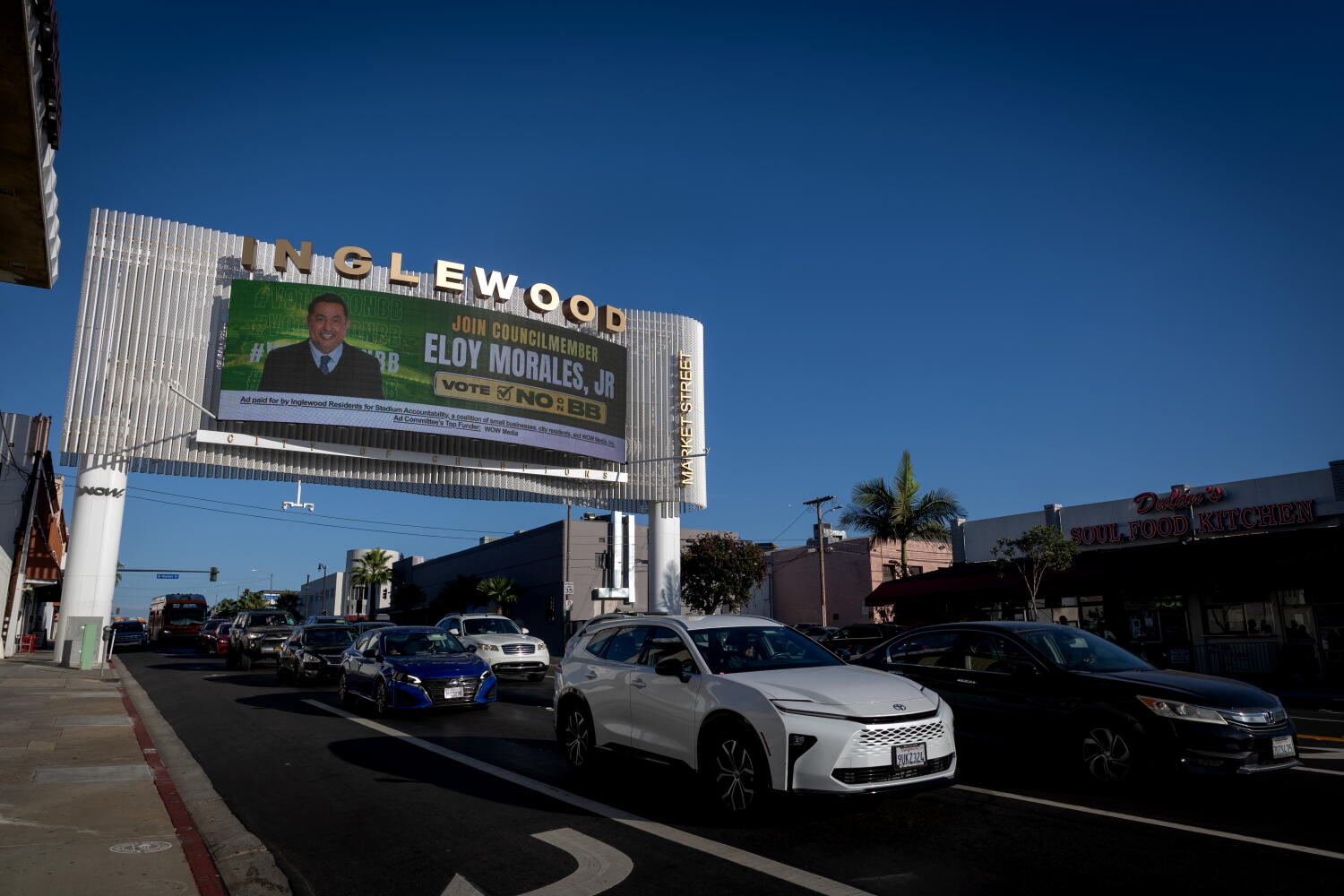
Two massive digital video billboards rising near Inglewood's entertainment district have triggered a high-stakes regulatory showdown with the California Department of Transportation. State officials contend that the structures violate the California Outdoor Advertising Act, a decades-old statute governing what can be built alongside state highways and how bright those displays can burn into the night sky. At the center of the dispute sits a familiar friction in Southern California real estate—a booming municipal development corridor colliding head-on with strict state-level highway safety and zoning mandates.
Local officials approved these installations to capture commercial revenue from the millions of fans pouring into SoFi Stadium, the Intuit Dome, and the Kia Forum. Caltrans regulators, however, view the towers through a entirely different lens. To the state agency, an unpermitted or non-conforming digital sign adjacent to a major freeway artery like Interstate 405 or Interstate 105 is not an economic engine. It is an illegal distraction engineered to pull drivers' eyes off the asphalt at sixty-five miles per hour. Discover more on a connected issue: this related article.
The Anatomy of a Regulatory Standoff
Highway billboards in California do not exist in a local vacuum. While a city council can rezone a parcel, issue building permits, and sign off on municipal revenue-sharing agreements, those local approvals do not override state jurisdiction. Under the Outdoor Advertising Act, Caltrans maintains strict authority over any advertising display placed within 660 feet of the edge of a state highway or interstate right-of-way.
The rules are unambiguous. Before a single steel beam goes into the ground, the operator must hold both a valid local permit and an active state outdoor advertising permit. In the Inglewood dispute, Caltrans flagged two video structures for operating outside the boundaries of state compliance. When a billboard company erects a digital face without final state clearance—or converts a traditional static sign into an illuminated LED screen without a fresh state review—the agency issues a formal violation notice. Additional reporting by Reuters delves into comparable perspectives on the subject.
These notices carry teeth. Under California Business and Professions Code, unpermitted displays are classified as public nuisances. Caltrans has the statutory authority to levy daily fines, revoke existing permits, and ultimately compel the physical removal of the steel superstructure. Yet anyone who has tracked outdoor media along the 405 corridor knows that notices of violation rarely lead to immediate demolition. Instead, they mark the opening bell of a protracted legal war of attrition.
Why Digital Conversions Trigger State Scrutiny
Converting a static vinyl billboard into a full-motion or variable-message LED screen fundamentally changes the regulatory math. State law treats illuminated, changing displays with far greater suspicion than traditional painted or printed boards. Regulators look closely at three specific compliance pillars:
- Spacing Requirements: State law mandates strict minimum distances between digital displays on the same side of a freeway—typically 500 to 1,000 feet depending on the highway classification—to prevent visual clutter and driver overload.
- Luminance and Glare: Digital screens must adhere to strict candela-per-square-meter limits, particularly after sunset, to prevent blinding motorists or washing out ambient road lighting.
- The "On-Premise" Exemption: State rules draw a hard line between on-premise signs (advertising a business located on the exact property where the sign stands) and off-premise signs (selling ad space to third-party brands like soda companies, studios, or sportsbooks).
That third bullet is where most California billboard battles are fought. Off-premise digital billboards face steep statutory hurdles and outright bans along many landscaped freeway segments. To bypass those restrictions, developers frequently attempt to classify massive stadium-district video towers as "on-premise" signage or architectural media facades tied to an overarching entertainment complex.
Caltrans rarely buys that argument without a fight. If a screen sits on a strip parcel separated from the main venue, or if 90 percent of its rotation features national consumer brands rather than the immediate tenant beneath the pole, state inspectors classify it as an illegal off-premise billboard.
The Economics Driving the Inglewood Gold Rush
To understand why an outdoor media operator would risk state enforcement action—and potentially millions of dollars in sunk construction costs—you have to look at the sheer financial gravity of Inglewood's stadium district. In the outdoor advertising industry, inventory is priced on Daily Effective Circulation (DEC), a metric measuring how many eyeballs pass a given structure every twenty-four hours.
Few corridors in North America rival the traffic density around LAX and Inglewood. Interstate 405 consistently ranks among the busiest freeways in the United States, carrying well over 300,000 vehicles on an average weekday. Add event-night surges from NFL games, NBA matchups, and sold-out arena tours, and the advertising value of a single high-definition LED face skyrockets.
A prime static billboard along a standard suburban highway might fetch $5,000 to $12,000 a month. A massive, double-sided digital spectacular overlooking the Inglewood approach routes can command $50,000 to over $150,000 per month per face—and because digital boards rotate six to eight advertisers every minute, operators multiply that revenue across an entire roster of blue-chip clients.
For a city that spent decades watching tax dollars flow to neighboring Los Angeles and Culver City, those numbers represent a fiscal lifeline. Municipal development agreements in stadium districts routinely carve out a percentage of gross billboard revenue or collect substantial annual concession fees directly into the city's general fund. When a city stands to collect hundreds of thousands of dollars annually from a single steel monopole, local officials have every incentive to interpret zoning codes broadly and push projects forward quickly.
The "Build First, Litigate Later" Playbook
Across the outdoor advertising sector, veteran observers recognize a familiar operational pattern. Regulatory delays in California can stretch for years, draining capital while prime advertising seasons pass by. Rather than waiting indefinitely for every administrative hurdle to clear, aggressive operators sometimes rely on local municipal sign-offs to begin construction, betting that once a multi-million-dollar steel structure is standing and generating revenue, regulators will negotiate a settlement rather than demand a teardown.
It is a calculated gamble. Let us look at a hypothetical example to see how the numbers work in practice. Suppose an operator spends $2.5 million erecting a dual-face digital spectacular and immediately begins booking $120,000 a month in ad contracts. Even if Caltrans issues a violation notice in month two and imposes statutory penalties, the operator can file administrative appeals, request hearings, and tie the enforcement action up in the state court system for eighteen to twenty-four months. During that litigation window, the screen generates nearly $2.9 million in gross billings—effectively paying off the physical asset before a judge ever rules on the underlying permit defect.
That financial reality explains why state regulators face an uphill battle policing California's freeway corridors. Fines written into statutes during the 1970s and 1980s were calibrated for an era of paper posters and floodlights, not high-margin programmatic digital networks.
Federal Money and the Highway Beautification Act
Caltrans does not enforce these rules merely out of bureaucratic pride. The agency's mandate is tied directly to federal highway funding under the Highway Beautification Act of 1965. championed by Lady Bird Johnson, that federal law requires states to maintain "effective control" over outdoor advertising along the Interstate and National Highway Systems.
If a state allows unpermitted billboards to proliferate unchecked, the Federal Highway Administration (FHWA) holds the authority to penalize the state by withholding up to 10 percent of its annual federal-aid highway funds. For California, a 10 percent cut translates into hundreds of millions of dollars earmarked for bridge repairs, pavement rehabilitation, and transit infrastructure.
Because federal dollars are on the line, Caltrans cannot simply look the other way when a municipality cuts a bespoke deal with an outdoor media vendor. Federal auditors periodically review state compliance records. If FHWA inspectors spot towering digital video screens operating along Interstate 405 or Interstate 105 without valid state permits, Sacramento answers to Washington.
This dynamic creates an unavoidable structural conflict. Inglewood officials answer to local taxpayers and business owners who want vibrant commercial districts and municipal revenue. Caltrans answers to federal highway mandates and statewide traffic safety standards. Neither side is acting irrationally, yet their mandates are fundamentally incompatible when a billboard goes up without dual approval.
The Safety Debate Behind Full-Motion Video
Beyond zoning lines and revenue splits lies the core public safety question that triggered the Caltrans crackdown: how much visual motion can drivers safely process?
Traditional digital billboards operate on a "slide-show" model. Under standard California regulations, a digital sign must display a static image for a minimum dwell time—typically four to eight seconds—before transitioning instantaneously to the next ad. Scrolling text, flashing lights, and full-motion video are strictly prohibited alongside state highways.
Full-motion video screens—the exact type of high-impact visual technology prized by sports arenas and entertainment districts—are engineered to hijack human peripheral vision. Evolutionary biology wires the human eye to track sudden movement. When a sixty-foot LED screen flashes a cinematic trailer or a fast-cut commercial beside a congested freeway interchange, drivers instinctively glance away from brake lights ahead.
Transportation safety researchers have debated the precise accident causation rates of digital billboards for two decades, and the data contains genuine gray areas. Some industry-funded studies argue that crash rates near digital signs show no statistically significant spike compared to control segments. Independent eye-tracking studies, however, consistently demonstrate that high-luminance, dynamic displays increase "long glances"—defined as eyes off the road for two seconds or more—which safety engineers link directly to rear-end collisions and lane-departure incidents.
In the Inglewood corridor, where out-of-town visitors constantly merge across multiple lanes trying to decipher stadium exit ramps while navigating LAX airport traffic, cognitive load is already maxed out. Adding unapproved video screens into that environment is precisely what the Outdoor Advertising Act was written to prevent.
Where the Legal Battle Goes From Here
When Caltrans declares a billboard structure in violation of state law, the administrative machinery moves along a predictable, grinding track. First comes the formal notice of violation, giving the property owner and sign operator a strict window—usually thirty days—to either cure the defect or prove that an exemption applies.
Because an operator cannot easily obtain a retroactive state permit for a structure that violates spacing or zoning rules, the response almost always shifts to legal challenge. Operators typically pursue one of three avenues:
- Challenging State Jurisdiction: Arguing that the sign is oriented toward a local city street rather than the state highway, or that it falls outside the statutory 660-foot measurement zone due to intervening structures or topography.
- Claiming Redevelopment or Entertainment District Exemptions: Pointing to special state legislation—California has occasionally passed targeted carve-outs for specific entertainment zones like downtown Los Angeles's L.A. Live—to argue the corridor qualifies for relaxed signage rules.
- Seeking Local Legislative Intervention: Lobbying state lawmakers representing the district to introduce last-minute statutory amendments that retroactively legalize existing structures under narrow geographic criteria.
That third option has long been the open secret of California outdoor advertising. Over the past twenty years, lawmakers in Sacramento have repeatedly entertained bills designed to grant surgical exemptions to specific cities, stadiums, and transit agencies, allowing them to erect massive digital signs that would otherwise be flatly illegal under state code.
Whether the two Inglewood video structures survive will ultimately depend on whether the operators can thread that narrow needle—either proving their screens fall outside Caltrans's legal reach or convincing lawmakers to redraw the statutory map around them. Until a court or the legislature intervenes, the violation notices stand, leaving two multi-million-dollar beacons caught squarely between municipal ambition and state law.