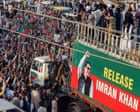
Thousands of shipping containers block the primary arteries leading into Islamabad, transforming Pakistan’s capital into an armed fortress designed to halt a mass mobilization demanding the release of imprisoned former Prime Minister Imran Khan. The administration of Prime Minister Shehbaz Sharif, backed by the country's powerful military apparatus, has drawn a hard line against the Pakistan Tehreek-e-Insaf (PTI) party, deploying tens of thousands of security personnel, suspending mobile networks, and sealing provincial borders. This high-stakes standoff is not merely a dispute over prison gates or street access. It is the physical manifestation of an existential collision between an entrenched political-military establishment and a populist movement that refuses to vanish despite years of sustained state suppression.
To understand why Islamabad resembles a war zone, one must examine the mechanics of containment practiced by modern Pakistani administrations. When the PTI issues a call to march from its stronghold in Khyber Pakhtunkhwa province, the state response relies on preemptive paralysis. Main roads are barricaded with multi-ton steel containers, educational institutions are shuttered, public transport is systematically disrupted, and hundreds of party loyalists and family members are detained before they can reach assembly points.
This strategy of absolute isolation is built on the fear of critical mass. In a country grappling with soaring inflation, severe structural economic fatigue, and deep public disillusionment, a massive mobilization converging on the seat of government carries the potential to crack the facade of institutional control. By barricading the capital, the government attempts to fragment the protest into localized, manageable skirmishes, keeping demonstrators penned up at provincial boundaries through the heavy use of tear gas and rubber bullets.
Yet, this fortress mentality exacts a brutal toll on the civilian population and the national economy. Daily wage earners, local merchants, and ordinary residents find their lives completely upended by the sudden sealing of urban centers. Supply chains break down, businesses grind to a halt, and public frustration deepens. Every shipping container stacked across a motorway serves as a physical reminder of the widening chasm between the governed and the governing. The state calculates that the economic and physical exhaustion of a prolonged lockdown is preferable to allowing an opposition march to penetrate the red zone of power.
The central pillar of the PTI strategy remains the figure of Khan himself, detained inside Adiala Jail under a barrage of legal cases ranging from corruption charges to state secrets—all of which he and his legal team maintain are politically fabricated to neutralize his enduring electoral appeal. Even from behind bars, designated as prisoner number 804, Khan commands a loyal base that views his detention as an assault on democratic norms. The state’s objective has shifted from simple political competition to total neutralization, aiming to erase his party's viability through judicial hurdles, media blackouts, and the systematic targeting of second and third-tier leadership.
This dynamic creates a dangerous political equilibrium. The government cannot afford to release Khan without risking an immediate resurgence of his political machinery, nor can it easily extinguish the grassroots anger driving his supporters onto the highways. Every attempt to block a march with brute force hardens the resolve of the base, transforming local protests into symbols of resistance against perceived authoritarian overreach.
As security forces maintain their watch over miles of razor wire and steel barriers, the underlying structural crises of the state remain unaddressed. The standoff on the approaches to Islamabad underscores a rigid political stalemate where neither side possesses the leverage to deliver a decisive blow, leaving the country suspended in a cycle of confrontation, economic distress, and institutional decay.