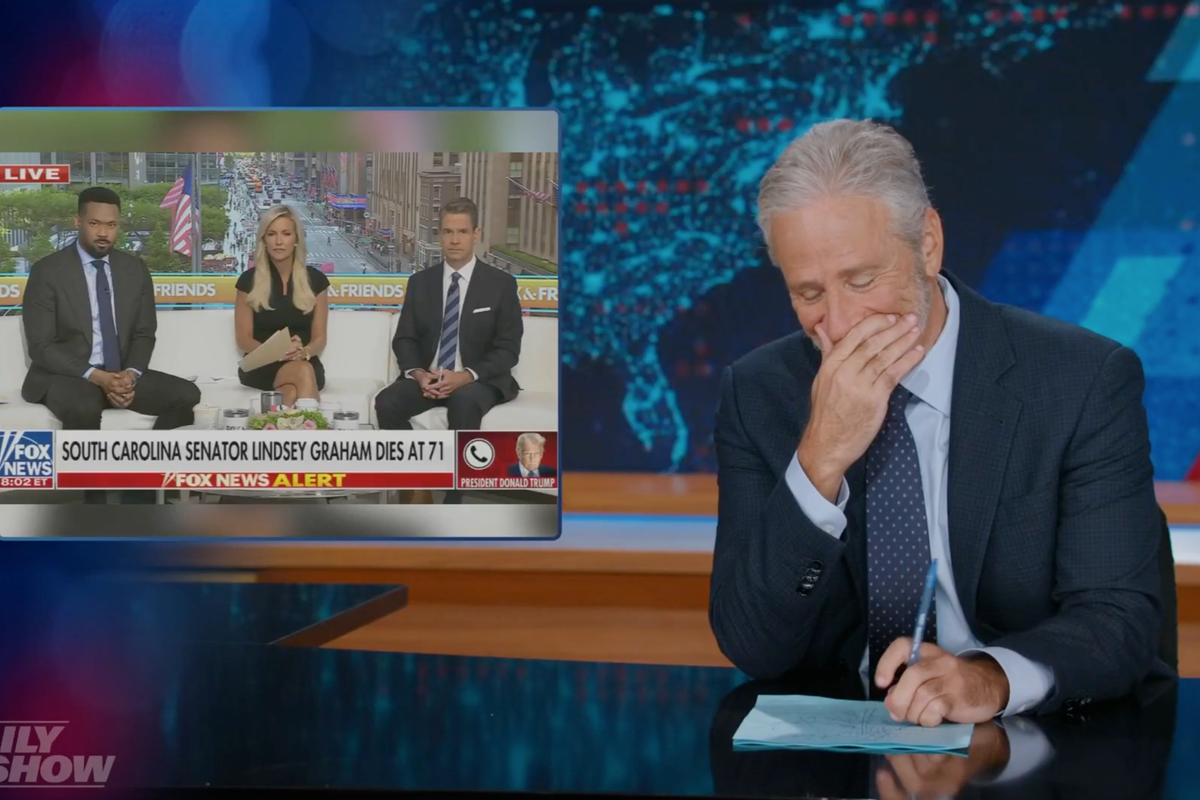
Jon Stewart returned to the late-night airwaves with a blistering takedown of the political establishment, zeroing in on Donald Trump's bizarre eulogy for the late Senator Lindsey Graham and the systemic issues plaguing a geriatric Congress. During his monologue, Stewart dissected Trump’s live phone-in interview on Fox News, where the former president completely derailed what should have been a standard political tribute. Instead of offering conventional condolences, Trump launched into a rambling series of grievances about Graham calling him too often, how Graham was "not a great striker of the ball" in golf, and scored the late senator's political legacy like a food critic evaluating a pizza slice.
The segment highlight saw Stewart struggling to contain his laughter before highlighting the dark underlying reality of American politics. Beyond the comedy, the moment laid bare a deeply entrenched crisis: a government where aging politicians cling to power, and the media networks designed to cover them are powerless to keep the narrative on track.
The Comedy of Grief and the Art of the Self Centered Eulogy
When a long-serving senator passes away, the political playbook dictates a predictable set of respectful platitudes. Donald Trump threw that playbook out the window during his Fox News call-in. Rather than highlighting Graham’s decades of legislative work, Trump focused heavily on personal dynamics, complaining that the senator called him incessantly.
"He'd call me all the time, I'd say, 'Stop calling me, Lindsey,'" Trump remarked.
Stewart, slipping effortlessly into his Trump impression, pushed the absurdity to its logical limit.
"I’ll never forget the way that I always let him go to voicemail," Stewart joked. "It was our thing."
The roast did not stop at personal communications. Trump went on to critique Graham’s golf game, noting that he was "not a great striker of the ball," before calling him a "total workaholic politician."
For Stewart, this was the ultimate display of self-absorbed grief. He pointed out that Trump had effectively skipped past the five traditional stages of grief—denial, anger, bargaining, depression, and acceptance—and invented a sixth stage specifically for his former golf partner.
Stage 1: Denial ──> Stage 2: Anger ──> Stage 3: Bargaining ──> Stage 4: Depression ──> Stage 5: Acceptance ──> Stage 6: "F*** That Guy"
The absurdity peaked when Trump evaluated Graham's response to the events of January 6, assigning him a score of "99 out of 100." Stewart compared this bizarre metric to Dave Portnoy reviewing a local pizza slice, mocking the idea of assigning a numerical "life score" during an official eulogy.
The Serious Crisis Behind the Late Night Laughs
While the studio audience roared at the sheer eccentricity of Trump’s television appearance, Stewart pivoted to the structural rot that makes these spectacles possible. Lindsey Graham’s passing marks the sixth death of an active member of Congress during this legislative term. For Stewart, this is not just a series of isolated personal tragedies, but a glaring sign of national frailty.
He compared the current state of Capitol Hill to any standard business operations. If six employees died at their desks during a single cycle in a private company, the entire operation would be shut down for a rigorous safety investigation. Instead, the American political system continues to normalize a governing body that is visibly physically and mentally declining.
The issue of an aging legislature is not a new debate, but the frequency of these occurrences has reached a tipping point. Stewart argued that the political system actively rewards incumbency above all else, keeping politicians in office long past their prime.
"These people aren't brilliant," Stewart argued. "They're barnacles."
By prioritizing fundraising power and name recognition over cognitive agility and physical stamina, both major political parties have created a system that is fundamentally out of touch with the populace. The stakes of modern governance—handling nuclear tensions, artificial intelligence, and global economic instability—require high-level cognitive functioning, yet the system consistently favors longevity over capability.
How the Media Monopolizes Chaos
The breakdown of Trump's interview also highlighted the media's complicity in sustaining this political circus. Fox News hosts struggled to steer the conversation back to a respectful remembrance, demonstrating a wider systemic weakness in modern journalism. Cable news outlets frequently find themselves hostage to the highly unpredictable, ratings-generating monologues of political figures.
By allowing unscripted, rambling phone-ins, networks prioritize viewership spikes over informative, structured reporting. This creates a feedback loop where substantive policy issues are sidelined in favor of personal feuds and erratic behavior.
Late-night hosts like Seth Meyers and guest host Ike Barinholtz joined the chorus, pointing out that this constant state of disruption serves a specific purpose. It distracts the public from critical policy shifts and international escalations, transforming serious geopolitical concerns into consumable entertainment. When the nation's political discourse is reduced to a series of comedic monologues, the actual mechanics of governance escape scrutiny.
Rather than looking ahead to the next election cycle for a magical fix, the immediate challenge lies in addressing the institutional rules that protect these career politicians. Term limits, stricter health evaluations, and a media landscape willing to cut the feed on aimless rants are necessary steps if the governing body is to remain functional. Until then, the public is left watching a system where the leaders are fading, the media is helpless, and the only response left is to laugh through the absurdity.