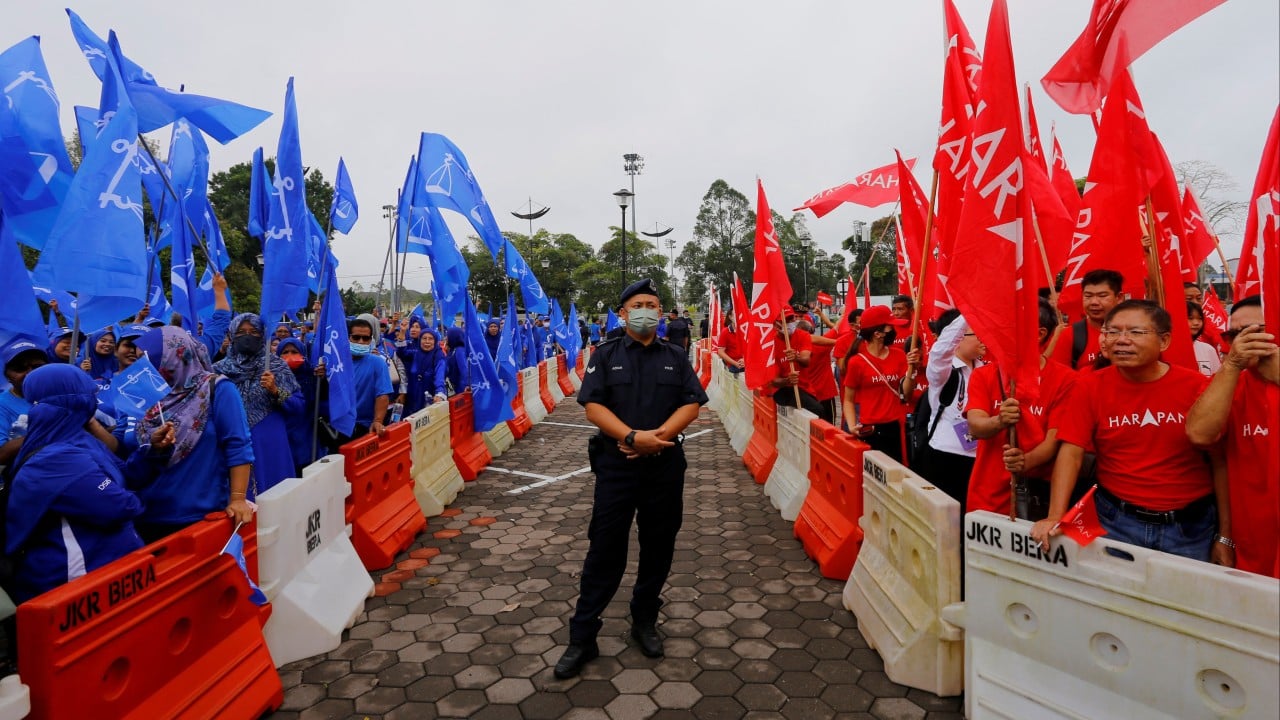
The federal unity government of Malaysian Prime Minister Anwar Ibrahim will survive a sweeping Barisan Nasional victory in the upcoming state polls, but the administration will emerge permanently altered. An immediate collapse of the parliamentary majority in Kuala Lumpur is highly unlikely because no single faction possesses the numbers to govern alone. However, a major triumph for the Malay-nationalist bloc will drastically shift the internal balance of power, emboldening the United Malays National Organisation to dictate terms, freeze Anwar’s reform agenda, and eventually force early national elections before the 2028 mandate expires. The alliance is safe for now, but its spirit is dead.
When Johor Menteri Besar Onn Hafiz Ghazi dissolved the state assembly a year ahead of schedule, he threw a wrench into the fragile equilibrium governing federal politics. Johor is not just another state. It is the birthplace of the United Malays National Organisation, the dominant force within the Barisan Nasional coalition. By declaring that Barisan Nasional would contest all 56 state seats entirely on its own, the state leadership effectively rejected the cooperative framework established at the federal level with Anwar’s Pakatan Harapan.
This decision triggered quiet fury in the prime minister's circle. Anwar and his allies have openly criticized the move, framing it as an act of political hubris. Yet, this friction reveals a deeper structural truth about Malaysian governance. The marriage between Pakatan Harapan and Barisan Nasional was never an ideological union. It was an arrangement born out of necessity following the deadlocked general election of 2022.
The Friction in Johor
The choice to go solo in Johor demonstrates that local dynamics frequently override federal arrangements. In Putrajaya, Barisan Nasional plays junior partner to Anwar's reformist alliance. In Johor, the roles are reversed. Barisan Nasional holds a commanding majority and sees little reason to share power or donate winnable seats to Pakatan Harapan, an outfit whose urban, multi-ethnic voter base clashes with Barisan Nasional's traditional rural Malay constituency.
Johor’s economy is currently outperforming most of the country. Fueled by heavy foreign investment, infrastructure developments like the Rapid Transit System link to Singapore, and the unfolding Johor-Singapore Special Economic Zone, the state government holds considerable leverage. Onn Hafiz Ghazi has built a reputation on high-visibility infrastructure inspections and populist welfare spending. His administration believes it can capture the state outright without federal assistance.
This independence creates a bizarre spectacle. Federal ministers from Pakatan Harapan find themselves traveling down south to campaign for their own candidates against the very same parties they share cabinet meetings with in the capital. The deputy chairman of Barisan Nasional, Mohamad Hasan, recently dismissed concerns by stating that administrative models differ between federal and state tiers. He argued that the country's political dynamics have simply evolved past old binaries. This rhetorical gymnastics serves to mask a bitter struggle for survival.
The Fragmented Opposition Factor
The calculations of both ruling factions are further complicated by the decay of the federal opposition, Perikatan Nasional. The conservative Malay-Muslim alliance led by Bersatu and the Islamist party PAS has seen its momentum stall. Internal divisions and a lack of clear strategy have crippled their ability to mount a unified challenge in southern states like Johor.
Perikatan Nasional chose not to contest nearly two dozen seats in the current state polls. This retreat directly benefits Barisan Nasional by preventing the fragmentation of the conservative Malay vote. When the right-wing opposition steps aside, the contest reverts to its historical default, a battle between the institutional machinery of Barisan Nasional and the reformist appeals of Pakatan Harapan. For Anwar, this is a dangerous development. A weak opposition does not guarantee stability for his government; instead, it allows his coalition partners to turn their weapons against him.
The Myth of Federal Stability
The central fallacy of the current political discourse is the assumption that a stable parliamentary majority equates to a functional government. Anwar commands a two-thirds supermajority on paper, largely due to the support of regional blocs from Sabah and Sarawak alongside Barisan Nasional. This arrangement has prevented the rapid-fire collapse of governments seen between 2020 and 2022.
Real stability remains elusive. Policy coordination has stalled across multiple ministries. To preserve his alliance with conservative Malay elements, Anwar has repeatedly deferred long-promised institutional changes, such as the separation of the Attorney General’s roles and major subsidy overhauls. A substantial victory for Barisan Nasional in the state elections will validate this conservative inertia. Leaders within the United Malays National Organisation will argue that the path to reclaiming their former dominance lies in asserting their traditional identity, not in accommodating the progressive aspirations of Pakatan Harapan.
Consider the dynamic within the cabinet. If Barisan Nasional demonstrates that its brand still commands majority support among ethnic Malays, its current president, Ahmad Zahid Hamidi, will face immense pressure from his own rank and file. Zahid has tied his political future to Anwar, acting as the bridge that keeps the unity government intact. If his party wins big while ignoring Pakatan Harapan, the internal anti-Anwar faction within his party will gain immense leverage. They will argue that the party is reviving despite the federal alliance, not because of it.
Why Neither Side Can Afford to Walk Away Yet
Despite the rhetoric, an immediate walkout remains highly unlikely. The anti-hopping laws passed in recent years make individual defections difficult, requiring entire party blocs to move together. More importantly, the financial and administrative benefits of federal incumbency are too significant to discard on a whim.
Barisan Nasional remembers the painful lessons of 2018 and 2020. Being cast into the political wilderness without access to federal ministries, government-linked companies, and national development funds weakens a party's patronage network. The party machinery requires state resources to function effectively. Similarly, Anwar knows that if Barisan Nasional pulls its 30 members of parliament from his coalition, his government becomes highly vulnerable to counter-coups, regardless of the stance taken by East Malaysian parties.
+-------------------------------------------------------------+
|               THE UNSTEADY TRUCE IN PUTRAJAYA                |
+-------------------------------------------------------------+
|  PAKATAN HARAPAN (PH)          |  BARISAN NASIONAL (BN)     |
|  - Controls 82 seats           |  - Controls 30 seats       |
|  - Relies on BN for majority   |  - Relies on PH for power  |
|  - Demands progressive reform  |  - Demands Malay hegemony  |
+-------------------------------------------------------------+
|     Result: Legislative gridlock and delayed policies       |
+-------------------------------------------------------------+
This mutual dependency creates a cold war scenario. Both sides will continue to sit at the same table in Putrajaya while actively undermining each other in the states. It is a deeply cynical form of stability that prioritizes power retention over long-term national planning. The economic cost of this gridlock is already evident, as foreign investors watch a government capable of passing budgets but seemingly incapable of implementing structural fiscal reforms due to fear of electoral backlash.
The High Stakes of the Malay Vote
The battleground for the soul of Malaysian politics remains the ethnic Malay majority. Pakatan Harapan has long struggled to win over rural and semi-urban Malay voters, who view the coalition's multi-ethnic rhetoric with suspicion. Anwar’s strategy has relied on Barisan Nasional acting as a shield, delivering those conservative voters to the unity government's column.
The state polls are testing whether that shield still exists or if it has transformed into an independent weapon. If Barisan Nasional secures a major victory on its own terms, it proves that the party does not need Anwar’s brand to win. This will shift the calculation for the next general election. Instead of negotiating a joint electoral pact where seats are divided between Pakatan Harapan and Barisan Nasional, an emboldened United Malays National Organisation will likely demand the lion's share of seats nationwide, setting up an inevitable clash.
The ultimate risk for the country is a prolonged period of political paralysis. As the state elections conclude and the results are tallied, the immediate future of the federal government will look unchanged. The prime minister will still walk into Parliament with his majority intact. The ministries will still issue press releases. The machinery will still hum. But beneath the surface, the foundations will have shifted, leaving a government that exists merely to survive, trapped in an unending campaign where the biggest threats come from within its own house.