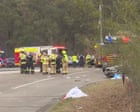
A celebration meant to honor a community's sporting heroes transformed into a scene of absolute carnage on a Newcastle roadside, leaving a five-year-old girl in an induced coma and nine others injured when an 18-year-old provisional driver allegedly careered into a crowd of Newcastle Knights fans.
The incident, which occurred as supporters lined the streets to farewell their team ahead of a grand final appearance, exposes an uncomfortable intersection between public fandom, vehicular bravado, and the systemic vulnerabilities of informal roadside gatherings. While the initial shockwaves focused on the immediate medical emergency and the rapid police response, a deeper examination reveals recurring structural failures in how public displays of sporting support are managed, supervised, and policed across Australian urban centers.
The Anatomy of a Tragedy
According to police reports and witness testimony, the driver of the vehicle, identified as 18-year-old Indika Bambrick Samarasinghe, was revving the engine and driving erratically near a major roundabout before losing control. The car veered sideways into a dense gathering of spectators, turning a festive morning into chaos. Four rescue helicopters and fifteen ambulances converged on the scene, transporting multiple patients with severe trauma.
Among the victims, the young child suffered critical injuries requiring an induced coma, while other adults sustained fractures and soft-tissue damage. Witnesses described a sudden shift from joyous chanting to absolute panic as bystanders rushed to lift wreckage and administer first aid.
Yet, treating this event as an isolated aberration ignores the underlying subculture that fuels such incidents. For decades, Australian sports culture has fostered an informal tradition of roadside send-offs, where fans congregate near major arterial roads, roundabouts, and motorway on-ramps to wave flags and cheer team buses. These gatherings are rarely sanctioned or officially organized by local councils or sporting clubs. They arise organically through social media calls, creating localized flashpoints where high-performance vehicles, youthful adrenaline, and dense pedestrian crowds mix without safety barriers.
The P-Plate Factor and the Psychology of Performance
The involvement of an inexperienced provisional driver brings a critical demographic into sharp focus. Young drivers operate under strict legal limitations regarding high-performance vehicles, yet the cultural pressure to perform, show off, or extract auditory validation from an exhaust pipe remains potent.
When a convoy of passionate fans lines a roadway, the psychological reward for a young motorist shifts toward exhibitionism. Revving an engine to elicit cheers from a crowd is a common, albeit hazardous, manifestation of social validation. In this instance, the transition from celebratory noise to catastrophic mechanical loss of control occurred in seconds.
Law enforcement agencies have long struggled to police spontaneous roadside rallies. Unlike a ticketed stadium event or a permitted street parade, a spontaneous gathering of supporters on a major thoroughfare like the Newcastle Link Road offers zero traffic mitigation, no spatial separation between heavy vehicles and pedestrians, and minimal rapid-response infrastructure.
The Broader Regulatory Blind Spot
Municipal authorities and sports franchises frequently promote civic pride during finals campaigns, but accountability for public safety during unofficial fan activations remains a gray area. Clubs issue statements expressing deep community concern and calling for unity, yet the structural mechanisms to prevent unauthorized roadside gatherings are largely reactive rather than preventative.
When thousands of supporters spill onto curb spaces and roundabouts, the burden of safety defaults entirely to individual behavioral restraint. When that restraint fails, the consequences are borne by innocent bystanders, including children attending a community celebration.
The legal proceedings following the crash—moving through bail hearings, court appearances, and stringent monitoring conditions—will address the specific criminal charges levied against the driver. However, the broader societal question remains unanswered. Until civic authorities and sporting organizations establish proactive protocols for channeling fan enthusiasm into secure, managed environments, the risk of similar disasters remains woven into the fabric of modern sports fandom.