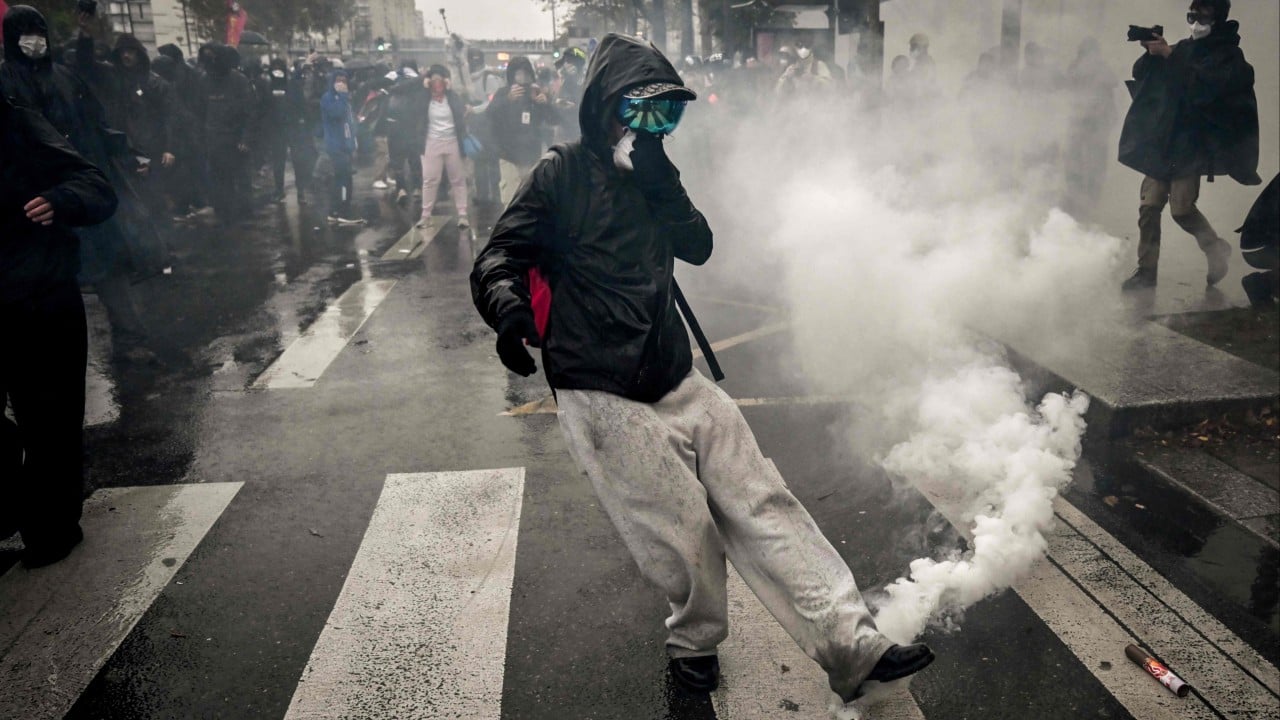
Small clashes erupting during Paris protests are rarely spontaneous outbursts of rage. They are the predictable friction points of a high-stakes operational doctrine designed to contain crowds before they march, rather than escort them safely through the capital. When Parisian police remain on high alert, deploying thousands of officers, armored vehicles, and tear gas canisters before a single banner is unfurled, the security posture itself alters the chemistry of the street. Understanding why these skirmishes keep happening requires looking past the broken shop windows and examining the tactical architecture of French public order policing.
For decades, the French approach to crowd control—known as maintien de l'ordre—relied on distance, patience, and union marshals to keep marches peaceful. That model has eroded. Today, the Paris Police Prefecture favors rapid containment, aggressive dispersal, and preemptive security perimeters. The result is a recurring cycle where minor provocations on the margins of a demonstration trigger disproportionate force, turning routine political dissent into a running battle across the boulevards. If you enjoyed this article, you should look at: this related article.
The Anatomy of a Parisian Flashpoint
Walk the route of any major Paris demonstration between Place de la République and Place de la Nation, and the choreography is unmistakable. Hours before protesters gather, black vans belonging to the Compagnies Républicaines de Sécurité (CRS) and the Gendarmerie Mobile seal off side streets. Metal barricades block access to commercial arteries. Police helicopters thrum overhead.
This saturation is meant to project absolute control. Instead, it creates a pressure cooker. For another look on this story, see the latest update from TIME.
When tens of thousands of people are funneled into narrow corridors with blocked exits, tension spikes immediately. In the classic French policing doctrine established after the Second World War, officers maintained a strict buffer zone between themselves and demonstrators. Contact was treated as a tactical failure. Over the past decade, however, the introduction of mobile arrest units—such as the Brigades de Répression de l'Action Violente Motorisées (BRAV-M)—reversed that logic.
These squads operate on motorcycles or on foot in lightweight gear, darting directly into crowds to make rapid arrests. While commanders argue this flexibility allows them to neutralize violent agitators without disrupting peaceful marchers, the operational reality on the ground is far messier.
When mobile units charge into a dense crowd, panic spreads faster than information. Peaceful demonstrators, journalists, and legal observers suddenly find themselves caught in the same cloud of tear gas and baton swings as the small minority of black-clad militants looking for a confrontation. Once that threshold is crossed, the protest fractures. The main union procession continues down the avenue, while the rear and flanks dissolve into localized skirmishes that dominate the evening news.
Why Intelligence Gathering Often Fails on the Ground
The Paris Police Prefecture possesses one of the most sophisticated domestic intelligence networks in Europe. Plainclothes officers embed within crowds, drones monitor rooftop movements, and social media channels are scraped continuously prior to major mobilization days. Yet despite knowing almost exactly who is showing up and where the trouble will start, police still struggle to prevent localized clashes.
The disconnect lies between strategic intelligence and tactical execution. Knowing that a few hundred radicalized individuals—often referred to in French media as the black bloc—intend to infiltrate the head of a march does not automatically solve the problem of separating them from forty thousand teachers, transit workers, or students.
If police intervene early to extract agitators from the crowd, they risk sparking a wider riot in the middle of a densely packed boulevard. If they wait until property damage occurs—such as the smashing of bank branches, bus shelters, or advertising kiosks—critics accuse them of standing idle while the city is vandalized. Commanders are trapped between two politically toxic outcomes, and they almost always choose the option that demonstrates visible firmness to their political superiors at the Ministry of the Interior.
The Political Pressure Behind High Alert Deployments
To understand why Paris police remain on hair-trigger alert, you have to look at the political cost of unrest in the French capital. In France, street protests are not merely an expression of public opinion; they are a traditional lever of political power. Governments have fallen, pension reforms have been shelved, and tax hikes have been abandoned because the streets of Paris became ungovernable.
Consequently, every Interior Minister treats Paris demonstrations as a direct test of state authority. Deploying 4,000 or 5,000 officers for a single afternoon is a political signal aimed at two audiences simultaneously. It tells the public that the state will not yield to street pressure, and it reassures business owners and tourists that the capital remains under control.
This political imperative overrides purely tactical considerations. Police unions themselves have quietly complained for years about exhaustion, over-deployment, and unclear rules of engagement. When officers are kept on high alert week after week, standing in heavy riot gear for ten hours at a stretch while absorbing insults and projectiles, fatigue degrades judgment.
"You cannot ask exhausted men in thirty kilograms of armor to make split-second legal distinctions when bricks are flying and orders from the command post are changing every five minutes," a veteran public order commander noted during a parliamentary inquiry into crowd policing practices.
That human factor is frequently erased from news coverage. A tired squad at the end of a long shift is far more likely to use tear gas or stun grenades—such as the GM2L—to clear a street corner quickly rather than executing a slow, methodical containment maneuver.
The Evolution of Protest Tactics in the Capital
Blaming police posture alone ignores the other half of the equation. The nature of street protest in Paris has undergone a structural shift that makes traditional policing extraordinarily difficult.
Historically, major French demonstrations were tightly controlled by powerful trade unions like the CGT. Union marshals wearing armbands locked arms to form human chains, physically policing their own marches and keeping radical elements out. If someone tried to throw a paving stone or smash a window, union security would often hand them over to the police or eject them from the procession.
That institutional monopoly has collapsed. Modern protest movements in France—from the Yellow Vests to spontaneous anti-government rallies—are decentralized, leaderless, and organized via encrypted messaging apps. Without an identifiable leadership structure, police commanders have no one to negotiate with before or during a march.
The Cat and Mouse Game of Unplanned Routes
When a protest is officially declared to the Prefecture, authorities and organizers agree on a fixed route, medical stations, and dispersal times. Increasingly, however, splinter groups ignore the declared path entirely.
Once a demonstration reaches its official endpoint, hundreds of participants routinely break away to stage wildcat marches through wealthy neighborhoods, commercial districts, or toward sensitive government buildings like the Élysée Palace or the National Assembly.
These unannounced movements force police into a reactive posture. Instead of holding static lines, squads must race across the city to block bridges, metro stations, and intersections. In these chaotic, fast-moving engagements, communication breaks down. Different police units operating on separate radio frequencies converge on the same square from opposite directions, sometimes inadvertently trapping crowds with no exit route—a controversial tactic known as kettling or nasse.
Under French administrative guidelines, kettling is strictly regulated because trapping peaceful citizens alongside violent agitators violates fundamental freedoms of movement and assembly. Yet in the heat of a decentralized protest, commanders routinely fall back on encirclement because it is the fastest way to halt a moving crowd. When people realize they are surrounded and tear gas begins to fall, panic ensues, and small clashes instantly escalate into major confrontations.
The Media Feedback Loop and Asymmetric Optics
Every clash in Paris now unfolds in front of thousands of high-definition smartphone cameras. This real-time documentation has fundamentally altered how both police and protesters behave during high-alert operations.
For radical groups, the goal is rarely to defeat the police physically—an impossible task against an armed state apparatus. The objective is to provoke a visually dramatic overreaction. A photograph of riot police charging into a crowd of retirees or firing tear gas near a hospital entrance carries immense political weight. It validates the narrative of an authoritarian state and guarantees international headlines.
Conversely, police commanders are acutely aware that every baton strike is being livestreamed. The Ministry of the Interior relies on its own communication teams to push out footage of injured officers, burning barricades, and vandalized storefronts to justify the heavy security presence.
This battle over optics creates a perverse incentive structure. Both sides operate knowing that the cameras are rolling, yet the presence of cameras does nothing to cool tempers on the ground. In fact, independent journalists and citizen reporters have increasingly found themselves caught in the crossfire, facing both hostility from radical protesters who accuse them of filming faces for police identification, and rough treatment from officers trying to clear streets rapidly.
Comparing Crowd Control Models Across Europe
To see how unusual the Parisian cycle of clashes has become, it helps to compare French methods with those used in neighboring democracies facing similar political unrest.
| Policing Element | French Model (Paris) | German Model (Berlin/Hamburg) | British Model (London) |
|---|---|---|---|
| Primary Doctrine | Preemptive deterrence and rapid dispersal | De-escalation and continuous dialogue | Liaison-led facilitation and targeted arrests |
| Use of Tear Gas | Routine first-line crowd dispersal tool | Rare; restricted to severe violence | Virtually nonexistent in public order |
| Mobile Units | Heavy reliance on motorcycle/foot strike squads | Specialized arrest teams integrated into lines | Evidence-gathering teams; arrests often made later |
| Crowd Containment | Frequent use of static blockades and kettling | Escorted corridors with clear exit routes | Dynamic cordons aimed at maintaining flow |
In Germany, police forces revised their public order doctrine after bitter clashes in the 1980s, adopting the de-escalation model. German officers deploy specialized anti-conflict teams dressed in bright vests whose sole job is to talk to protesters, explain police movements, and resolve minor disputes before riot squads are ever called forward. Tear gas is treated as a weapon of last resort, not a routine crowd-management tool.
In the United Kingdom, police rely heavily on Police Liaison Officers who build relationships with protest organizers weeks in advance. Rather than attempting to arrest violent individuals in the middle of a volatile crowd—which inevitably triggers wider fighting—British forces frequently use high-resolution cameras to identify offenders and arrest them at their homes days later.
French authorities have repeatedly resisted adopting these methods wholesale. Officials argue that Paris presents unique geographic and political challenges, pointing out that the intensity of ideological street violence in France exceeds what police face in London or Berlin. There is truth to that claim; France has a long, deeply ingrained culture of revolutionary street politics that treats confrontation with the state as a legitimate form of civic expression.
However, relying almost exclusively on coercive deterrence guarantees that the capital remains locked in a permanent state of low-grade siege whenever major political debates spill onto the pavement.
The Hidden Costs of Permanent High Alert
When Paris police remain on high alert every weekend, the consequences extend far beyond the immediate bruises and broken glass of a Saturday afternoon.
First, there is the staggering financial drain. Mobilizing thousands of specialized officers from across the country, housing them in hotels around the Île-de-France region, paying overtime, and replacing expended munitions costs the French treasury millions of euros every month. Those funds are pulled directly from regular policing budgets, leaving local precincts short-staffed for routine criminal investigations and neighborhood patrols.
Second, the normalization of heavy riot policing erodes public trust in democratic institutions. When citizens exercising their constitutional right to protest must pass through identity checks, bag searches, and rings of armored vehicles just to reach a public square, the psychological barrier to civic participation rises. Families, elderly citizens, and moderate voices gradually stop attending demonstrations, leaving the streets disproportionately to the most radicalized elements on the fringes.
That self-selection process makes future protests even more volatile. As moderate voices retreat, the ratio of hardcore agitators to peaceful demonstrators climbs, forcing the Prefecture to maintain an even higher state of alert the next time a call to march goes out.
Where the Standoff Goes From Here
Breaking this cycle requires more than new crowd-control equipment or revised press guidelines from the Interior Ministry. It demands a fundamental rethinking of how the French state manages political conflict in public spaces.
Until the Paris Police Prefecture shifts its operational priority from aggressive containment back to genuine de-escalation—and until political leaders stop treating every square meter of Parisian asphalt as a battlefield for state prestige—high-alert deployments will continue to produce the exact clashes they are meant to prevent.


