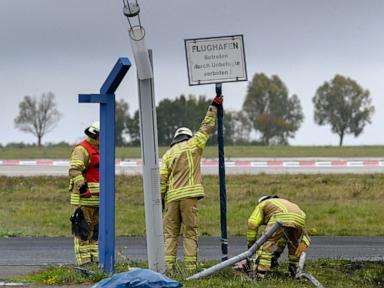
When a private jet skids off a runway and hits a fence at a Las Vegas airport, the public gets a sensational headline and a photograph of crumpled metal against a perimeter barrier. The real story sits underneath the surface. Runway excursions rarely happen because of a single catastrophic failure; they usually expose thin margins in braking physics, rushed decision-making near the end of a flight, and airports squeezing massive traffic volumes into tight physical footprints.
To understand what actually goes wrong when a private jet skids off a runway and hits a fence at a Las Vegas airport, you have to look past the drama of the crash site. Aviation safety experts call these events runway excursions—either overruns past the end of the pavement or veer-offs to the side. In major commercial hubs with heavy business aviation traffic like Las Vegas, even a minor excursion triggers immediate chaos, shutting down critical capacity and forcing regulators to examine how small operational miscalculations snowball into hardware damage. For an alternative look, consider: this related article.
Why Runway Excursions Keep Happening in High-Pressure Hubs
Airports serving major entertainment and business centers operate under relentless tempo. Private jets arrive in waves around conventions, concerts, major sporting events, and holiday weekends. Controllers pack traffic tightly, pilots manage complex arrival procedures, and ramp crews work under constant turnaround pressure.
None of that pressure excuses poor airmanship. It does, however, explain why margin gets eaten alive before the wheels even touch down. Further reporting on this trend has been provided by The Guardian.
Consider a hypothetical example of a midsize business jet approaching a busy desert airfield in the late afternoon. The crew receives a late runway change or an updated wind check just miles out. Maybe the tailwind component creeps up slightly, or the surface is slick from rare desert moisture mixed with rubber deposits and dust. If the aircraft crosses the threshold a few knots fast and touches down a thousand feet past the aiming point, the stopping distance equation changes dramatically.
Stopping a jet is not like stopping a car on an interstate. Braking action depends on tire-to-pavement friction, ground spoilers deploying cleanly, thrust reversers engaging without delay, and autobrakes or manual pedal inputs modulating properly. On a wet or contaminated surface, friction drops sharply, and a jet carrying excess energy can quickly run out of pavement or drift toward the edge.
When an aircraft leaves the prepared surface, a perimeter fence is rarely a brick wall designed to stop a multi-ton airframe like a tank trap. Perimeter fencing exists primarily to deter unauthorized entry and keep wildlife off the airfield. Hitting a fence is often a symptom of a jet that had already lost directional control or failed to decelerate within the runway environment, meaning the fence simply marks the spot where forward momentum finally met an obstacle.
The Illusion of Long Runways
Pilots and passengers often assume that a long runway guarantees a safe stop. Length helps, of course. Extra concrete buys time and distance when something goes wrong.
Yet long pavement creates its own trap. Crews can subconsciously relax when staring down thousands of feet of asphalt, assuming there is plenty of room to bleed off speed or float a little past the touchdown zone. Then a gust hits, spoilers hesitate, or brake effectiveness turns out worse than expected, and suddenly that generous margin vanishes in seconds.
Weather and Surface Friction Variables
Desert airports are famous for clear skies and predictable visibility, which breeds complacency. When unexpected rain hits arid ground, oils, dust, and accumulated rubber residue turn the top layer of pavement into a slick film. Even light moisture can catch crews off guard if they mentally anchor to "normal dry desert" conditions rather than actual surface conditions.
Wind adds another layer of complexity. Gusty crosswinds test rudder authority and landing gear alignment at the exact moment the aircraft transitions from flying to rolling. A slight bounce or asymmetrical braking input during a crosswind landing can pull a jet toward the side of the runway before the crew regains full authority.
Business Aviation Dynamics Behind the Headlines
Private aviation operates differently from scheduled airline service in ways that matter during abnormal events. Airlines run standardized fleets, strict dispatch controls, and heavily rehearsed operational playbooks across thousands of daily flights. Business aviation spans everything from corporate flight departments with airline-grade training programs to charter operators and owner-flown aircraft with widely varying experience levels.
That diversity is a strength when flights go smoothly. It creates uneven risk profiles when conditions turn tight.
Charter flights frequently involve tight schedules dictated by clients whose time is expensive and whose plans shift at the last minute. A crew might fly multiple legs in a day, deal with unfamiliar airports, or feel subtle commercial pressure to get passengers into the city without diversion. Experienced captains resist that pressure coldly. Less seasoned crews sometimes rationalize approaches that would be better abandoned.
In aviation, an excursion is rarely a bolt from the blue; it is usually the final receipt for a series of small compromises made earlier in the descent.
Maintenance and equipment state also play quiet roles. Tire tread depth, brake wear, anti-skid system health, and thrust reverser dispatch status all affect stopping performance. If an aircraft is operating with a deferred item or marginal braking performance, the crew's margin for error shrinks even further—especially if the numbers weren't recalculated conservatively for changing winds or surface conditions.
| Operational Factor | How It Erodes Stopping Margin | Practical Mitigation |
|---|---|---|
| High approach speed | Increases kinetic energy exponentially as speed rises | Fly strict target approach speeds; go around if unstable |
| Long touchdown | Consumes hundreds or thousands of feet of usable runway | Touch down firmly in the designated zone; reject if long |
| Contaminated or wet surface | Reduces tire friction and extends stopping distance | Apply conservative landing distance factors; verify braking reports |
| Crosswind or gusty conditions | Complicates directional control and lateral alignment | Maintain disciplined crab/sideslip technique and firm rollout control |
| Crew fatigue or schedule rush | Encourages rushed checklists and delayed go-around calls | Enforce strict stabilized approach gates and unhurried briefbacks |
How Airport Infrastructure Shapes the Consequence
Once an aircraft leaves the runway, geography and airfield design dictate what happens next. A jet that slips off the pavement onto a wide safety area with soft soil or engineered arrestor material might come to a gentle halt. A jet that clips a taxiway intersection, drainage ditch, lighting structure, or perimeter fence faces very different outcomes.
Major airports must balance safety areas against constrained real estate. Over decades, terminals, hangars, roads, and perimeter boundaries have been built around existing runways. Where space is tight, safety margins between active pavement and perimeter infrastructure leave little room for wide excursions.
In Las Vegas, high traffic density compounds the operational ripple effect. When a runway closes—even temporarily—for an aircraft recovery, debris inspection, or federal investigation, arrival and departure flows backing up across the region immediately feel the squeeze. Commercial airliners hold or reroute, private flights divert or sit on ramps, and airport operations teams juggle emergency response alongside passenger movement.
What Investigators Look For First
When investigators examine a runway excursion involving a private jet and a perimeter fence, they don't stop at the skid marks. They reconstruct the flight path minute by minute using air traffic control recordings, radar data, flight data or cockpit voice recorders if equipped, weather observations, and maintenance logs.
Key questions dominate the early phase of any inquiry:
- Was the aircraft stabilized on final approach with proper speed, descent rate, and configuration?
- Where exactly did the main landing gear touch down relative to the runway threshold?
- How quickly were speed brakes, thrust reversers, and wheel brakes applied after touchdown?
- What were the exact wind, temperature, and surface conditions at the time of landing?
- Did any mechanical anomaly, hydraulic issue, or flight control quirk contribute to loss of control or deceleration?
Answers to those questions rarely point to villainy. More often, they reveal a chain of ordinary human and technical factors lining up at the worst possible moment.
The Cost of "Making It Work"
Every seasoned pilot knows the temptation to salvage a slightly messy landing rather than execute a go-around. Going around burns extra fuel, adds time, requires another approach, and can feel awkward if passengers are eager to step off the plane.
Yet a go-around is a normal maneuver, not a confession of failure. Choosing to land long, fast, or slightly crooked to save ten minutes is one of the oldest ways pilots get themselves into trouble. Once a jet touches down with too much speed or too little runway remaining, options narrow fast—and by the time the crew realizes the aircraft won't stop comfortably on the pavement, physics is already driving the bus.
Separating Sensational Coverage from Real Aviation Risk
News coverage of a private jet hitting an airport fence naturally gravitates toward dramatic details: flashing lights, emergency vehicles, closed runways, and speculation about who was on board. Those details tell you what happened after the mistake occurred. They rarely tell you how to prevent the next one.
True risk reduction in aviation comes from unglamorous discipline. It lives in conservative landing distance calculations, unhesitating go-around decisions, honest runway surface assessments, and thorough pre-flight briefings that treat "routine" arrivals with the same respect as bad-weather approaches.
Even when a runway excursion produces no severe injuries, it serves as a loud warning bell for the entire operating environment. Every fence strike or runway overrun is a near-miss with a much worse outcome waiting just a few yards further down the line.
Next time a private jet skids off a runway and hits a fence at a busy hub like Las Vegas, look past the broken barrier and ask whether the crew gave themselves enough margin before the wheels ever touched the ground.