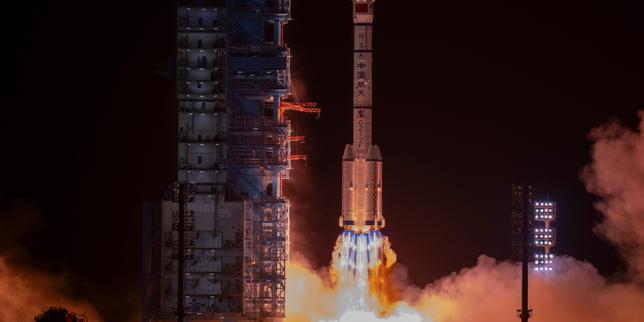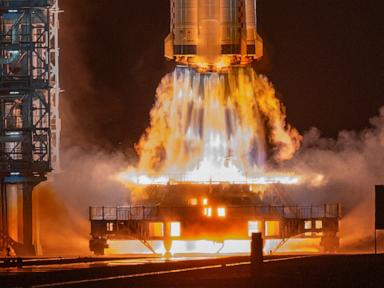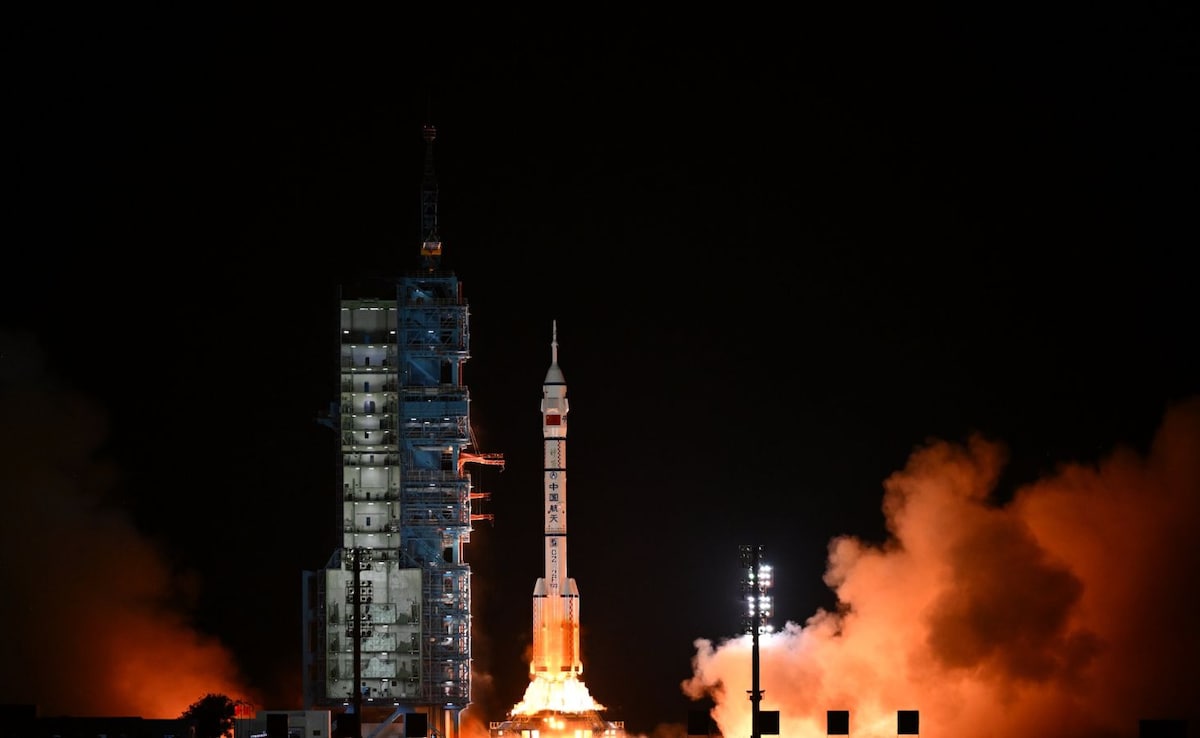
China successfully launched the crewed Shenzhou-23 spacecraft on May 24, 2026, sending three astronauts to the Tiangong space station for a mission that includes a groundbreaking one-year orbital stay. While mainstream coverage frames this as a routine crew rotation with a symbolic nod to Beijing’s 2030 lunar ambitions, the reality is far more calculated. This long-duration mission addresses a critical bottleneck in deep-space engineering: human endurance. By testing human physiology and autonomous fast-docking procedures over a 365-day window, China is systematically gathering the data required to break out of low-Earth orbit and survive the treacherous deep-space environment of the lunar south pole.
The Physical Toll of the Lunar Path
Western space analysts frequently track the hardware metrics of China’s space program, counting rocket launches and measuring engine thrust. They often overlook the human variable. Low-Earth orbit is a protective cocoon compared to the deep-space environment between Earth and the Moon.
The primary purpose of the year-long stay aboard Tiangong is to study microgravity degradation and radiation exposure under tightly controlled conditions. Six months—the standard Shenzhou rotation—is insufficient to model the deep physiological changes that occur during extended lunar construction phases. A full year pushes the human body into a different tier of systemic stress.
Physiological Risk Areas for Extended Spaceflight:
1. Bone Mineral Density Loss (Up to 1% per month in microgravity)
2. Optic Nerve Swelling (Spaceflight-Associated Neuro-ocular Syndrome)
3. Cosmic Radiation Accumulation (Elevated outside Earth's magnetosphere)
4. T-Cell Suppression (Immune system degradation over time)
By keeping an astronaut in orbit for twelve consecutive months, the China Manned Space Agency (CMSA) is gathering precise data on bone density degradation, cardiovascular remodeling, and neuro-ocular syndrome. These metrics are critical for the crews slated to build the International Lunar Research Station (ILRS) alongside Russia in the 2030s. If an astronaut cannot maintain physical autonomy after months of microgravity, a lunar landing mission fails before the lander touches the regolith.
Technical Dress Rehearsals in Plain Sight
The Shenzhou-23 mission serves as a testbed for automated orbital mechanics. Beyond the human endurance aspect, this flight executed a highly optimized, autonomous rapid rendezvous and docking procedure with the Tiangong core module.
This specific docking profile is not just a convenience for the crew. It is a direct technical dress rehearsal for the 2030 lunar landing architecture. China’s current plan avoids the massive, single-launch profile of the historic Saturn V rocket. Instead, Beijing relies on a dual-launch framework.
- The Mengzhou Crew Spacecraft: Launched on a heavy-lift Long March-10 rocket to carry the crew to lunar orbit.
- The Lanyue Lunar Lander: Launched separately on a second Long March-10 rocket to meet the crew in orbit.
These two distinct vehicles must execute an automated rendezvous and docking sequence in lunar orbit before astronauts can descend to the surface. The autonomous algorithms tested during the Shenzhou-23 docking provide the foundational code for this complex lunar-orbit maneuver. If the automated docking system fails in low-Earth orbit, a crew simply returns home; if it fails around the Moon, the mission turns catastrophic.
Geopolitical Shifts and the Fourth Batch
The composition of the Shenzhou-23 crew reveals a deliberate political evolution within the Chinese aerospace ecosystem. Commander Zhu Yangzhu and Pilot Zhang Zhiyuan represent the traditional PLA military pipeline. The inclusion of Payload Specialist Li Jiaying breaks the historical mold.
Li is a former Hong Kong police inspector and the first astronaut from the city to participate in a Chinese space mission. Her inclusion signifies the operational integration of the "fourth batch" of Chinese astronauts, a cohort selected specifically to include civilian scientists, engineers, and specialists from Hong Kong and Macao.
This broadening of the talent pool is a pragmatic adjustment to changing mission requirements. Early spaceflights required military test pilots capable of handling manual reentry emergencies. The upcoming lunar research stations require geologists, materials scientists, and automation engineers. Beijing is transitioning its corps from a group of elite operators into an industrial workforce capable of maintaining permanent infrastructure on another world.
Infrastructure Challenges in Hainan and Beyond
While the media focuses on the fiery spectacle of launches from Jiuquan, the true blueprint for China's lunar architecture is being built on the coast of Hainan Island. The Wenchang Spacecraft Launch Site is undergoing massive structural expansions to accommodate the heavy-lift Long March-10 and Long March-5 families.
The Gobi Desert’s Jiuquan facility is restricted by rail transportation logistics, limiting the diameter of the rockets it can handle. Wenchang allows for sea-transported components, which is essential for rockets with core diameters exceeding five meters. Throughout 2026, China is accelerating the construction of these coastal launch pads, ground support networks, and vertical assembly buildings.
Launch Facility Matrix:
+---------------------+-----------------------+--------------------------+
| Facility Location   | Primary Rocket Class  | Mission Profile          |
+---------------------+-----------------------+--------------------------+
| Jiuquan (Gobi)      | Long March-2F         | Crewed Low-Earth Orbit   |
| Wenchang (Hainan)   | Long March-5, -10     | Heavy Cargo & Lunar      |
+---------------------+-----------------------+--------------------------+
This dual-track approach keeps the Tiangong space station fully operational via Jiuquan while freeing up Wenchang to focus entirely on the heavy-lift infrastructure required for the Moon. The hardware is moving out of the conceptual phase. Static fire tests of the Long March-10 propulsion systems and zero-height abort tests for the Mengzhou capsule have already concluded, signaling that the structural components of the 2030 timeline are hitting their engineering benchmarks.
Testing the Frontiers of Deep Space Biology
The true scale of China's long-term ambitions can be found in the unorthodox experiments tucked inside the Tiangong modules. Onboard science payloads have shifted from basic material science toward complex biological reproduction studies.
Recent state media reports confirmed that human stem cell samples were sent to orbit to conduct human artificial embryo experiments. The objective is to evaluate how microgravity and cosmic radiation impact cellular division, long-term survival, and human reproduction in space.
This research exposes the shallow nature of the "space race" narrative favored by general news outlets. Beijing is not merely attempting to plant a flag on the lunar surface to beat NASA's delayed Artemis schedule. The focus is on establishing a self-sustaining presence. If human cells cannot divide normally or if embryos cannot develop under sub-G conditions, long-term colonization remains a scientific impossibility. By confronting these biological hurdles in low-Earth orbit today, China is preparing for the harsh realities of the lunar base planned for 2035.
The technical steps taken during this flight show that Beijing views the Moon not as a final destination, but as an industrial outpost that requires a completely rewritten manual of human endurance and automated logistics.