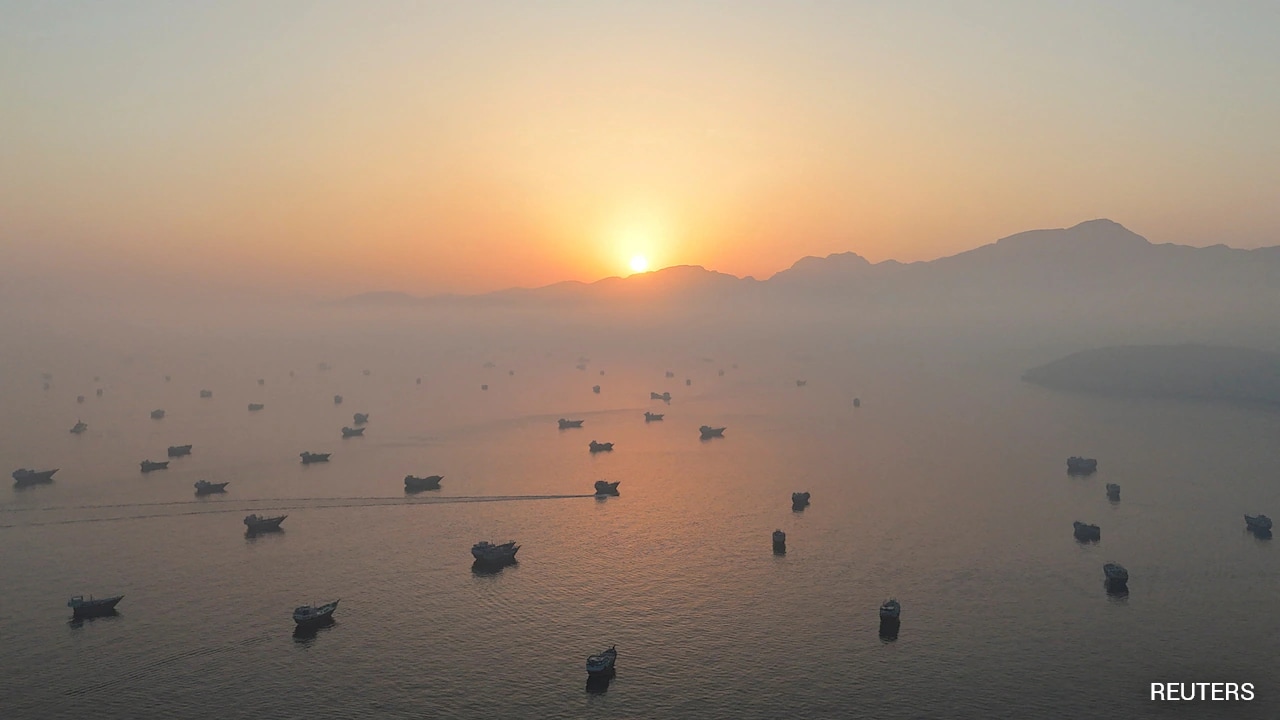
The Strait of Hormuz is not just a body of water. It is the jugular vein of the global economy. Since late February 2026, when open conflict ignited between the United States and Iran, that vein has been under a tourniquet. Yet, against the expectations of military analysts and market speculators alike, millions of barrels of oil continue to exit the Persian Gulf every night. This movement is not the result of a magical maritime resurgence or a cooling of tensions. It is the product of a clandestine naval operation, a high-stakes escort game played under the shroud of darkness.
American forces have established a de facto, militarized corridor through the southern lane of the waterway. By systematically degrading Iranian radar arrays and maritime surveillance nodes, the United States has clawed back control of a sliver of the strait. Every night, between 15 and 20 tankers move in carefully choreographed convoys. They are not merely passing through. They are following precise, military-issued navigation packets designed to keep them outside the reach of the remaining Iranian shore-based assets.
This operation requires coordination that borders on the obsessive. A centralized task force, operating from army facilities far removed from the desert heat of the Gulf, processes a constant flow of intelligence from regional partners. They build daily lists. They assign transit times. They dictate the speed and spacing of vessels to minimize the cross-section of the convoy and maximize the ability of escorting air cover to respond to threats.
The effectiveness of this corridor relies on a simple, brutal reality: Iran is losing its eyes. A two-week campaign by US Central Command focused on blinding the Islamic Revolutionary Guard Corps. Radar stations were neutralized. Command centers were hit. What remains for the Iranians is a desperate, fragmented surveillance network consisting of spotters on fast boats and a handful of repaired sensors. It is enough to launch drones or cruise missiles at the general vicinity of the southern lane, but it is not enough to maintain tactical dominance.
In this environment, the US military has shifted from traditional freedom-of-navigation patrols to an active, offensive-defensive stance. Fighter jets prowl the overhead skies, serving as the primary deterrent against aerial strikes. When an Iranian drone or missile moves to engage a tanker, it is frequently intercepted by these assets. The success rate of these interceptions is a closely guarded statistic, but the fact that 10 million barrels of oil now exit the Gulf daily—half the pre-war volume—speaks to the raw, kinetic power being applied to the problem.
Consider a hypothetical scenario of how one of these nightly transits unfolds. A supertanker, dark and silent, enters the staging area in the Arabian Sea. It waits for the signal from the task force. At a designated hour, it joins a line of five other ships. They turn off their primary identification systems to avoid being painted by any lingering ground-based fire control radar. They move at a speed dictated by the lead escort. Overhead, an airborne warning and control system monitors the entire channel. If a blip appears on the screen that does not match the known convoy, an interceptor is vectored in immediately. The ship is a ghost in the machine, and the machine is commanded by the Pentagon.
This is not a long-term solution. It is a stopgap measure born of necessity. Iran still possesses the capability to disrupt this traffic. The risk of a "lucky" hit—a missile or drone successfully penetrating the protective umbrella—is always present. For the tanker crews, the hazard pay and the knowledge that they are operating in a combat zone are constant companions. They are the human cost of a strategy that prioritizes global oil supply over total maritime safety.
The reliance on this corridor also reveals the extreme vulnerability of modern energy transit. We have moved from a world where international law and freedom of the seas governed the movement of goods to one where that movement depends on the ability of a single military power to enforce a path through a contested zone. The moment the escort stops, the oil stops. The stability of the global price of crude is currently tethered to the operational readiness of a few squadrons of aircraft and the survival of a handful of command-and-control nodes.
Furthermore, the participation of regional allies remains a delicate balancing act. While they provide the necessary data to facilitate these convoys, they are also deeply exposed to Iranian retaliation. The intelligence sharing is not just a matter of logistics; it is a matter of survival. If one of these transit lists were leaked, or if a partner nation were caught in the crossfire of an Iranian response, the entire mechanism could collapse overnight.
The current flow of oil is a testament to the fact that military might can, for a time, override geopolitical disruption. Yet, every day the strait remains partially closed, the strain on the global energy market grows. This is a game of attrition. The United States is betting that its ability to keep the oil moving will outlast the Iranian capacity to threaten the tankers. If that bet fails, the ripple effects will move far beyond the price at the pump. We are witnessing the fragility of an interconnected world being held together by the thin, reinforced steel of a naval escort. The danger is not that the oil stops entirely. The danger is that we have become comfortable with a world where the flow of energy is a temporary favor granted by a fleet of warships.
The operation continues. The tankers move. The radar remains dark. The bottleneck is the new order, and it is governed by the speed of an interceptor and the resolve of a task force that refuses to let the lights go out. For now, the corridor holds.


